Complexity of Homogeneous Co-Boolean Constraint Satisfaction Problems
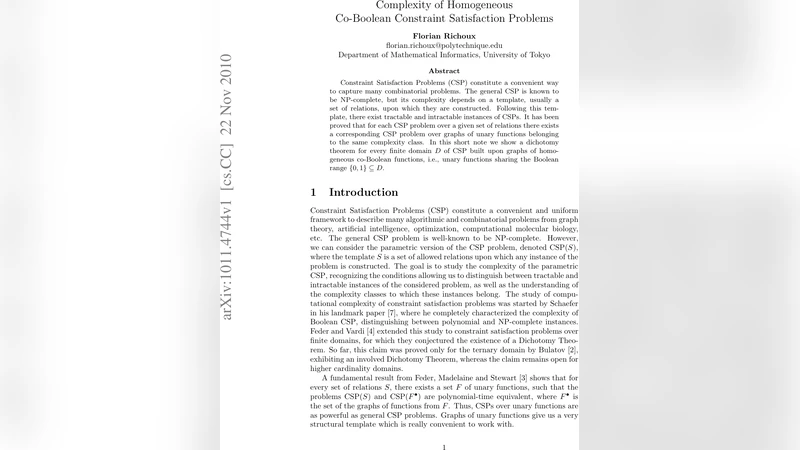
Constraint Satisfaction Problems (CSP) constitute a convenient way to capture many combinatorial problems. The general CSP is known to be NP-complete, but its complexity depends on a template, usually a set of relations, upon which they are constructed. Following this template, there exist tractable and intractable instances of CSPs. It has been proved that for each CSP problem over a given set of relations there exists a corresponding CSP problem over graphs of unary functions belonging to the same complexity class. In this short note we show a dichotomy theorem for every finite domain D of CSP built upon graphs of homogeneous co-Boolean functions, i.e., unary functions sharing the Boolean range {0, 1}.
💡 Research Summary
The paper investigates the computational complexity of constraint satisfaction problems (CSPs) whose templates consist of graphs of homogeneous co‑Boolean unary functions—functions defined on a finite domain D that map every element to either 0 or 1. Building on the well‑known fact that any CSP over a relational template can be equivalently expressed using graphs of unary functions, the authors focus on the special case where all functions share the same Boolean range, which they term “homogeneous co‑Boolean.”
Using the algebraic approach to CSP classification, the authors examine the polymorphisms (i.e., operations that preserve all relations in the template) admitted by a given set F of such functions. They identify four key polymorphisms that determine tractability: (i) the binary conjunction (∧) and disjunction (∨) operations, which correspond to Horn and dual‑Horn structures; (ii) the majority operation, which yields a 2‑SAT‑like tractable class; (iii) the minority (or affine) operation, which makes the problem reducible to solving systems of linear equations over GF(2); and (iv) simple projections that collapse the instance to a tree‑like form.
The main theorem states that if the function set F is closed under any of these operations, the associated Homogeneous Co‑Boolean CSP can be solved in polynomial time by standard algorithms (Horn‑SAT solvers, 2‑SAT reductions, Gaussian elimination, etc.). Conversely, if F lacks all of these polymorphisms, the authors construct polynomial‑time reductions from classic NP‑complete problems such as 3‑SAT, 1‑in‑3‑SAT, or graph coloring, thereby proving that the CSP is NP‑complete. The reductions exploit the uniform Boolean range and the unary nature of the functions to encode literals and clauses directly into the function graphs.
Thus the paper delivers a clean dichotomy: every finite‑domain CSP built from graphs of homogeneous co‑Boolean functions is either in P (when the template admits one of the identified polymorphisms) or NP‑complete (otherwise). This result extends Schaefer’s dichotomy and the Bulatov‑Dalmau classification from relational templates to a natural class of function‑based templates, demonstrating that the algebraic method remains powerful in this broader setting and opening avenues for future work on non‑homogeneous or higher‑arity function graphs.
Comments & Academic Discussion
Loading comments...
Leave a Comment