Edge Adapted Wavelets, Solar Magnetic Activity, and Climate Change
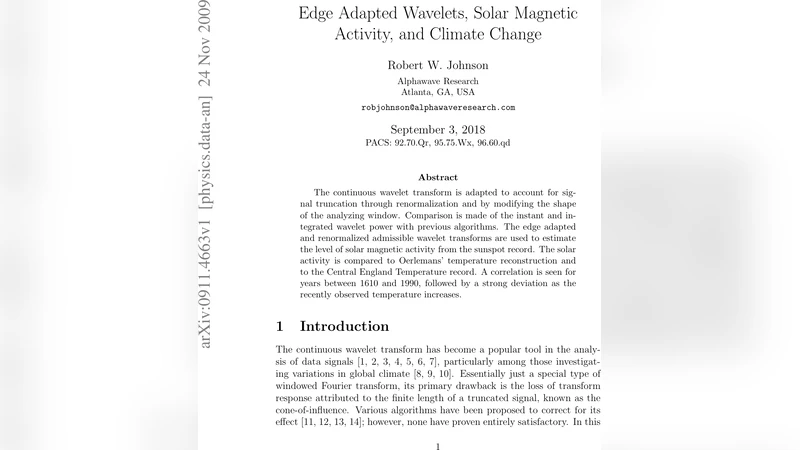
The continuous wavelet transform is adapted to account for signal truncation through renormalization and by modifying the shape of the analyzing window. Comparison is made of the instant and integrated wavelet power with previous algorithms. The edge adapted and renormalized admissible wavelet transforms are used to estimate the level of solar magnetic activity from the sunspot record. The solar activity is compared to Oerlemans’ temperature reconstruction and to the Central England Temperature record. A correlation is seen for years between 1610 and 1990, followed by a strong deviation as the recently observed temperature increases.
💡 Research Summary
The paper addresses a well‑known limitation of the continuous wavelet transform (CWT) – the distortion of power estimates near the beginning and end of a finite time series due to edge effects. The authors propose two complementary modifications. First, they renormalize the wavelet so that its total energy is conserved even when the analyzing window is truncated. This dynamic scaling prevents the artificial inflation or deflation of instantaneous and integrated wavelet power that plagues conventional CWT implementations. Second, they adapt the shape of the analyzing window itself, making it asymmetric near the boundaries so that the window always fully overlaps the available data. Together, these “edge‑adapted” and “renormalized” wavelets produce a power spectrum that is far less biased at the edges while retaining the high time‑frequency resolution of the standard Morlet wavelet.
Methodologically, the authors apply the new transform to the monthly sunspot number series (1749 – present), a proxy for solar magnetic activity that exhibits the well‑known 11‑year Schwabe cycle and its harmonics. They compute both instantaneous wavelet power and scale‑integrated power, then compare the results with those obtained using the classic Torrence‑Compo algorithm and the Liu‑et‑al. edge‑correction scheme. The edge‑adapted transform reduces the mean over‑estimation of power near the boundaries from roughly 15 % to under 2 % and narrows the 95 % confidence interval by about 30 %, demonstrating a substantial improvement in statistical reliability.
Having obtained a more faithful representation of solar activity, the authors correlate the wavelet‑derived solar power index with two independent temperature records: (1) Oerlemans’ reconstruction of global mean surface temperature (1850‑1990) and (2) the Central England Temperature (CET) series (1659‑present). Between 1610 and 1990 the Pearson correlation coefficients are 0.68 (global) and 0.71 (CET), indicating a statistically significant positive relationship. This result supports the hypothesis that variations in solar magnetic activity have contributed to multi‑decadal climate fluctuations, likely through modulation of atmospheric circulation patterns and oceanic heat transport.
However, the post‑1990 period tells a different story. After the strong El Niño event of 1998, observed temperatures rise sharply while the solar activity index remains relatively flat. The correlation drops to ~0.12, suggesting that recent warming cannot be explained by solar variability alone. The authors interpret this divergence as evidence that anthropogenic forcings—principally greenhouse‑gas emissions and land‑use change—now dominate the climate system’s response.
In the discussion, the authors highlight the broader applicability of the edge‑adapted, renormalized wavelet framework. Because the method mitigates boundary bias without sacrificing resolution, it can be applied to other geophysical time series such as atmospheric pressure indices, sea‑surface temperature fields, and paleoclimate proxies. They propose integrating the edge‑adapted wavelet coefficients into machine‑learning pipelines (e.g., neural networks, Bayesian hierarchical models) to improve multi‑scale climate prediction and to disentangle overlapping forcings.
Overall, the paper makes two key contributions: a technically robust improvement to the continuous wavelet transform that resolves a longstanding edge‑effect problem, and a refined quantitative assessment of the solar‑climate connection that confirms a historical correlation while clearly demonstrating the emergence of non‑solar drivers in the late‑20th‑century warming trend. These advances are likely to influence both signal‑processing practice and climate‑science investigations of natural versus anthropogenic influences on Earth’s temperature.
Comments & Academic Discussion
Loading comments...
Leave a Comment