Combinatorial Geometry of Graph Partitioning - I
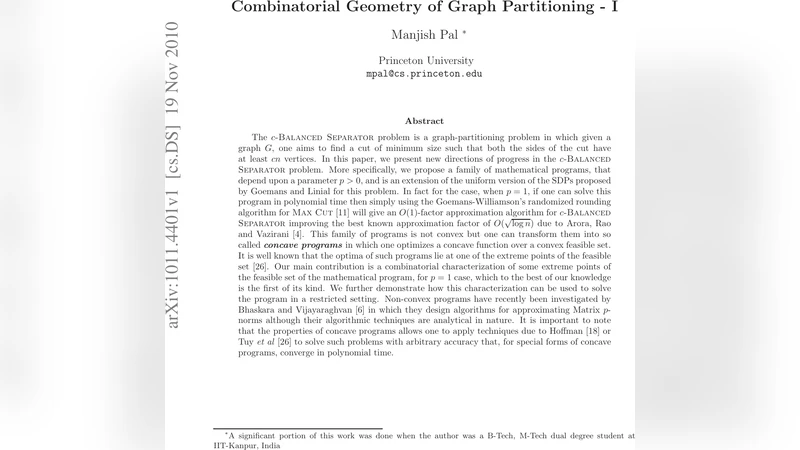
The {\sc $c$-Balanced Separator} problem is a graph-partitioning problem in which given a graph $G$, one aims to find a cut of minimum size such that both the sides of the cut have at least $cn$ vertices. In this paper, we present new directions of progress in the {\sc $c$-Balanced Separator} problem. More specifically, we propose a family of mathematical programs, that depend upon a parameter $p > 0$, and is an extension of the uniform version of the SDPs proposed by Goemans and Linial for this problem. In fact for the case, when $p=1$, if one can solve this program in polynomial time then simply using the Goemans-Williamson’s randomized rounding algorithm for {\sc Max Cut} \cite{WG95} will give an $O(1)$-factor approximation algorithm for {\sc $c$-Balanced Separator} improving the best known approximation factor of $O(\sqrt{\log n})$ due to Arora, Rao and Vazirani \cite{ARV}. This family of programs is not convex but one can transform them into so called \emph{\textbf{concave programs}} in which one optimizes a concave function over a convex feasible set. It is well known that the optima of such programs lie at one of the extreme points of the feasible set \cite{TTT85}. Our main contribution is a combinatorial characterization of some extreme points of the feasible set of the mathematical program, for $p=1$ case, which to the best of our knowledge is the first of its kind. We further demonstrate how this characterization can be used to solve the program in a restricted setting. Non-convex programs have recently been investigated by Bhaskara and Vijayaraghvan \cite{BV11} in which they design algorithms for approximating Matrix $p$-norms although their algorithmic techniques are analytical in nature.
💡 Research Summary
The paper tackles the classic graph‑partitioning task known as the c‑Balanced Separator: given an undirected graph G with n vertices and a constant c (0 < c < ½), find a cut that separates the vertex set into two parts each containing at least c n vertices while minimizing the number of crossing edges. The best known polynomial‑time approximation before this work was the Arora‑Rao‑Vazirani (ARV) algorithm, which achieves an O(√log n) factor.
Main contribution – the authors introduce a family of mathematical programs parameterized by a real number p > 0. The objective is
\
Comments & Academic Discussion
Loading comments...
Leave a Comment