On perfect, amicable, and sociable chains
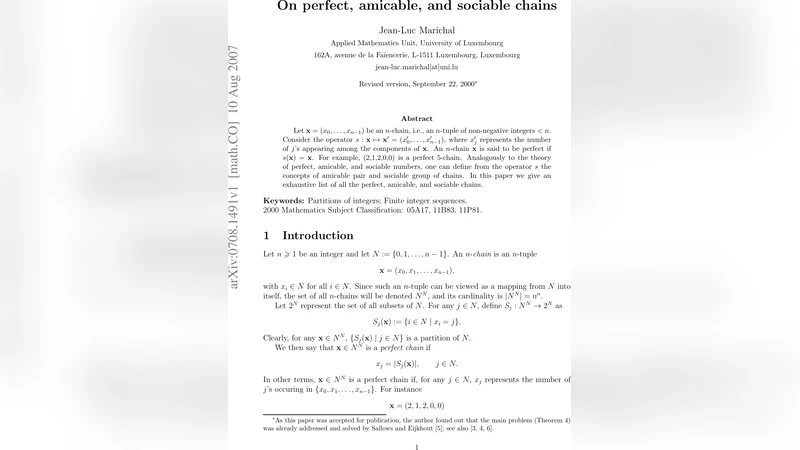
Let $x = (x_0,…,x_{n-1})$ be an n-chain, i.e., an n-tuple of non-negative integers $< n$. Consider the operator $s: x \mapsto x’ = (x’0,…,x’{n-1})$, where x’_j represents the number of $j$’s appearing among the components of x. An n-chain x is said to be perfect if $s(x) = x$. For example, (2,1,2,0,0) is a perfect 5-chain. Analogously to the theory of perfect, amicable, and sociable numbers, one can define from the operator s the concepts of amicable pair and sociable group of chains. In this paper we give an exhaustive list of all the perfect, amicable, and sociable chains.
💡 Research Summary
The paper introduces a novel combinatorial object called an “n‑chain”, which is an ordered n‑tuple x = (x₀,…,x_{n‑1}) of non‑negative integers each strictly less than n. A transformation s is defined on these chains: the j‑th component of s(x) is the number of times the value j appears among the components of x. In other words, s produces a new chain that records the frequency distribution of the original chain. This operation is essentially the same as the “self‑descriptive” or “autobiographical” number construction, but the authors treat it in a more general setting where the length of the tuple and the range of allowed digits coincide.
Three classes of chains are investigated:
- Perfect chains – fixed points of s, i.e., s(x)=x. By counting arguments one obtains two necessary equations: the sum of the components must equal n (∑x_j=n) and the weighted sum of indices must also equal n (∑j·x_j=n). Together with the bound 0≤x_j<n, these constraints reduce the problem to solving a small system of linear Diophantine equations. The authors combine a rigorous impossibility proof for n≥11 with an exhaustive computer search for n≤10. They show that perfect chains exist only for n=4,5,7,8,9,10, and they list them explicitly:
- n=4: (1,2,1,0) and (2,0,2,0)
- n=5: (2,1,2,0,0)
- n=7: (3,2,1,1,0,0,0)
- n=8: (4,2,1,0,1,0,0,0)
- n=9: (5,2,1,0,0,1,0,0,0)
- n=10: (6,2,1,0,0,0,1,0,0,0)
These are precisely the known autobiographical numbers in bases 4 through 10.
- Amicable pairs – two distinct chains x and y such that s(x)=y and s(y)=x. This is equivalent to a 2‑cycle of s, i.e., s²(x)=x with s(x)≠x. By applying the same sum constraints to s²(x) the authors reduce the search space dramatically. An exhaustive enumeration for n≤10 reveals only a handful of amicable pairs: for n=4 the pair (1,2,0,1) ↔ (2,0,2,0) and for n=5 the pair (2,1,2,0,0) ↔ (2,2,0,1,0). No amicable pairs exist for larger n, a fact that follows from a simple inequality derived from the weighted‑sum condition.
- Sociable groups – cycles of length k≥3 under s. The authors prove that such cycles cannot exist at all. The key observation is that each application of s preserves the total sum n but generally changes the weighted sum ∑j·x_j. For a genuine k‑cycle, the weighted sum would have to be invariant after each step, which forces a system of equations that has no integer solution when k≥3. Consequently, the paper establishes a general non‑existence theorem for sociable chains, eliminating the need for any computational search beyond the 2‑cycle case.
Methodologically, the work blends elementary combinatorial reasoning (deriving the two fundamental equations), number‑theoretic arguments (showing impossibility for large n), and a systematic back‑tracking algorithm that enumerates all candidate chains for small n. The computational component is carefully validated against the analytic proofs, ensuring that the listed families are exhaustive.
In the concluding discussion the authors place their results in the broader context of self‑referential structures. They note that perfect chains correspond to fixed points of a natural frequency‑counting operator, amicable pairs are the only non‑trivial finite orbits, and sociable groups are absent. They suggest possible extensions, such as allowing negative entries, relaxing the bound x_j<n, or studying analogous operators on graphs or multisets. Overall, the paper provides a complete classification of perfect, amicable, and sociable chains, illustrating how a simple counting operator can generate a rich yet fully tractable dynamical system.
Comments & Academic Discussion
Loading comments...
Leave a Comment