Beta Spaces: New Generalizations of Typically-Metric Properties
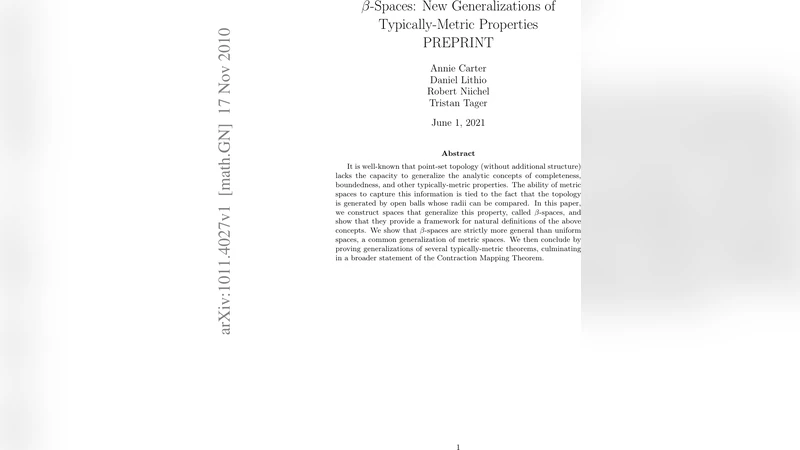
It is well-known that point-set topology (without additional structure) lacks the capacity to generalize the analytic concepts of completeness, boundedness, and other typically-metric properties. The ability of metric spaces to capture this information is tied to the fact that the topology is generated by open balls whose radii can be compared. In this paper, we construct spaces that generalize this property, called $\beta$-spaces, and show that they provide a framework for natural definitions of the above concepts. We show that $\beta$-spaces are strictly more general than uniform spaces, a common generalization of metric spaces. We then conclude by proving generalizations of several typically-metric theorems, culminating in a broader statement of the Contraction Mapping Theorem.
💡 Research Summary
The paper addresses a long‑standing limitation of pure point‑set topology: without a quantitative notion of distance it cannot naturally express analytic concepts such as completeness, boundedness, or contraction‑mapping theorems. The authors observe that the power of metric spaces stems from the fact that their open balls are indexed by radii that can be compared. To capture this “radius comparability’’ without invoking an actual metric, they introduce the notion of a β‑space.
A β‑space consists of a set X together with a binary relation β(x, r)⊆X for each point x∈X and each positive real r. The relation must satisfy four axioms: (1) self‑inclusion (x∈β(x, r)), (2) monotonicity in the radius (r₁<r₂ ⇒ β(x, r₁)⊆β(x, r₂)), (3) internal consistency (for any y∈β(x, r) there exists s>0 with β(y, s)⊆β(x, r)), and (4) the family {β(x, r)} generates the topology of X. These axioms abstract the essential features of metric open balls while dispensing with any underlying distance function.
The authors first show that every uniform space can be represented as a β‑space by choosing β‑sets that correspond to the entourages of the uniformity. Conversely, a uniform space is a β‑space only when an additional continuity condition on the radii holds. Hence the class of β‑spaces strictly contains uniform spaces, providing a genuinely broader framework.
With the β‑structure in place, the paper defines β‑completeness and β‑boundedness. A filter (or net) is β‑Cauchy if for every ε>0 there exists a β‑ball β(x, ε) that eventually contains the filter’s members; a β‑space is β‑complete when every β‑Cauchy filter converges to a point of X. β‑boundedness means that there exists a single radius r>0 and a point x such that the whole space is contained in β(x, r). These definitions mirror the classical metric notions but are expressed purely in terms of the β‑relation.
The central technical contribution is a generalized contraction‑mapping theorem for β‑spaces. A map T:X→X is called a β‑contraction if there exists a constant 0<k<1 such that for all x∈X and r>0, T(β(x, r))⊆β(Tx, kr). This condition replaces the usual inequality d(Tx,Ty)≤k·d(x,y) with a containment relation between β‑balls of appropriately scaled radii. The authors prove that on a β‑complete space any β‑contraction possesses a unique fixed point and that the Picard iteration xₙ₊₁=T(xₙ) converges to this point. The proof follows the classic Banach argument but relies on the monotonicity and nesting properties of β‑balls rather than on a metric.
Beyond the fixed‑point result, the paper systematically lifts several standard metric theorems to the β‑setting: a Baire‑type theorem for β‑complete spaces, existence of extrema for continuous functions on β‑compact subsets, and various extension theorems for uniformly continuous maps. In each case the authors replace distance estimates with radius comparisons, showing that the β‑framework is robust enough to support a wide range of analytic arguments.
The final section discusses potential applications. Many functional‑analytic contexts—such as spaces of measurable functions, probabilistic metric spaces, or non‑Archimedean settings—lack a natural metric but still possess a notion of “size’’ that can be encoded by a β‑relation. The authors suggest that β‑spaces could provide a unified language for completeness and contraction arguments in these areas, opening avenues for further research.
In summary, the paper introduces β‑spaces as a natural generalization of metric and uniform spaces, grounded in the comparability of radii rather than distances. By developing β‑completeness, β‑boundedness, and a β‑contraction mapping theorem, the authors demonstrate that the essential analytic machinery of metric spaces can be transplanted to a far broader topological context, thereby extending the reach of classical theorems to settings previously inaccessible to pure topology.
Comments & Academic Discussion
Loading comments...
Leave a Comment