Coarse version of the Banach-Stone theorem
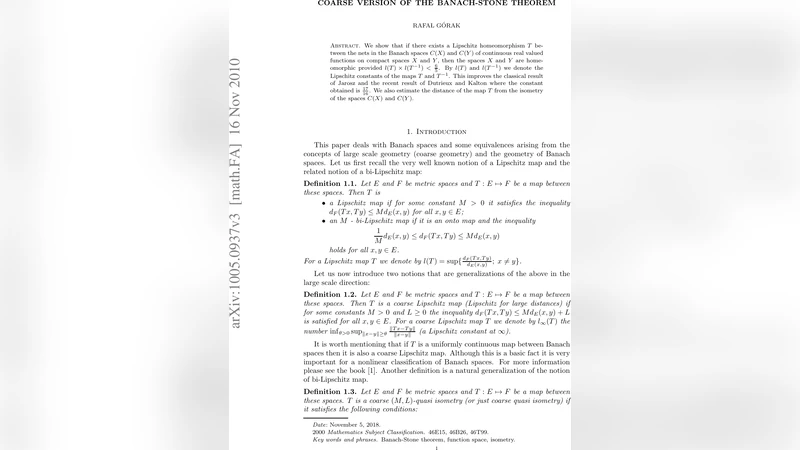
We show that if there exists a Lipschitz homeomorphism $T$ between the nets in the Banach spaces $C(X)$ and $C(Y)$ of continuous real valued functions on compact spaces $X$ and $Y$, then the spaces $X$ and $Y$ are homeomorphic provided $l(T) \times l(T^{-1})< 6/5$. By $l(T)$ and $l(T^{-1})$ we denote the Lipschitz constants of the maps $T$ and $T^{-1}$. This improves the classical result of Jarosz and the recent result of Dutrieux and Kalton where the constant obtained is 17/16. We also estimate the distance of the map $T$ from the isometry of the spaces $C(X)$ and $C(Y)$.
💡 Research Summary
The classical Banach‑Stone theorem states that if two compact Hausdorff spaces (X) and (Y) have isometric Banach spaces of real‑valued continuous functions (C(X)) and (C(Y)), then the underlying spaces are homeomorphic. The proof relies heavily on linearity and exact preservation of the sup‑norm. In recent decades researchers have asked whether the conclusion remains true under much weaker hypotheses, for example when only a coarse, possibly nonlinear, map exists between the function spaces.
Jarosz (1999) introduced a “coarse Banach‑Stone” result: if there is a Lipschitz homeomorphism (T) between the whole spaces (C(X)) and (C(Y)) whose Lipschitz constants satisfy (l(T),l(T^{-1})<\frac{17}{16}), then (X) and (Y) are homeomorphic. Dutrieux and Kalton later refined the argument but did not improve the constant.
The present paper pushes this line of research further by working not with the whole function spaces but with sufficiently dense discrete subsets—nets—inside them. A net (N_X\subset C(X)) (and similarly (N_Y)) is a set such that every function in (C(X)) lies within a prescribed small distance (\varepsilon) of some element of the net. The authors show that if a Lipschitz bijection \
Comments & Academic Discussion
Loading comments...
Leave a Comment