We prove that a Hausdorff space $X$ is very $\mathrm I$-favorable if and only if $X$ is the almost limit space of a $\sigma$-complete inverse system consisting of (not necessarily Hausdorff) second countable spaces and surjective d-open bonding maps. It is also shown that the class of Tychonoff very $\mathrm I$-favorable spaces with respect to the co-zero sets coincides with the d-openly generated spaces.
Deep Dive into Very I-favorable spaces.
We prove that a Hausdorff space $X$ is very $\mathrm I$-favorable if and only if $X$ is the almost limit space of a $\sigma$-complete inverse system consisting of (not necessarily Hausdorff) second countable spaces and surjective d-open bonding maps. It is also shown that the class of Tychonoff very $\mathrm I$-favorable spaces with respect to the co-zero sets coincides with the d-openly generated spaces.
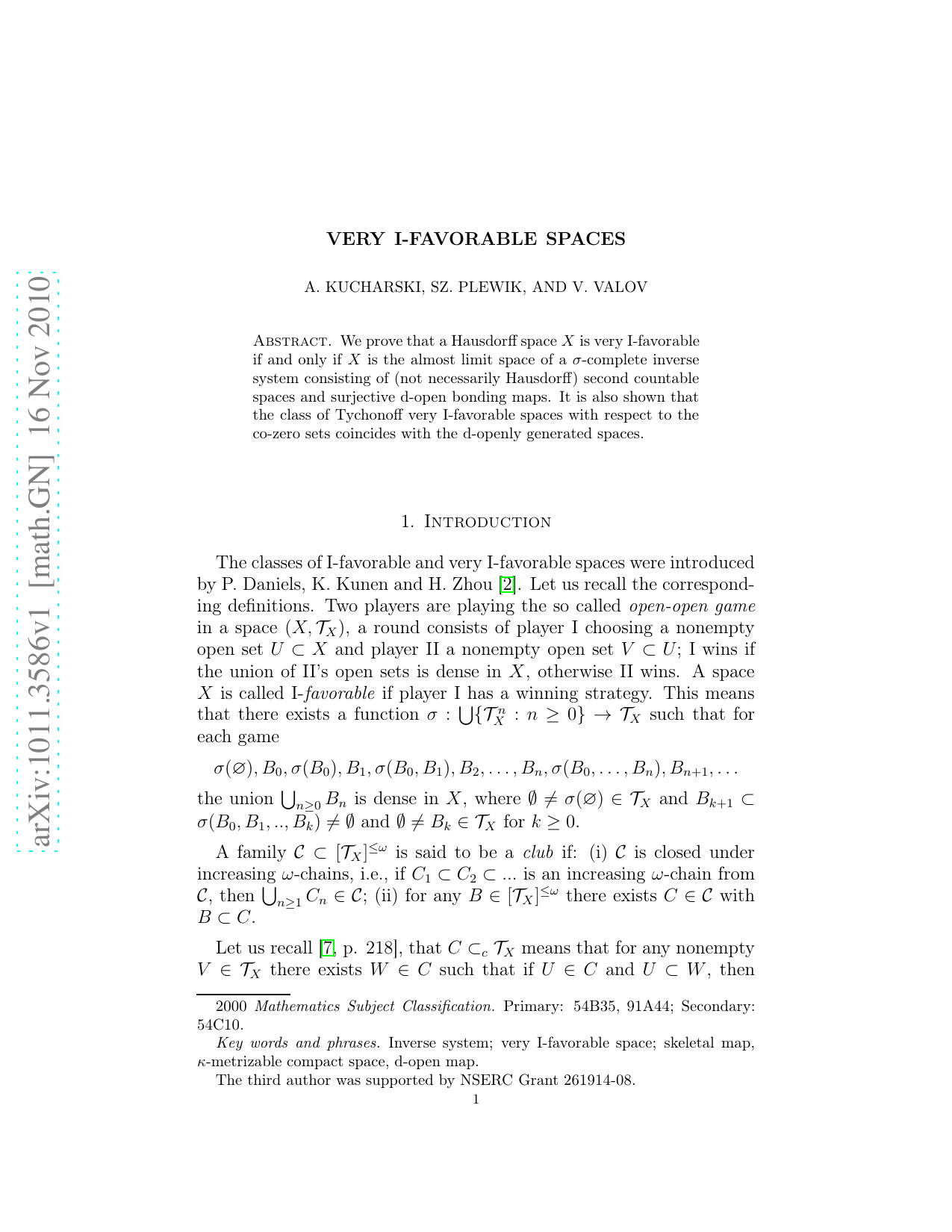
The classes of I-favorable and very I-favorable spaces were introduced by P. Daniels, K. Kunen and H. Zhou [2]. Let us recall the corresponding definitions. Two players are playing the so called open-open game in a space (X, T X ), a round consists of player I choosing a nonempty open set U ⊂ X and player II a nonempty open set V ⊂ U; I wins if the union of II's open sets is dense in X, otherwise II wins. A space X is called I-favorable if player I has a winning strategy. This means that there exists a function σ : {T n X : n ≥ 0} → T X such that for each game σ(∅), B 0 , σ(B 0 ), B 1 , σ(B 0 , B 1 ), B 2 , . . . , B n , σ(B 0 , . . . , B n ), B n+1 , . . . the union n≥0 B n is dense in X, where ∅ = σ(∅) ∈ T X and B k+1 ⊂ σ(B 0 , B 1 , .., B k ) = ∅ and ∅ = B k ∈ T X for k ≥ 0.
A family C ⊂ [T X ] ≤ω is said to be a club if: (i) C is closed under increasing ω-chains, i.e., if C 1 ⊂ C 2 ⊂ … is an increasing ω-chain from C, then n≥1 C n ∈ C; (ii) for any B ∈ [T X ] ≤ω there exists C ∈ C with B ⊂ C.
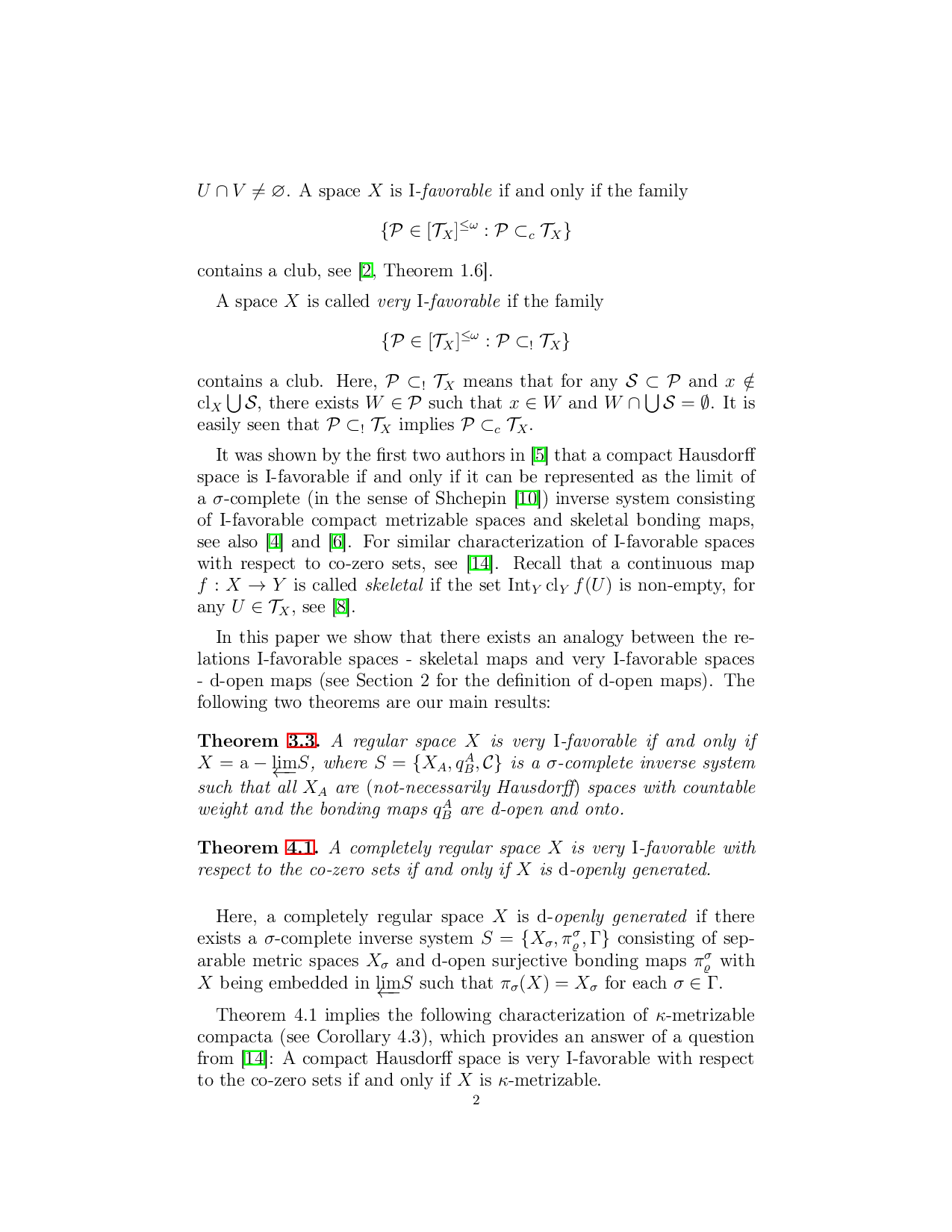
Let us recall [7, p. 218], that C ⊂ c T X means that for any nonempty V ∈ T X there exists W ∈ C such that if U ∈ C and U ⊂ W , then U ∩ V = ∅. A space X is I-favorable if and only if the family {P ∈ [T X ] ≤ω : P ⊂ c T X } contains a club, see [2,Theorem 1.6].
A space X is called very I-favorable if the family {P ∈ [T X ] ≤ω : P ⊂ ! T X } contains a club. Here, P ⊂ ! T X means that for any S ⊂ P and x / ∈ cl X S, there exists W ∈ P such that x ∈ W and W ∩ S = ∅. It is easily seen that P ⊂ ! T X implies P ⊂ c T X .
It was shown by the first two authors in [5] that a compact Hausdorff space is I-favorable if and only if it can be represented as the limit of a σ-complete (in the sense of Shchepin [10]) inverse system consisting of I-favorable compact metrizable spaces and skeletal bonding maps, see also [4] and [6]. For similar characterization of I-favorable spaces with respect to co-zero sets, see [14]. Recall that a continuous map f : [8].
In this paper we show that there exists an analogy between the relations I-favorable spaces -skeletal maps and very I-favorable spaces -d-open maps (see Section 2 for the definition of d-open maps). The following two theorems are our main results: Theorem 3.3. A regular space X is very I-favorable if and only if X = alim ← -S, where S = {X A , q A B , C} is a σ-complete inverse system such that all X A are (not-necessarily Hausdorff) spaces with countable weight and the bonding maps q A B are d-open and onto.
Theorem 4.1. A completely regular space X is very I-favorable with respect to the co-zero sets if and only if X is d-openly generated.
Here, a completely regular space X is d-openly generated if there exists a σ-complete inverse system S = {X σ , π σ ̺ , Γ} consisting of separable metric spaces X σ and d-open surjective bonding maps π σ ̺ with X being embedded in lim ← -S such that π σ (X) = X σ for each σ ∈ Γ. Theorem 4.1 implies the following characterization of κ-metrizable compacta (see Corollary 4.3), which provides an answer of a question from [14]: A compact Hausdorff space is very I-favorable with respect to the co-zero sets if and only if X is κ-metrizable.
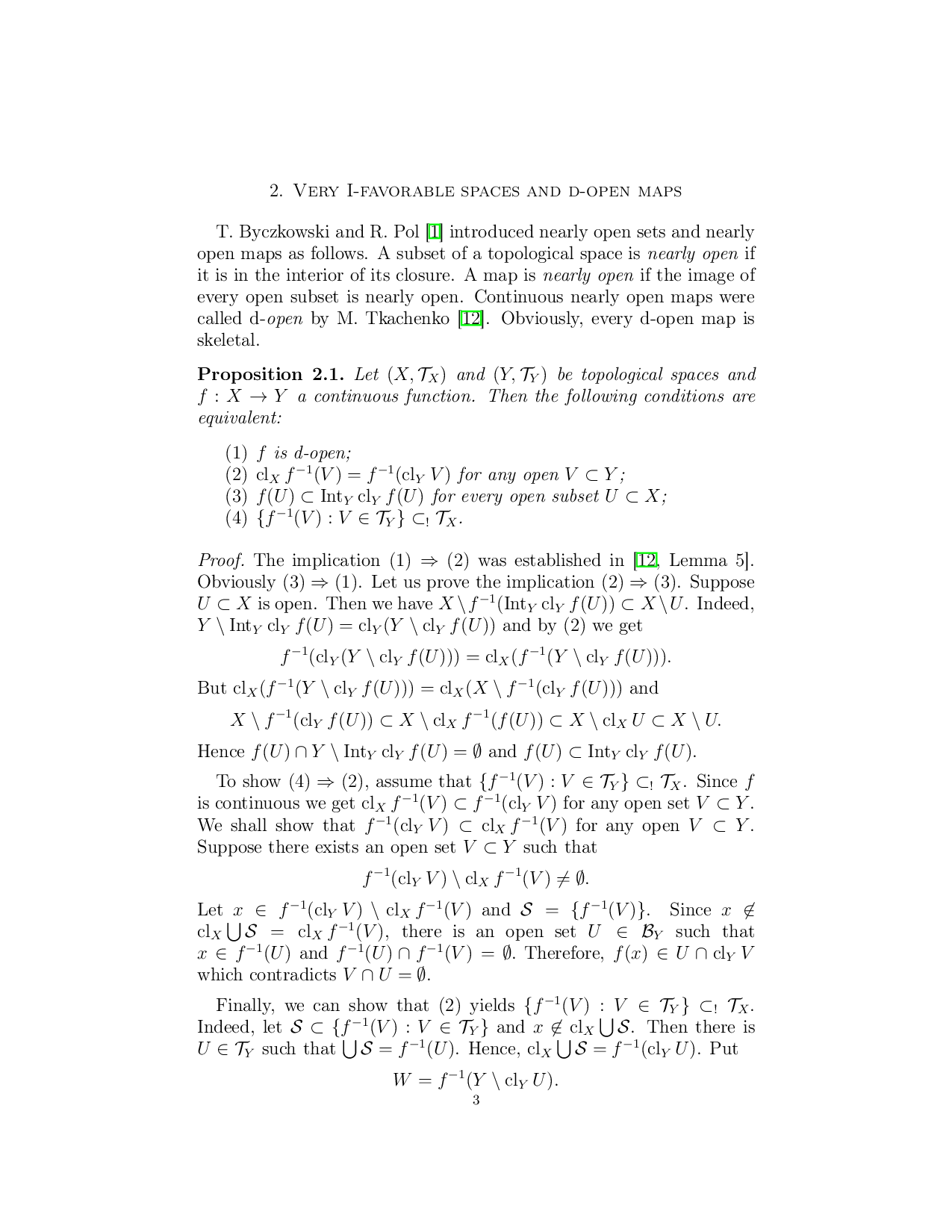
T. Byczkowski and R. Pol [1]
Proof. The implication (1) ⇒ (2) was established in [12,Lemma 5].
and by (2) we get
Indeed, we can follow the proof of the implication (4) ⇒ (2) from Proposition 2.1. The only difference is the choice of the family S. If there exists
Next lemma was established in [12,Lemma 9].
Let X be a topological space equipped with a topology T X and Q ⊂ T X . Suppose that there exists a function σ : Proof. Let P ⊂ Q be closed under σ and finite intersections. Fix a family S ⊂ P and x ∈ cl S. If σ(∅) ∩ S = ∅, then take an element U ∈ S such that σ(∅) ∩ U = ∅ and put
Proposition 2.5. Let X be a topological space and Q ⊂ T X be a family closed under finite intersection. Then there is a strong winning strategy Suppose there exists a strong winning strategy σ :
The absorbing property (i.e. for every A ∈ [T X ] ≤ω there is an element
and note that cl S = cl S ′ . The last equality follows from the inclusion S ′ ⊂ S and the fact that A U is dense in U for every
If X is a completely regular space, then Σ X denotes the collection of all co-zero sets in X.
Corollary 2.8. Let X be a completely regular space and B ⊂ Σ X a base for X. If {P ∈ [B] ≤ω : P ⊂ ! B} contains a club, then the family {P ∈ [Σ X ] ≤ω : P ⊂ ! Σ X } contains a club too.
Proof. The proof of previous proposition works in the present situation. The only modification is that for each U ∈ Σ X \B we assign a countable family A U ⊂ B of pairwise disjoint co-zero subsets of U such that cl A U = cl U. Such A U exists. For example, any maximal disjoint family of elements from B which are contained in U can serve as A U . The new club is the family
every U ∈ B. The maps q A B are also d-open, see Lemma 3.2. In this way we obtained the inverse system S = {X A , q A B , C} consisting of spaces with countable weight and d-open b
…(Full text truncated)…
This content is AI-processed based on ArXiv data.