Non-symmetric discrete Toda systems from quad-graphs
For all non-symmetric discrete relativistic Toda type equations we establish a relation to 3D consistent systems of quad-equations. Unlike the more simple and better understood symmetric case, here the three coordinate planes of $\mathbb Z^3$ carry d…
Authors: Raphael Boll, Yuri B. Suris
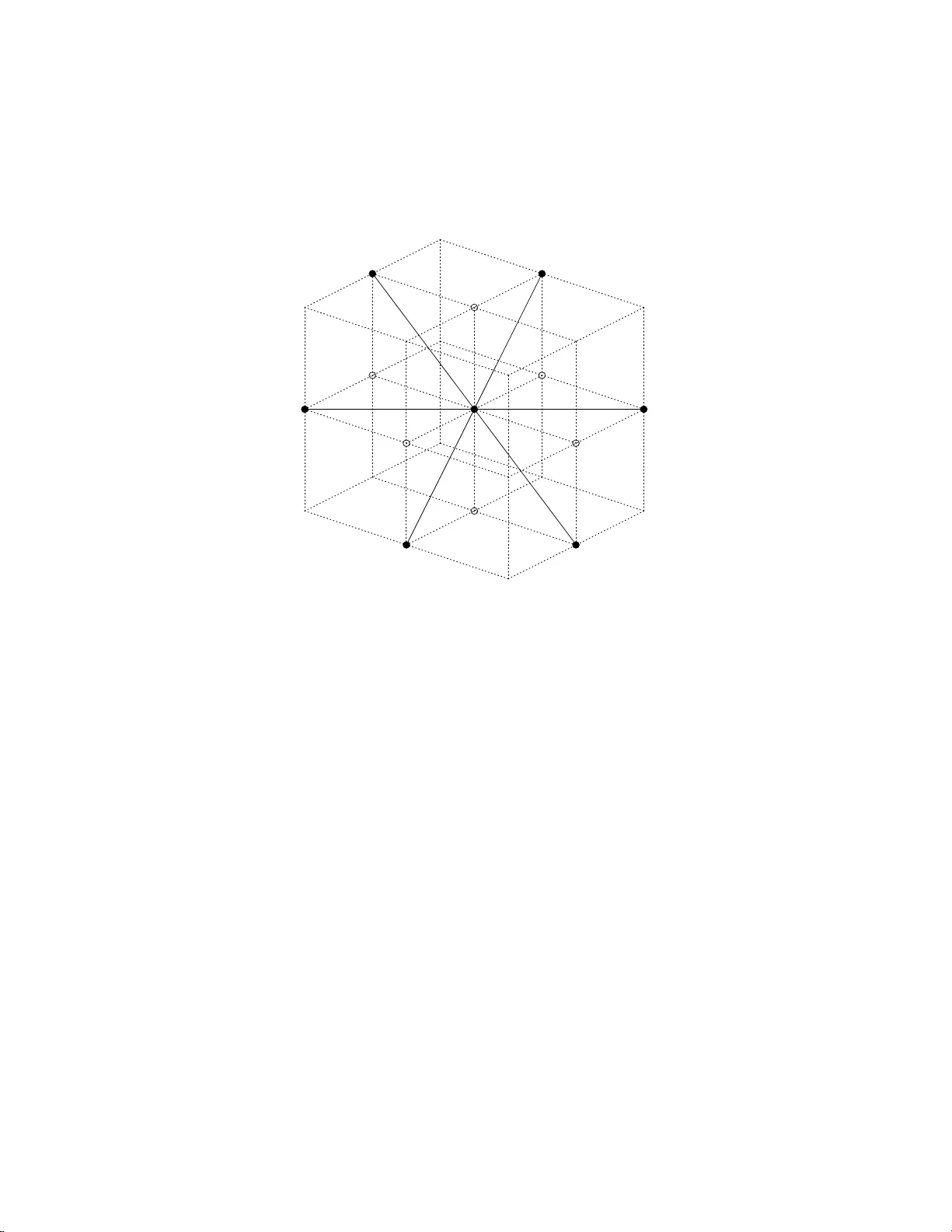
Non-symmetric discrete T o da systems from quad-graphs Raphael Boll 1 and Y uri B. Suris 2 No v em ber 21, 2018 Abstract F or all non-sy mmetr ic discrete re la tivistic T o da type equa tions we establish a relation to 3D consisten t systems of quad-equations. Unlik e the more simple and better un dersto o d symmetric case, here the three co or dinate planes of Z 3 carry different equations. Our construction allows for an algorithmic deriv a tion of the zero curv ature representations and yields a nalogous r esults also for the co n tinuous time case. 1 In tro duction This p ap er is dev oted to one asp ect of the general topic of discrete in tegrable systems. In the recen t years the viewp oin t that discrete inte grable systems are in a sense more fundamental than con tin uous ones b ecomes gradually more and more acce pted in the soliton theory comm unit y . Th e last dev elopmen ts led to the understanding t hat the ve ry definition of int egrabilit y b ecomes m ore transp aren t and natural on the d iscrete lev el, see [11]. O ne can consider certain types of discrete equations, lik e the so called quad- equations, as a sort of “elemen tary particles” of the solitonic w orld, with the enormous ric hness of this w orld r esulting fr om v arious combinations and limiting p ro cedures of these elemen tary ob jects. Here, w e disco v er suc h “elemen tary particles” underlying the so called equations of the relativistic T o da t yp e. Th is “microstructure” b ecome visib le only after th e discretizatio n p r o cedure, and even then some hidd en degrees of f reedom remain to b e unco v ered in ord er for the whole simplicit y to b ecome apparen t. W e review the r elativistic T o da type equatio ns and their integ rable discretizations in Sections 2 and 3, r esp ectiv ely . After that, general T o da equations on graphs are discussed in Section 4 . F un damen tal notion of quad-graphs and qu ad-equations (which b elong, in our view, to the “elemen tary particles” mentioned ab o v e) are discus sed in Section 5, while the f ollo wing Section 6 is dev oted to the explanatio n of ho w the T o d a t yp e equations on graphs can b e reduced to th e systems of quad-equations. In Section 7 some com binatorial aspects of the regular triangular lattice are discussed, since this lattice underlies the discrete relativistic T o da t yp e equ ations. F inally , Sections 8– 10 cont ain 1 Zentrum Mathematik, T ec hnische Universit¨ at M ¨ unc hen, Boltzmannstr. 3, 85748 Garching, G ermany 2 Institut f¨ ur Mathematik, MA 7-2, T echnische Universit¨ at Berlin, Str. des 17. Juni 136, 10623 Berlin, German y 1 the main new results of this pap er. Namely , in Section 8 we presen t the systems of quad- equations whic h yield the non-symmetric discrete relativistic T o da equations. In Section 9 we sh o w that all this sys tems ha v e their common origin in just on e master system of this t yp e. In Section 10 w e demonstrate h o w to derive th e zero curv a ture represen tations for relat ivistic T o da t yp e equations (discrete and con tin uous) in an algorithmic manner. A brief outlo ok is form ulated in the concludin g S ection 11. 2 Lattice equations of the relati vistic T o da t yp e The term “equations of the r elativistic T o da type” is us ed to denote in tegrable lattice equations of the general form ¨ x k = r ( ˙ x k ) ˙ x k +1 f ( x k +1 − x k ) − ˙ x k − 1 f ( x k − x k − 1 ) + g ( x k +1 − x k ) − g ( x k − x k − 1 ) . (1) The relativistic T o da lattice prop er wa s inv en ted by S. Ruijsenaars [14]. It is describ ed b y Newtonian equations of motion ¨ x k = (1 + α ˙ x k +1 )(1 + α ˙ x k ) e x k +1 − x k 1 + α 2 e x k +1 − x k − (1 + α ˙ x k )(1 + α ˙ x k − 1 ) e x k − x k − 1 1 + α 2 e x k − x k − 1 . (2) Here α is a small parameter wh ose physical meaning is the inv erse sp eed of light. In the non-relativistic limit α → 0 system (2) turns into the usu al T o d a lattice. It took ab out a decade for further in tegrable equations of the relativistic T o da t yp e to b e d iscov e red. In [16] the follo wing ones were foun d: tw o systems whic h again can b e considered as α -p erturbations of the usual T o da lattice: ¨ x k = (1 + α ˙ x k +1 ) e x k +1 − x k − (1 + α ˙ x k − 1 ) e x k − x k − 1 − α 2 e 2( x k +1 − x k ) + α 2 e 2( x k − x k − 1 ) (3) and ¨ x k = (1 − α ˙ x k ) 2 (1 − α ˙ x k +1 ) e x k +1 − x k − (1 − α ˙ x k − 1 ) e x k − x k − 1 , (4) and t w o systems wh ic h can b e considered as α -p erturbations of the so called mo difi ed T o da lattice: ¨ x k = ˙ x k e x k +1 − x k − e x k − x k − 1 + α ˙ x k +1 ˙ x k e x k +1 − x k 1 + αe x k +1 − x k − ˙ x k ˙ x k − 1 e x k − x k − 1 1 + αe x k − x k − 1 ! (5) 2 and ¨ x k = ˙ x k (1 − α ˙ x k ) (1 − α ˙ x k +1 ) e x k +1 − x k 1 + αe x k +1 − x k − (1 − α ˙ x k − 1 ) e x k − x k − 1 1 + αe x k − x k − 1 ! . (6) F or all these systems a Lagrangian and a Hamiltonian formulat ions w ere giv en, and their complete integ rabilit y was demonstrated b y presenting the f ull set of integral s of motion and a lo cal zero curv ature represen tations of the t yp e ˙ L k = M k +1 L k − L k M k (7) in terms of 2 × 2 matrices (lo calit y means that the matrix L k dep end s only on x k and the corresp onding canonically conjugate m omen tum p k , and not on phase v a riables from other lattice sites). Tw o further systems of the relativistic T o d a t yp e w ith r ational in teractions (as opp osed to exp onen tial in teractio ns in the pr evious ones) app eared in [17]: ¨ x k = ˙ x k ( x k +1 − 2 x k + x k − 1 ) + α ˙ x k +1 ˙ x k 1 + α ( x k +1 − x k ) − α ˙ x k ˙ x k − 1 1 + α ( x k − x k − 1 ) (8) and ¨ x k = ˙ x k (1 + α 2 ˙ x k ) x k +1 − x k − α ˙ x k +1 1 + α ( x k +1 − x k ) − x k − x k − 1 − α ˙ x k − 1 1 + α ( x k − x k − 1 ) . (9) Both these systems are α -p erturbations of the so-called dual T o d a lattice. Also for these systems the Lagrangian and the Hamiltonian form ulations were giv en in [17], as w ell as a demonstration of their complete int egrabilit y . Ho w ev e r, lo cal zero cur v ature represent ations we re not given at th at p oint. Along another line of researc h , a complete classification of “integ rable” systems of the t yp e (1) wa s ac hiev ed in [6]. The notion of “in tegrabilit y” used in this pap er is a clev er and un exp ected d evice, allo wing to carry out a complete classification, but it has, ` a priori , nothing to do with the u sual Liouville-Arnold in tegrabilit y . Namely , they noticed that the ab o ve systems are alw ays Lagrangian, and r equired that their form b e retained under a s ort of Legendre transformation. Th is allo wed them to find all th e Newtonian equations men tioned ab o ve, as w ell a new s eries of systems, including the most general one, ¨ x k = − 1 2 ( ˙ x 2 k − ν 2 ) sinh 2( x k +1 − x k ) − ν − 1 sinh(2 ν α ) ˙ x k +1 sinh 2 ( x k +1 − x k ) − sinh 2 ( ν α ) − − sinh 2( x k − x k − 1 ) − ν − 1 sinh(2 ν α ) ˙ x k − 1 sinh 2 ( x k − x k − 1 ) − sinh 2 ( ν α ) ! , (10) its limiting case (firs t rescale x k 7→ ν x k , ν 7→ γ ν , and then s end ν → 0): ¨ x k = − ( ˙ x 2 k − γ 2 ) x k +1 − x k − α ˙ x k +1 ( x k +1 − x k ) 2 − γ 2 α 2 − x k − x k − 1 − α ˙ x k − 1 ( x k − x k − 1 ) 2 − γ 2 α 2 , (11) 3 as w ell as the particular cases ν = 0, resp. γ = 0, of the latter t wo systems: ¨ x k = − ˙ x 2 k coth( x k +1 − x k ) − coth( x k − x k − 1 ) − α ˙ x k +1 sinh 2 ( x k +1 − x k ) + α ˙ x k − 1 sinh 2 ( x k − x k − 1 ) ! (12) and ¨ x k = − ˙ x 2 k 1 x k +1 − x k − 1 x k − x k − 1 − α ˙ x k +1 ( x k +1 − x k ) 2 + α ˙ x k − 1 ( x k − x k − 1 ) 2 . (13) Complete in tegrabilit y of these systems in the usu al sense, along with 2 × 2 local zero curv ature represen tations for the last t wo ones, was d emonstrated in the monograph [18]. 3 Time discretization of the relativistic T o da t yp e equa- tions In tegrable discretizations of th e relativistic T o da typ e equations all h a ve the follo win g general shap e of discr ete time Newtonian e quations of motion : F ( e x k − x k ) − F ( x k − x e k ) = G ( x k +1 − x k ) − G ( x k − x k − 1 ) + H ( x e k +1 − x k ) − H ( x k − e x k − 1 ) . (14) Here and b elo w we use the follo wing abbr eviations for functions of the discrete time h Z : x k = x k ( t ) , e x k = x k ( t + h ) , x e k = x k ( t − h ) . The integ rabilit y preserving time d iscretizatio n of the Ruijsenaars’ r elativistic T o d a lattice wa s p erformed in [15], where the follo wing equations w ere derived: 1 + αh − 1 e e x k − x k − 1 1 + αh − 1 e x k − x e k − 1 = 1 + α 2 e x k +1 − x k 1 + α ( α − h ) e x k − e x k − 1 1 + α 2 e x k − x k − 1 1 + α ( α − h ) e x e k +1 − x k . (15) It w as sho wn in [15] that, up on a natur al L agrangian (or discrete Hamiltonian) re- form ulation in terms of the canonically conjugate v ariables x k , p k , discrete time equations (15) share in tegrals of motion with the con tin uous time equations (2), and therefore ha ve the same in tegrabilit y pr op erties (b elong to th e same integrable hierarc hy). This remains true also for all int egrable discr etizations in th is section. The Newtonian systems (3) and (4) w ere d iscretized in [16] in an “additiv e” manner as e e x k − x k − e x k − x e k = hαe x k +1 − x k − hαe x k − x k − 1 − h ( α − h ) e x e k +1 − x k 1 − hαe x e k +1 − x k + h ( α − h ) e x k − e x k − 1 1 − hαe x k − e x k − 1 (16) 4 and 1 1 − αh − 1 e e x k − x k − 1 − 1 1 − αh − 1 e x k − x e k − 1 = = α ( α + h ) e x e k +1 − x k − α ( α + h ) e x k − e x k − 1 − α 2 e x k +1 − x k + α 2 e x k − x k − 1 , (17) while the discretizations of the systems (5 ) and (6) giv en there w ere “m ultiplicativ e”: e e x k − x k − 1 e x k − x e k − 1 = 1 + he x e k +1 − x k 1 + αe x k − e x k − 1 1 + αe x k +1 − x k 1 + αe x e k +1 − x k 1 + he x k − e x k − 1 1 + αe x k − x k − 1 (18) and e e x k − x k − 1 e x k − x e k − 1 · 1 − αh − 1 e x k − x e k − 1 1 − αh − 1 e e x k − x k − 1 = = 1 + αe x k − x k − 1 1 + αe x k +1 − x k · 1 + ( α + h ) e x e k +1 − x k 1 + ( α + h ) e x k − e x k − 1 . (19) Discretizat ions of the rational systems (8) and (9) app eared in [17]: e x k − x k x k − x e k = 1 + h ( x e k +1 − x k ) 1 + α ( x e k +1 − x k ) · 1 + α ( x k − e x k − 1 ) 1 + h ( x k − e x k − 1 ) · 1 + α ( x k +1 − x k ) 1 + α ( x k − x k − 1 ) (20) and ( e x k − x k ) 1 + α ( α + h ) h − 1 ( x k − x e k ) ( x k − x e k ) 1 + α ( α + h ) h − 1 ( e x k − x k ) = = 1 + α ( x k − x k − 1 ) 1 + α ( x k +1 − x k ) · 1 + ( α + h )( x e k +1 − x k ) 1 + ( α + h )( x k − e x k − 1 ) . (21) A discrete version of the device from [6] was dev elop ed in [1]. It wa s used to classify “in tegrable” systems of the general typ e (14), i.e., those retaining their form u nder a sort of a discrete Lege ndr e transformation. The resulting list consisted essen tially of the systems quoted in ab o ve in this section, as w ell as of discretizatio ns of the systems 5 (10)–(13). A discretization of (10) reads sinh( e x k − x k + ν h ) sinh( e x k − x k − ν h ) · sinh( x k − x e k − ν h ) sinh( x k − x e k + ν h ) = sinh( x k +1 − x k + ν α ) sinh( x k +1 − x k − ν α ) · sinh( x k − x k − 1 − ν α ) sinh( x k − x k − 1 + ν α ) × sinh( x e k +1 − x k − ν α + ν h ) sinh( x e k +1 − x k + ν α − ν h ) · sinh( x k − e x k − 1 + ν α − ν h ) sinh( x k − e x k − 1 − ν α + ν h ) . (22) Its rational v ersion, which is a discretization of (11 ), reads ( e x k − x k + γ h ) ( e x k − x k − γ h ) · ( x k − x e k − γ h ) ( x k − x e k + γ h ) = ( x k +1 − x k + γ α ) ( x k +1 − x k − γ α ) · ( x k − x k − 1 − γ α ) ( x k − x k − 1 + γ α ) × × ( x e k +1 − x k − γ α + γ h ) ( x e k +1 − x k + γ α − γ h ) · ( x k − e x k − 1 + γ α − γ h ) ( x k − e x k − 1 − γ α + γ h ) . (23) Finally , the ν → 0, resp. the γ → 0 limits of the latter tw o equ ations lead to additiv e ones: h coth( e x k − x k ) − h coth ( x k − x e k ) = α coth ( x k +1 − x k ) − α coth( x k − x k − 1 ) − − ( α − h ) coth( x e k +1 − x k ) + ( α − h ) coth ( x k − e x k − 1 ) (24) and h e x k − x k − h x k − x e k = α x k +1 − x k − α x k − x k − 1 − α − h x e k +1 − x k + α − h x k − e x k − 1 , (25) whic h d iscr etize (12) and (13 ), r esp ectiv ely . Th e int egrabilit y of the difference equations (22)–(25) in the usu al sen se w as dealt with in [18], where it w as shown that they share the in tegrals of motio n and the matrices L k from the zero curv atur e represen tations with their con tin uous time counterparts. 4 Discrete T o da t yp e equations on graphs An imp ortant observ ation made in [2] was that the natural com binatorial structur e un - derlying the d iscrete relativistic T o da t yp e latt ices (14) is actually the r egular triangular lattice in the plane (rather th an the standard squ are lattic e Z 2 ). Namely , eac h equation of the system (14) relates sev en fields assigned to the star of a v ertex of the regular triangular lattice, eac h one of the fun ctions F , G, H b eing asso ciated to edges of one of the tree directions, see Figure 1. Note that while in the systems (15)–(21 ) (called hereafter non-symmetric discr ete r elativistic T o da typ e e q uations ) the tree functions F , G, H are, generally sp eaking, d if- feren t, this is no more the case for sys tems (22)–(25). In the latter systems (calle d 6 e x k − 1 e x k x k − 1 x k x k +1 x e k x e k +1 Figure 1: Regular triangular lattice underlying discrete relativistic T o da t yp e s ystems hereafter symmetric discr ete r elativistic T o da typ e e quations ) all three fun ctions essen- tially coincide, differing only by th e v alues of the b uilt-in parameters. This allo w s, at least for symmetric sys tems, the next generalization step, whic h was made in [3], n amely the introd uction of discrete T o da t yp e systems on arbitrary graphs. Definition 1. Let G b e a graph, with the set of v ertices V ( G ) and the set of edges E ( G ). A discr ete T o da typ e system on G for a function x : V ( G ) → C reads: X v ∈ star( v 0 ) φ ( x 0 , x ) = 0 . (26) There is one equation for ev ery vertex v 0 ∈ V ( G ); t he summation is extended ov er star( v 0 ), the set of vertice s of G connected to v 0 b y an edge (see Figure 2); we wr ite x 0 = x ( v 0 ) and x = x ( v ) an d ofte n supp ress the notatio nal d ifference b etw een the v er tices v of the graph and the fields x = x ( v ) assigned to them. Often, the function φ = φ ( x 0 , x ; α ) is sup p osed to additionally dep end on some parameters α : E ( G ) → C , assigned to the edges of G . The notion of in tegrabilit y of discrete T o da t yp e systems is not w ell established y et. W e discuss here a defi nition based on the notion of the discrete zero cu rv ature represent ation which works under an additional assumption about the graph G . Namely , it has to come fr om a strongly r egular p olytopal cell d ecomp osition of an orien ted su rface. W e consider, in somewhat more detail, the dual graph (cel l decomposition) G ∗ . Eac h e ∈ E ( G ) separates tw o faces of G , whic h in tur n corresp ond to t w o v ertices of G ∗ . A path b et w een these t wo vertices is then declared the edge e ∗ ∈ E ( G ∗ ) dual to e . If one assigns a direction to an edge e ∈ E ( G ), then it w ill b e assumed that the dual edge e ∗ ∈ E ( G ∗ ) is also d irected, in a w ay consisten t with the orientat ion of the underlyin g surface, n amely so that th e pair ( e , e ∗ ) is p ositiv ely orien ted at its crossing p oin t. Th is orien tation conv en tion implies that e ∗∗ = − e . Finally , the faces of G ∗ are in a one-to- one corresp ondence with the v ertices of G : if x 0 ∈ V ( G ), and x 1 , . . . , x n ∈ V ( G ) are its neigh b ors connected with x 0 b y the edges e 1 = ( x 0 , x 1 ) , . . . , e n = ( x 0 , x n ) ∈ E ( G ), then the face of G ∗ dual to x 0 is b ou n ded by the dual edges e ∗ 1 = ( y 1 , y 2 ) , . . . , e ∗ n = ( y n , y 1 ); see Figure 3. 7 x 0 x 1 x 2 x 3 x 4 x 5 Figure 2: Star of a vertex x 0 in the graph G . x 0 y 1 x 1 y 2 x 2 y 3 x 3 y 4 x 4 y 5 x 5 Figure 3: F ace of G ∗ dual to a v ertex x 0 of G . W e will sa y that a discrete T o d a type system on G p ossesses a discrete zero curv ature represent ation if there is a collect ion of matrices L ( e ∗ ; λ ) ∈ G [ λ ] from some lo op group G [ λ ], asso ciated to dir ected edges e ∗ ∈ ~ E ( G ∗ ) of the dual gr aph G ∗ , suc h that: • the matrix L ( e ∗ ; λ ) = L ( x 0 , x , α ; λ ) dep end s on the fields x 0 and x at the v ertices of the edge e = ( x 0 , x ) ∈ E ( G ), dual to th e edge e ∗ ∈ E ( G ∗ ), as w ell as on the parameter α = α ( e ); • for any d irected edge e ∗ = ( y 1 , y 2 ), if − e = ( y 2 , y 1 ), then L ( − e , λ ) = L ( e , λ ) − 1 ; (27) • for any closed p ath of directed edges e ∗ 1 = ( y 1 , y 2 ) , e ∗ 2 = ( y 2 , y 3 ) , . . . , e ∗ n = ( y n , y 1 ) , w e ha v e L ( e ∗ n , λ ) · · · L ( e ∗ 2 , λ ) L ( e ∗ 1 , λ ) = 1 . (28) The matrix L ( e ∗ ; λ ) is inte rpreted as a tr an s ition matrix along the edge e ∗ ∈ E ( G ∗ ), that is, a transition acr oss the edge e ∈ E ( G ). Under conditions (27), (28) one can define a wave function Ψ : V ( G ∗ ) → G [ λ ] on the v ertices of the du al graph G ∗ , by the follo wing requiremen t: for an y d irected edge e ∗ = ( y 1 , y 2 ), the v alues of the w av e fu nctions at its ends must b e connected via Ψ( y 2 , λ ) = L ( e ∗ , λ )Ψ ( y 1 , λ ) . (29) F or an arbitrary graph, the analytical consequences of the zero curv atur e rep r esen- tation for a giv en collection of equations are not clear. Ho w ev er , in the case of regular graphs, like the square lattic e or the regular triangular lattice, suc h a represent ation 8 ma y b e u sed to determine conserv ed quantit ies for suitably d efi ned Cauch y problems, as w ell as to apply p o werful analytical metho ds for findin g concrete solutions. It wa s sho wn in [3] that discrete T o da t yp e systems with the follo wing f unctions φ are in tegrable in the ab ov e sens e: φ ( x 0 , x ; α ) = α x − x 0 , (30) φ ( x 0 , x ; α ) = α cot h ( x − x 0 ) , (31) φ ( x 0 , x ; α ) = log x − x 0 + α x − x 0 − α , (32) φ ( x 0 , x ; α ) = log sinh( x − x 0 + α ) sinh( x − x 0 − α ) . (33) See [3] for d etails ab out the admissible assignmen ts of edge p arameters α . Actually the discrete T o da system with the functions (31) is reduced to the one w ith the functions (30) via the c hange of v ariables x 7→ exp(2 x ) and th erefore actually do es not n eed to b e considered separately . 5 Quad-graphs and quad-equations Although one can consider 2D integ rable systems on very different kin ds of grap h s on surfaces, there is one kind — quad-graph s — sup p orting the most fun damen tal in tegrable systems. Definition 2. A quad-gr aph D is a strongly regular p olytopal cell decomp osition of a surface with all quadr ilateral faces. Quad-graphs are privileged b ecause from an arb itrary strongly regular p olytopal cell decomp osition G one can pr o duce a certain quad-graph D , called the double of G . The double D is a quad-graph, constructed from G and its du al G ∗ as f ollo ws. The set of vertice s of the dou b le D is V ( D ) = V ( G ) ⊔ V ( G ∗ ). Eac h pair of dual edges, sa y e = ( x 0 , x 1 ) ∈ E ( G ) and e ∗ = ( y 1 , y 2 ) ∈ E ( G ∗ ), defines a quadrilateral ( x 0 , y 1 , x 1 , y 2 ). These quadrilaterals constitute the face s of a cell decomp osition (quad-graph) D . Thus, a star of a ve rtex x 0 ∈ V ( G ) generate s a flo wer of adjacen t quadrilaterals from F ( D ) around x 0 ; see Figure 4. Let us stress that edges of D b elong neither to E ( G ) nor to E ( G ∗ ). Quad-graphs D coming as doubles are bipartite: the set V ( D ) m ay b e decomp osed in to t wo complemen tary halv es, V ( D ) = V ( G ) ⊔ V ( G ∗ ) (“blac k” and “wh ite” vertic es), suc h that the ends of eac h edge from E ( D ) are of different colors. Equiv alen tly , an y closed lo op consisting of edges of D has an ev en length. The construction of the double can b e rev ersed. Start with a bipartite qu ad-graph D . F or instance, an y quad-graph em b edd ed in a plane or in an op en disc is automat- ically bipartite. An y bipartite quad-graph pro duces tw o dual p olytopal (in general, no more quadr ilateral) cell decomp ositions G and G ∗ , with V ( G ) con taining all the “blac k” v er tices of D and V ( G ∗ ) cont aining all the “white” ones, and edges of G (resp . of G ∗ ) 9 x 0 y 1 x 1 y 2 x 2 y 3 x 3 w 4 x 4 y 5 x 5 Figure 4: F aces of D around the v ertex x 0 . connecting “black” (resp. “white” ) v ertices along the diagonals of eac h face of D . Th e decomp osition of V ( D ) into V ( G ) and V ( G ∗ ) is uniqu e, up to int erc hanging the roles of G and G ∗ . A pr ivileged role play ed by the quad-graph s is reflected in the privileged role pla y ed in th e theory of discr ete in tegrable systems b y the s o called qu ad-e q uations su pp orted b y quad-graphs. Definition 3. F or a given bipartite qu ad-graph D , the system of quad-e qu ations for a function x : V ( D ) → C consists of equations of the type Q ( x 0 , y 1 , x 1 , y 2 ) = 0; (34) see Figure 5. Ther e is one equation for ev ery face ( x 0 , y 1 , x 1 , y 2 ) of D . The f unction Q is supp osed to b e multi-affine , i.e., a p olynomial of degree ≤ 1 in eac h argument, so that equation (34) is uniquely solv able for an y of its argumen ts. Often, it is supp osed that the function Q = Q ( x 0 , y 1 , x 1 , y 2 ; α, β ) additionally dep end s on some p arameters usually assigned to the edges of the quadrilaterals, α : E ( D ) → C , so that th e opp osite edges carry equal parameters: α = α ( x 0 , y 1 ) = α ( y 2 , x 1 ) and β = α ( x 0 , y 2 ) = α ( y 1 , x 1 ). There exists a fun damen tal and sur prisingly simp le n otion of 3D consistency of quad- equations whic h can b e put in to the basis of the inte gr ability the ory , whic h has b een done in [10] and [13 ]. The pr op ert y of 3D consistency allo ws one, in particular, to deriv e in an algorithmic w ay su c h basic integ rabilit y attribu tes as discrete zero cu rv ature repre- sen tations and B¨ acklund transformations for quad-equations. Moreo ve r, this p rop erty has b een p ut [4] int o the basis of a classification of integ rable quad-equations which pro vided a finite list of su c h equ ations kno wn no wa da ys as the “ABS list”. 6 F rom quad-equations to discrete T o da t y p e systems The geometric relation of a giv en s u rface graph G to its double D , describ ed in Section 5, leads to a r elation of d iscrete T o da type systems on G to qu ad-equations on D . The 10 x 0 x 1 y 1 y 2 Q Figure 5: A quad-equation. x 0 x 1 y 1 y 2 ψ ψ φ Figure 6: Three-leg form of a quad-equation. latter relation is based on a deep and somewhat m ysterious prop ert y of qu ad-equations whic h w as disco v ered in sev eral examples in [10], w as established for all equations of the ABS list in [4], and w as p ro ved for all quad-equations with m u lti-affine fun ctions Q by V. Adler, see Exercise 6.16 in [11]. Definition 4. A quad-equation (34) p ossesses a thr e e - le g form cen tered at th e vertex x 0 if it is equiv alent to the equation ψ ( x 0 , y 1 ) − ψ ( x 0 , y 2 ) = φ ( x 0 , x 1 ) (35) with some fun ctions ψ , φ . Th e terms on the left-hand side co rresp ond to the “short” legs ( x 0 , y 1 ) , ( x 0 , y 2 ) ∈ E ( D ), while the righ t-hand side corresp onds to the “long” leg ( x 0 , x 1 ) ∈ E ( G ). Summation of quad-graph equ ations for the fl o wer of quadrilaterals adjacen t to the “blac k” v ertex x 0 ∈ V ( G ) (see Figure 4) immediately leads, due to the telescoping effect, to the follo win g statemen t. Theorem 1. a) Supp ose that e quation (34) on a bip artite quad-gr aph D p ossesses a thr e e-le g f orm. Then the r estriction of a ny solution f : V ( D ) → C to the “black” vertic es V ( G ) satisfies the discr ete T o da typ e e quations, X x k ∈ star( x 0 ) φ ( x 0 , x k ) = 0 . (36) b) Conversely, give n a solution f : V ( G ) → C of the T o da typ e e qu ations (36) on a simply c onne cte d surfac e gr aph G , ther e exists a one-p ar ameter family of extensions f : V ( D ) → C satisfying e quation (34) on the double D . Su c h an extension is uniqu ely determine d by the value at one arbitr ary vertex of V ( G ∗ ) . It w as shown in [10] that symmetric discrete T o d a t yp e systems mentio ned at the end of S ection 4 come, throu gh this construction, from the follo wing inte grable qu ad- equations: the systems with legs (30) and (32) come from the δ = 0 and δ = 1 cases, resp ectiv ely , of the so called Q1 equation of the ABS list, wh ic h r eads α ( x 0 y 1 + x 1 y 2 ) − β ( x 0 y 2 + x 1 y 1 ) − ( α − β )( x 0 x 1 + y 1 y 2 ) + δ αβ ( α − β ) = 0 , 11 while the system with legs (33) comes fr om the δ = 0 case of the so called Q 3 equation of the ABS list, which reads sinh( α )( x 0 y 1 + x 1 y 2 ) − sinh( β )( x 0 y 2 + x 1 y 1 ) − sinh( α − β )( x 0 x 1 + y 1 y 2 ) = 0 . 7 T riangular lattice In Section 6 w e established, for symmetric d iscrete T o d a systems on an arbitrary planar graph G , a relation to integ rable quad-equations on the doub le D . F or non-symmetric discrete relativistic T o da t yp e systems, suc h a relation r emained unknown until recen tly , and it constitutes the main new result of th e pr esen t pap er. The non-symm etric discrete relativistic T o d a t yp e systems liv e on the regular tri- angular lattice T and cannot b e dir ectly generalized to arbitrary graphs. Therefore, w e in tro duce no w the sp ecific n otation tailored for the regular triangular lattice. Th e double of T is the quad-graph K kno wn as the dual kagome lattic e (dra wn on Figure 7 in dashed lines). The latter graph has v ertices of t w o kinds, blac k v ertices of v alence 6 and wh ite ve rtices of v alence 3, and edges of three t yp es, all ed ges of eac h t yp e b eing parallel. The quadrilateral faces of the dual k agome lattice are of three differen t t yp es. W e will d enote them by t yp e I, I I, and I I I, according to Figure 9. e x k − 1 e x k x k − 1 x k x k +1 x e k x e k +1 Ψ k Φ k +1 Ψ k +1 e Φ k +1 e Ψ k e Φ k e Ψ k +1 Figure 7: Fields and wa v e fu nctions on the triangular lattice The du al k agome lattic e can b e realized as a quad-surface in Z 3 , so th at the thr ee t yp es of qu adrilaterals are realiz ed as elemen tary squares of Z 3 parallel to the three co ordinate planes (this is easy to see d irectly bu t follo ws also from the general theory of quasi-crystallic qu ad-graphs in [9]). In th is r ealizat ion, the black vertice s of K , that 12 is, the v er tices of T , are the p oint s ( i 1 , i 2 , i 3 ) ∈ Z 3 lying in the plane i 1 + i 2 + i 3 = 0, while th e wh ite v ertices of K are the p oint s of Z 3 lying in the planes i 1 + i 2 + i 3 = 1 (the v ertices Ψ) and i 1 + i 2 + i 3 = − 1 (the ve rtices Φ ). See Figure 8. x k − 1 x k x k +1 x e k e x k e x k − 1 x e k +1 Ψ k Ψ k +1 e Ψ k e Φ k e Φ k +1 Φ k +1 Figure 8: Embed d ing of the triangular latti ce and the dual k agome latti ce in to Z 3 8 Discrete relativisti c T o da t yp e system from quad-equations on K W e no w formulate th e main result of the pr esen t pap er. Theorem 2. Each discr ete r elativistic T o da typ e system is a r e striction to the triangula r lattic e T of a c e rtain 3D c onsistent system of q uad-e quations on the dual kagome lattic e K c onsider e d as a quad-surfac e in Z 3 . Pro of of this theorem is obtained by a direct case-b y-case constru ction of the corre- sp ond in g systems of quad-equations (see, ho wev er, ab out the unifying “master sy s tem” in Section 9). F or the lac k of space, these systems are giv en b elo w not for all discrete relativistic T o da systems, but for four of them only , namely , for (15), (16), (18), and (20). Detai ls for other systems can b e found in [12]. The s y s tems are sp ecified by giving the quad-equations explicitly for eac h t yp e of quadrilateral faces separately in notation of Figure 9. One has to: a) find the three-leg forms, cente red at x k , of quad-equations for all six quadrilaterals around x k and then c hec k that addin g these three-leg forms results in the corresp onding discrete T o da equ ation, and b ) c hec k the 3D consistency of the qu ad-equations. All this is a matter of direct computations wh ic h are easy enough 13 to p erform by hands but are b etter d elegate d to a sym b olic manip u lator like Maple or Mathematica . System ( 15). 3D consisten t system of quad-equations: αhλ ( X Y + U V ) − αh ( α − h ) λ 2 X U − ( α − h ) λ 2 + h X V + αλ 2 Y V = 0 , (I) αλ ( X Y + U V ) − X V + λ 2 Y V = 0 , (I I) α ( α − h ) λ ( X Y + U V ) + αh ( α − h ) X U + ( α − h ) λ 2 + h X V − αY V = 0 . (I I I) The three-leg forms of these equations (cen tered at x k ) read: αe e x k − x k − ( α − h ) · he x k + λ e Ψ k e Ψ k − ( α − h ) λe x k · e x k e x k − αλ e Φ k +1 = h λ , (N) 1 1 + α 2 e x k +1 − x k · e x k − αλ e Φ k +1 e x k · λe x k + α Ψ k +1 e x k = λ, (E) 1 + α ( α − h ) e x e k +1 − x k · e x k λe x k + α Ψ k +1 · λe x k + h Φ k +1 e x k − ( α − h ) λ Φ k +1 = 1 , (SE) 1 αe x k − x e k − ( α − h ) · e x k − ( α − h ) λ Φ k +1 λe x k + h Φ k +1 · Ψ k − αλe x k Ψ k = λ h , (S) 1 + α 2 e x k − x k − 1 · Ψ k Ψ k − αλe x k · e Φ k αe x k + λ e Φ k = 1 λ , (W) 1 1 + α ( α − h ) e x k − e x k − 1 · αe x k + λ e Φ k e Φ k · e Ψ k − ( α − h ) λe x k he x k + λ e Ψ k = 1 . (NW) Multiplying these equations leads to (15). System ( 16). 3D consisten t system of quad-equations: h ( X Y + U V ) + Y V − (1 − hλ ) X V + h 2 X U = 0 , (I) α ( X Y + U V ) + Y V − (1 − αλ ) X V + α 2 X U = 0 , (I I) ( h − α )( X Y + U V ) + (1 − αλ ) Y V − (1 − hλ ) X V + + h 2 (1 − αλ ) X U − α 2 (1 − hλ ) Y U = 0 . (I I I) 14 V = e e x k − 1 Y = e Ψ k U = e x k X = e Φ k (a) North-western quadrilateral of typ e I I I X = e x k U = e Φ k +1 Y = e e x k V = e Ψ k (b) Northern qu adrilateral of type I X = Ψ k Y = e Φ k U = e x k V = e x k − 1 (c) W estern quadrilateral of t yp e I I X = Ψ k +1 Y = e Φ k +1 U = e x k +1 V = e x k (d) Eastern q uadrilateral of t yp e I I X = e x e k U = Φ k +1 Y = e x k V = Ψ k (e) Southern quadrilateral of typ e I V = e x k Y = Ψ k +1 U = e x e k +1 X = Φ k +1 (f ) South -eastern quad rilateral of type I I I Figure 9: Notatio n for single quadrilaterals of the dual k agome lattice around the v ertex x k 15 Three-leg forms of these equations, cente red at x k : e e x k − x k + h e Φ k +1 e x k − (1 − hλ ) e Ψ k e Ψ k + he x k = 0 , (N) − αe x k +1 − x k − e Φ k +1 e x k + (1 − αλ )Ψ k +1 e x k + α Ψ k +1 = 0 , (E) ( α − h ) e x e k +1 − x k 1 − hαe x e k +1 − x k − (1 − αλ )Ψ k +1 e x k + α Ψ k +1 + (1 − hλ )Φ k +1 e x k + h Φ k +1 = 0 , (SE) − e x k − x e k + (1 − hλ ) e x k e x k + h Φ k +1 − he x k Ψ n = 0 , (S) αe x k − x k − 1 + e x k Ψ k − (1 − αλ ) e x k e Φ k + αe x k = 0 , (W) − ( α − h ) e x k − e x k − 1 1 − hαe x k − e x k − 1 + (1 − αλ ) e x k e Φ k + αe x k − (1 − hλ ) e x k e Ψ k + he x k = 0 . (NW) Adding these equations leads to (16). System ( 18). 3D consisten t system of quad-equations: hλ ( X Y + U V ) − hλ 2 X U − λ 2 + h X V + λ 2 Y V = 0 , (I) αλ ( X Y + U V ) − αλ 2 X U − λ 2 + α X V + λ 2 Y V = 0 , (I I) ( h − α ) λ ( X Y + U V ) − h ( λ 2 + α ) X U − ( λ 2 + h ) X V + + α ( λ 2 + h ) Y U + ( λ 2 + α ) Y V = 0 . (I I I) Three-leg forms of these equations, cente red at x k : e e x k − x k − 1 · λ e Ψ k + he x k e Ψ k − λe x k · e x k e x k − λ e Φ k +1 = h λ , (N) 1 1 + αe x k +1 − x k · e x k − λ e Φ k +1 e x k · λe x k + α Ψ k +1 e x k − λ Ψ k +1 = λ, (E) 1 + αe x e k +1 − x k 1 + he x e k +1 − x k · e x k − λ Ψ k +1 λe x k + α Ψ k +1 · λe x k + h Φ k +1 e x k − λ Φ k +1 = 1 , (SE) 1 e x k − x e k − 1 · e x k − λ Φ k +1 λe x k + h Φ k +1 · Ψ k − λe x k Ψ k = λ h , (S) 1 + αe x n − x n − 1 · Ψ k Ψ k − λe x k · e Φ k − λe x k λ e Φ k + αe x k = 1 λ , (W) 1 + he x k − e x k − 1 1 + αe x k − e x k − 1 · λ e Φ k + αe x k e Φ k − λe x k · e Ψ k − λe x k λ e Ψ k + he x k = 1 . (NW) Multiplying these equations leads to (18). 16 System ( 20). 3D consisten t system of quad-equations: h ( X Y − X U − Y V + U V ) − (1 − hλ )( X − Y ) − hλ ( U − V ) − hλ 2 = 0 , (I) α ( X Y − X U − Y V + U V ) − (1 − αλ )( X − Y ) − αλ ( U − V ) − αλ 2 = 0 , (I I) ( h − α )( X Y + U V ) − h (1 − 2 αλ )( X U + Y V ) + α (1 − 2 hλ )( X V + Y U ) − − (1 − ( α + h ) λ ) ( X − Y ) − ( h − α ) λ ( U − V ) − ( h − α ) λ 2 = 0 . (I I I) Three-leg forms of these equations, cente red at x k : ( e x k − x k ) · 1 + h ( x k − e Ψ k − λ ) x k − e Ψ k + λ · 1 x k − e Φ k +1 − λ = − h, (N) 1 1 + α ( x k +1 − x k ) · ( x k − e Φ k +1 − λ ) · 1 − α ( x k − Ψ k +1 + λ ) x k − Ψ k +1 − λ = 1 , (E) 1 + α ( x e k +1 − x k ) 1 + h ( x e k +1 − x k ) · x k − Ψ k +1 − λ 1 − α ( x k − Ψ k +1 + λ ) · 1 − h ( x k − Φ k +1 + λ ) x k − Φ k +1 − λ = 1 , (SE) 1 x k − x e k · x k − Φ k +1 − λ 1 − h ( x k − Φ k +1 + λ ) · ( x k − Ψ k + λ ) = − 1 h , (S) (1 + α ( x k − x k − 1 )) · 1 x k − Ψ k + λ · x k − e Φ k + λ 1 + α ( x k − e Φ k − λ ) = 1 , (W) 1 + h ( x k − e x k − 1 ) 1 + α ( x k − e x k − 1 ) · 1 + α ( x k − e Φ k − λ ) x k − e Φ k + λ · x k − e Ψ k + λ 1 + h ( x k − e Ψ k − λ ) = 1 . (NW) Multiplying these equations leads to (20). 9 The master system It tur ns out that all the 3D consisten t systems of qu ad-equations leading to non- symmetric discrete relativi stic T o d a systems (those give n ab o v e and those omitted f or the sp ace reasons), as w ell as the systems Q1 and Q3 δ =0 leading to the sym metric dis- crete relativistic T o da systems are particular or limiting cases of one multi-parametric system. T h us th is latter system can b e s een as the master one b ehind the whole the- ory of the relativistic T o d a systems of the t y p e (14) (with d iscrete time) and (1) (with con tinuous time). Master system of qu ad-equations: ( δ − β γ ) λ ( X Y + U V ) + β δ ( λ 2 − γ ) X U + ( β λ 2 − δ ) X V + + γ ( β λ 2 − δ ) Y U + ( λ 2 − γ ) Y V = 0 , (I) ( η − γ ǫ ) λ ( X Y + U V ) + ( λ 2 − γ ) X U + ( ǫλ 2 − η ) X V + + γ ( ǫλ 2 − η ) Y U + ǫη ( λ 2 − γ ) Y V = 0 , (I I) ( β η − δ ǫ ) λ ( X Y + U V ) − β δ ( ǫλ 2 − η ) X U + ǫη ( β λ 2 − δ ) X V + + ( β λ 2 − δ ) Y U − ( ǫλ 2 − η ) Y V = 0 . (II I) 17 Three-leg forms of these equations, cente red at x k : e e x k + β e x k γ e e x k + δ e x k · δ e x k + λ e Ψ k β λe x k + e Ψ k · λe x k − γ e Φ k +1 e x k − λ e Φ k +1 = 1 , (N) γ e x k +1 + η e x k e x k +1 + ǫ e x k · e x k − λ e Φ k +1 λe x k − γ e Φ k +1 · ǫλe x k + Ψ k +1 η e x k + λ Ψ k +1 = 1 , (E) β e x e k +1 − ǫ e x k δ e x e k +1 − η e x k · η e x k + λ Ψ k +1 ǫλe x k + Ψ k +1 · λe x k + δ Φ k +1 e x k + β λ Φ k +1 = 1 , (SE) γ e x k + δ e x e k e x k + β e x e k · e x k + β λ Φ k +1 λe x k + δ Φ k +1 · λe x k − Ψ k γ e x k − λ Ψ k = 1 , (S) e x k + ǫ e x k − 1 γ e x k + η e x k − 1 · γ e x k − λ Ψ k λe x k − Ψ k · λe x k + η e Φ k e x k + ǫ λ e Φ k = 1 , (W) δ e x k − η e e x k − 1 β e x k − ǫ e e x k − 1 · e x k + ǫ λ e Φ k λe x k + η e Φ k · β λe x k + e Ψ k δ e x k + λ e Ψ k = 1 . (NW) Multiplying these three-leg f orms leads to the follo wing general equation of the discrete relativistic T o da t yp e: e e x k − x k + β γ e e x k − x k + δ · γ e x k − x e k + δ e x k − x e k + β · γ e x k +1 − x k + η e x k +1 − x k + ǫ · e x k − x k − 1 + ǫ γ e x k − x k − 1 + η · β e x e k +1 − x k − ǫ δ e x e k +1 − x k − η · δ e x k − e x k − 1 − η β e x k − e x k − 1 − ǫ = 1 . (37) This equation has fi v e parameters β , γ , δ , ǫ, η . Actually there are only four, b ecause of homogeneit y: if γ 6 = 0, w e can set γ = 1 by rep lacing δ, η through δ/γ , η /γ , resp ectiv ely . Moreo ve r, w e could eliminate t w o furth er parameters b y sh ifts of the form x k ( t ) → x k ( t ) + Ak + B t , which ke ep the form of the equation in v ariant. It is not difficult to find out the sp ecial v alues of parameters whic h lead to all the discrete relativistic T o da type equations liste d in S ection 3. In particular, the v alue γ = 1 leads to the most general symmetric equation (22), with fu rther degenerations to (23), (24), (25). The v alue γ = 0 is of the pr imary in terest for the aims of the present pap er, since it leads to e e x k − x k + β e x k − x e k + β · e x k − x k − 1 + ǫ e x k +1 − x k + ǫ · β e x e k +1 − x k − ǫ δ e x e k +1 − x k − η · δ e x k − e x k − 1 − η β e x k − e x k − 1 − ǫ = 1 , (38 ) whic h happ ens to encapsulate all the non-symmetric equations. F or instance: • System (15) ap p ears from (38) w ith the c hoice η = ∞ , β = ( h − α ) /α and ǫ = 1 /α 2 . In the quad-equations it is conv enien t to s et δ = αh and to r e-scale λ αλ . 18 • System (18) app ears from (38) with the choic e β = η = − 1, δ = h and ǫ = 1 /α . • One gets fr om (38) to the additiv e equation (16) in t wo steps. On the first step, one starts with the parameter v alues β = ( h − θ ) /θ , η = θ / ( α − θ ), δ = hθ , ǫ = 1 / ( αθ ), whic h leads to a remark able equation int ro du ced in [18]: 1 + θ h − 1 e e x k − x k − 1 1 + θ h − 1 e x k − x e k − 1 = = 1 + θ αe x k +1 − x k 1 + θ αe x k − x k − 1 · 1 + h ( θ − α ) e x e k +1 − x k 1 + α ( θ − h ) e x e k +1 − x k · 1 + α ( θ − h ) e x k − e x k − 1 1 + h ( θ − α ) e x k − e x k − 1 . (*) This equation interp olates b et ween (15 ) (corresp onding to θ = α ) and (16) (which corresp onds to θ = 0). In the corresp onding quad-equations it is conv enient to re-scale λ θ λ . W e remark that the last equation is a time d iscretization of ¨ x k = (1 + θ ˙ x k ) (1 + α ˙ x k +1 ) e x k +1 − x k 1 + θ αe x k +1 − x k − (1 + α ˙ x k − 1 ) e x k − x k − 1 1 + θ αe x k − x k − 1 + α ( θ − α ) e 2( x k +1 − x k ) 1 + θ αe x k +1 − x k − α ( θ − α ) e 2( x k − x k − 1 ) 1 + θ αe x k − x k − 1 ! , whic h in turn in terp olates b et w een the con tinuous time equations (2) (for θ = α ) and (3) (for θ = 0). On the second step, one p erforms in equation (*) the limit θ → 0. In this limit one should also re-scale th e auxiliary v ariables acc ording to Ψ λ Ψ, Φ Φ /λ , and λ 1 + θ λ/ 2. • T o transf orm (38) to the r ational equation (20) one makes the c hange of v ariables x κx, accompanied by the change of p arameters β − 1 + κβ , δ − 1 + κδ , ǫ − 1 + κǫ, η − 1 + κη . Sending κ → 0, one arr iv es at e x k − x k + β x k − x e k + β · x k − x k − 1 + ǫ x k +1 − x k + ǫ · x e k +1 − x k − β + ǫ x e k +1 − x k − δ + η · x k − e x k − 1 − δ + η x k − e x k − 1 − β + ǫ = 1 . Equation (20) corresp onds to the c h oice β = η = 0 , δ = − 1 /h, ǫ = 1 /α. 19 10 Zero c urv ature represen tations The construction of d iscrete T o d a type systems on graphs from systems of qu ad-equations allo ws one to find, in an algorithmic w a y , discrete zero curv ature representa tions for the former. Indeed, eac h quad-equation can b e view ed as a M¨ obius transformation of the field at one w h ite v ertex of a quad int o the fi eld at the other white v ertex, with the co efficien ts dep endent on the fields at the b oth blac k vertic es. Th e S L (2 , C ) matri- ces representi ng these M¨ o bius transf orm ations pla y then the role of transition matrices across the edges connecting the blac k ve rtices. T h e prop erty (28) is satisfied automati- cally , b y construction. Sp ecializing this construction to the case of the regular triangular latt ice (see Figure 7), w e denote by L k the transition matrix fr om Ψ k to Ψ k +1 , and by V k the transition matrix from Ψ k to e Ψ k . In this notation, the discr ete zero r ep resen tation reads: e L k V k = V k +1 L k , (39) b oth parts r epresen ting the trans ition from Ψ k to e Ψ k +1 along t wo different p aths. I t is clear that L k is the pr o duct of tw o matrices, the firs t corresp onding to the transition from Ψ k to Φ k +1 across the edge [ x k , x e k ], and th e second corresp ond ing to the transition from Φ k +1 to Ψ k +1 across the edge [ x k , x e k +1 ], so that L k = L ( x k , x e k , x e k +1 ; λ ) . (40) Similarly , V k can b e represented as the pro duct of t wo matrices, the first corresp onding to the transition from Ψ k to e Φ k across the edge [ x k , x k − 1 ], and the second corresp onding to the transition from e Φ k to e Ψ k across the edge [ x k , e x k − 1 ], s o that V k = V ( x k , x k − 1 , e x k − 1 ; λ ) . (41) The matrices L k , V k for a giv en discrete relativistic T o da t yp e equation can b e co mputed in a s traigh tforward wa y , as so on as the generating sys tem of quad-equations is kno wn. Theorem 2 provi des us with the m eans for this goal. The resulting zero curv ature representat ions p ossess an add itional remark able p r op- ert y . It is w ell kn own (see, e.g ., [4], [7]) that the discrete relativistic T o da t yp e equations p ossess a Lagrangian (v ariational) interpretatio n with a discrete Lagrange function L ( x, x e ) = X k ∈ Z Λ 1 ( x k − x e k ) − Λ 2 ( x e k +1 − x e k ) − Λ 3 ( x e k +1 − x k ) . (42) Here Λ 1 , Λ 2 , Λ 3 are antideriv ativ es of the functions F , G , H in the general equation (14). The canonically conjugate momen ta and the Lagrangian form of equations of motion are giv en b y p k = ∂ L ( x, x e ) ∂ x k = − ∂ L ( e x, x ) ∂ x k , whic h sp ecializes in our case to p k = F ( x k − x e k ) + H ( x e k +1 − x k ) (43) = F ( e x k − x k ) + H ( x k − e x k − 1 ) − G ( x k +1 − x k ) + G ( x k − x k − 1 ) . (44) 20 Theorem 3. F or al l discr ete r elativistic T o da typ e systems, the tr ansition matrix L k fr om e quation (40) is lo c al, when expr esse d in terms of c anonic al ly c onjugate variables: L k = L ( x k , p k ; λ ) . (45) Mor e over, as a matter of fact, the matrix L k do es not dep end on the time discr etiza- tion p ar ameter h , so that the c orr esp onding L agr angian map s ( x, p ) 7→ ( e x, e p ) b elong to the same inte gr able hier ar c hies as their r e sp e ctive c ontinuous time Hamiltonian c oun- terp arts. In other wor ds, these L agr angian maps serve as B¨ acklund tr ansformations for the r esp e ctive H amiltonian flows , the B¨ acklund p ar ameter b eing the time step h . Pro of of this theorem is obtained again via direct compu tations on the case-by- case basis. F or all cases where the lo cal discrete zero curv atur e represen tation w as known (those cases are listed in [18]) the results obtained from th e system of quad-equations coincide with the previously a v ailable ones. Th erefore, w e illustrate the claims of the theorem with the case where the local discrete zero cur v ature representat ion was not kno wn previously , namely with th e rational systems (20), (21). It is usefu l to k eep in mind that these t wo sys tems come as tw o elemen tary flo ws (a p ositiv e and a negativ e ones) of the same hierarc hy [18]. Equation (20). The Lagrangian form reads: he p k = ( x k − x e k ) · 1 + h ( x e k +1 − x k ) 1 + α ( x e k +1 − x k ) (46) = ( e x k − x k ) · 1 + α ( x k − x k − 1 ) 1 + α ( x k +1 − x k ) · 1 + h ( x k − e x k − 1 ) 1 + α ( x k − e x k − 1 ) . (47) The transition matrices of the zero cur v ature represent ation of this map read: L k = − λ + x k λ 2 + λαe p k − ( x k − αe p k ) x k − e p k 1 − λ − x k + αe p k (48) and V k = I + h − λ + x k λ 2 + λ ( x k − e x k − 1 + αe e p k − 1 ) − ( e x k − 1 − αe e p k − 1 ) x k 1 − λ − e x k − 1 + αe e p k − 1 ! . (49) Note that in the limit h → 0 one obtains a zero curv atur e repr esen tation (7) for the Hamiltonian form of equation (8 ) w ith the same matrix L k as in (48) and with the matrix M k = − λ + x k λ 2 + λ ( x k − x k − 1 + αe p k − 1 ) − ( x k − 1 − αe p k − 1 ) x k 1 − λ − x k − 1 + αe p k − 1 . (50) T o the b est of our kno w ledge, this result (and eve n its non-relativistic particular case α = 0) w as previously unkno wn. 21 Equation (21). The Lagrangian form reads: he p k = e x k − x k 1 + α ( α + h ) h − 1 ( e x k − x k ) · (1 + ( α + h )( x k − e x k − 1 )) (51) = x k − x e k 1 + α ( α + h ) h − 1 ( x k − x e k ) · 1 + α ( x k +1 − x k ) 1 + α ( x k − x k − 1 ) · (1 + ( α + h )( x e k +1 − x k )) . (52) This Lagrangian map admits a discrete zero curv ature represen tation W k +1 e L k = L k W k (53) with the same transition matrix L k as in (48) and with W k = I − h (1 − 2 αλ ) 1 + ( α + h )( x k − e x k − 1 − αe p k ) × λ + x k − αe p k λ 2 + λ ( x k − e x k − 1 − αe p k ) − ( x k − αe p k ) x k − 1 1 λ − e x k − 1 . (54) Again, in the limit h → 0 one obtains a zero curv atur e represen tation (7) for th e Hamil- tonian form of equation (9) with the same matrix L k as in (48) and with the matrix M k = 1 (1 − 2 αλ ) 1 + α ( x k − x k − 1 − αe p k ) × λ + x k − αe p k λ 2 + λ ( x k − x k − 1 − αe p k ) − ( x k − αe p k ) x k − 1 1 λ − x k − 1 . (55) Also these results seem to b e previously unknown, ev en in the contin uous time case. 11 Conclusions In this p ap er, we cla rified the origin of all non-symmetric d iscrete equations of the rela- tivistic T o da type from 3D consistent systems of qu ad-equations. Unlik e the symm etric case, the thr ee coord in ate p lanes carry here three d ifferen t quad-equations, so that a more general unders tanding of the 3D consistency than usu al is required. Note that th is more general concept has already b een discussed and laid into the basis of a classifica- tion pro cedur e in [5], see also examples discussed in [8]. Ho wev er, the classificat ion on ly has b een p erformed for the so called systems of type Q in [5] (all edge biquadratics non- degenerate, see the original pap er for details) . Examples which arose in the present w ork demonstrate that also the systems of t y p e H (with some of the edge b iquadratics b eing degenerate) are of a considerable imp ortance, wh ic h calls for a complete classification of this case, as w ell. W e plan to tu rn to this tedious task in our futur e work. 22 References [1] V.E. Adler, L e gendr e tr ansformations on the triangular lattic e , F unct. Anal. App l., 34 (1999) , pp. 1–9. [2] ——— , On the structur e of the B¨ acklund tr ansformations for the r elativistic lattic es , J. Nonlin. Math. Phys. 7 (2000), pp . 34–5 6. [3] ——— , Discr ete e quations on planar gr aphs , J. Phys. A: Math. Gen. 34 (2001), pp . 10453 –10460 . [4] V.E. Adler, A.I. Bob enk o, Y u.B. Suris, Classific ation of inte gr able e quations o n quad-gr aphs. The c onsistency appr o ach , Comm. Math. Phys. 233 (2003), pp. 513– 543. [5] V.E. Adler, A.I. Bob enko , Y u .B. Suris, Discr ete nonline ar hyp erb olic e quations. Classific ation of inte gr able c ases , F unct. An al. Appl. 43 (2009 ), pp. 3–17. [6] V.E. Adler and A.B. Shabat, Gener alize d L e ge ndr e tr ansformations , Theor. Math. Ph ys. 112 (1997), pp. 935–948. [7] V.E. Adler, Y u.B. Suris, Q4: inte gr able master e quation r elate d to an e l liptic curve , In tern. Math. Researc h Notices, Nr. 47 (2004), pp . 2523–2553 . [8] J . Atkinson, B¨ acklund tr ansformations for inte gr able lattic e e quations , J . Phys. A: Math. Theor. 41 (2008) 135202 , 8 pp. [9] A.I. Bob enk o, Ch. Mercat, Y u .B. Sur is, Line ar and nonline ar the ories of discr e te an- alytic fu nctions. Inte gr able structur e and isomono dr omic Gr e en ’s function , J. Reine Angew. Math., 583 (2005), pp. 117–16 1. [10] A.I. Bob enk o, Y u.B. Suris. Inte gr able systems on quad-gr aphs , In tern. Math. Re- searc h Notice s, Nr. 11 (2002 ), pp. 573–61 1. [11] ———, Discr ete Differ ential Ge ometry. Inte gr able Structur e , Graduate S tudies in Mathematics , V ol. 98. AMS, Pro vidence, 2008. [12] R. Boll, Emb e dding of Non-Symmetric Discr e te T o da Systems in Multidimensional L attic es , Diploma thesis, TU M ¨ unc h en, 2009. [13] F. Nijh off, L ax p air for the A d ler (lattic e Krichever–Novikov) system , Phys. L ett. A 297 (2002 ), pp. 49–58. [14] S.N.M. Ruijsenaars, R e lativistic T o da systems , Commun. Math. Phys. 133 (199 0), pp. 217–24 7. [15] Y u.B. Suris, A discr ete-time r elativistic T o da lattic e , J. Ph ys. A: Math. and Gen. 29 (1996 ), pp. 451–46 5. 23 [16] ———, New inte gr able systems r e late d to the r elativistic T o da lattic e , J. Phys. A: Math. and Gen. 30 (1997), pp. 1745–176 1. [17] ———, R -matrix hier ar c hies, inte gr able lattic e systems, and their inte gr able dis- cr e tizations , in Symmetries and Inte gr ability of Differ enc e Eq u ations , P .Clarkson and F.Nijhoff, eds, Cam bridge Univ. Press, 1999, pp. 79–94. [18] ———, The Pr oblem of Inte g r able Discr etization. Hamiltonian A ppr o ach , Progress in Mathematics V ol. 219, Birkh¨ auser, Basel, 2003. 24
Original Paper
Loading high-quality paper...
Comments & Academic Discussion
Loading comments...
Leave a Comment