Directed algebraic topology and higher dimensional transition system
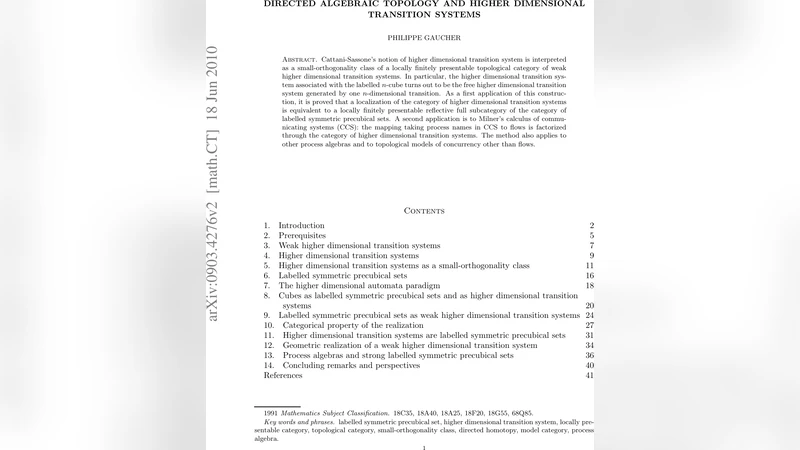
Cattani-Sassone’s notion of higher dimensional transition system is interpreted as a small-orthogonality class of a locally finitely presentable topological category of weak higher dimensional transition systems. In particular, the higher dimensional transition system associated with the labelled n-cube turns out to be the free higher dimensional transition system generated by one n-dimensional transition. As a first application of this construction, it is proved that a localization of the category of higher dimensional transition systems is equivalent to a locally finitely presentable reflective full subcategory of the category of labelled symmetric precubical sets. A second application is to Milner’s calculus of communicating systems (CCS): the mapping taking process names in CCS to flows is factorized through the category of higher dimensional transition systems. The method also applies to other process algebras and to topological models of concurrency other than flows.
💡 Research Summary
The paper provides a comprehensive categorical reconstruction of higher‑dimensional transition systems (HDTS), originally introduced by Cattani and Sassone, and demonstrates how this reconstruction yields new connections with labelled precubical sets, process algebras, and topological models of concurrency.
First, the authors embed the classical notion of HDTS into a broader category of weak higher‑dimensional transition systems (WHDTS). They prove that WHDTS is a locally finitely presentable (LFP) topological category, meaning that every object can be expressed as a filtered colimit of finitely presentable ones. This LFP property is essential for constructing free objects and for applying orthogonality techniques.
Next, they characterize HDTS as a small‑orthogonality class inside WHDTS. Concretely, they fix a set R of regular morphisms (essentially the “generating cofibrations” for the theory) and define an HDTS to be any WHDTS that is orthogonal to every map in R. This definition replaces the original operational rules with a purely categorical condition: an object belongs to the class precisely when it has the right lifting property with respect to the maps in R. As a consequence, HDTS can be described as the class of R‑injective objects, and the usual free‑generation constructions become available.
The authors then focus on the labelled n‑cube, a fundamental example in concurrency theory. They show that the labelled n‑cube is the free HDTS generated by a single n‑dimensional transition. In other words, starting from one n‑cell together with its boundary (the 0‑dimensional states), the orthogonal closure produces exactly the HDTS that models an n‑fold concurrent step. This result illustrates how higher‑dimensional behaviour can be generated from a minimal set of generators within the orthogonal framework.
Having established the orthogonal description, the paper proceeds to localise the HDTS category by formally inverting a class of weak equivalences. The localisation is proved to be equivalent to a reflective full subcategory of the category of labelled symmetric precubical sets. The reflection functor supplies, for any labelled precubical set, a canonical HDTS that captures precisely the concurrent execution information encoded in the set. This equivalence bridges the algebraic world of HDTS with the combinatorial world of precubical sets, allowing techniques from one side (e.g., model‑category arguments on precubical sets) to be transferred to the other.
The second major application concerns Milner’s Calculus of Communicating Systems (CCS). Traditionally, one maps CCS process terms directly to flows (topological spaces equipped with a directed structure). The authors factor this mapping through HDTS: a CCS term is first interpreted as an HDTS (using the operational semantics of CCS to generate transitions of various dimensions), and then the HDTS is sent to a flow via a well‑known “geometric realisation” functor. This factorisation clarifies the role of higher‑dimensional transitions in the semantics of CCS and shows that HDTS serve as an intermediate, algebraically tractable model.
Finally, the authors argue that the same methodology applies to other process algebras such as π‑calculus, CSP, and to other topological models of concurrency like d‑spaces or streams. In each case, the algebraic syntax can be translated into an HDTS, and the resulting HDTS can be realised as a flow or a similar topological object, preserving the essential concurrency information.
Overall, the paper achieves three significant contributions: (1) it recasts HDTS as a small‑orthogonality class in an LFP topological category, (2) it establishes a precise equivalence between a localisation of HDTS and a reflective subcategory of labelled symmetric precubical sets, and (3) it provides a clean factorisation of the CCS‑to‑flow semantics via HDTS, thereby opening the way for systematic extensions to a broad range of concurrent formalisms. The work deepens the categorical foundations of concurrency theory and supplies powerful new tools for relating algebraic, combinatorial, and topological models of concurrent computation.
Comments & Academic Discussion
Loading comments...
Leave a Comment