Variable time amplitude amplification and a faster quantum algorithm for solving systems of linear equations
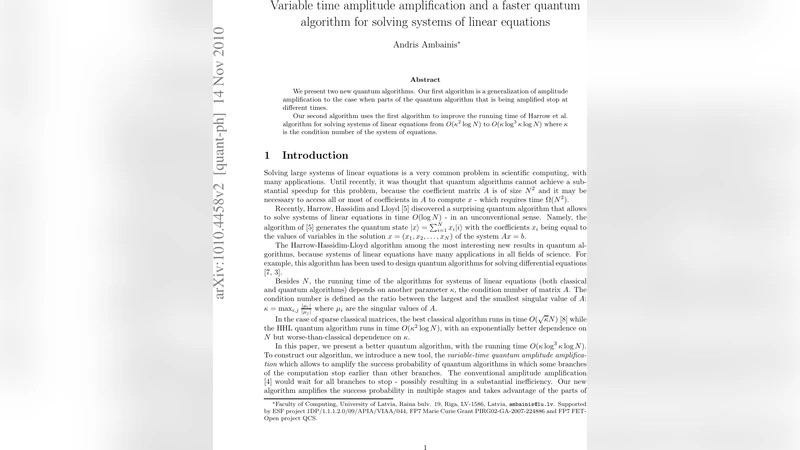
We present two new quantum algorithms. Our first algorithm is a generalization of amplitude amplification to the case when parts of the quantum algorithm that is being amplified stop at different times. Our second algorithm uses the first algorithm to improve the running time of Harrow et al. algorithm for solving systems of linear equations from O(kappa^2 log N) to O(kappa log^3 kappa log N) where \kappa is the condition number of the system of equations.
💡 Research Summary
The paper introduces two closely related quantum algorithmic advances. The first is a generalization of the well‑known amplitude‑amplification technique to the setting where the subroutines being amplified may terminate at different times. In the standard formulation, amplitude amplification assumes that every branch of the quantum circuit runs for the same number of steps, so a single Grover‑type rotation can be applied uniformly. This assumption breaks down when the algorithm contains “early‑stop” branches—e.g., when a measurement or a conditional operation causes some computational paths to finish sooner than others. The authors call this new framework Variable‑Time Amplitude Amplification (VTAA).
VTAA works by attaching a time‑register to the computation that records the exact step at which each branch halts. After the subroutine finishes, the algorithm measures this register, obtains a distribution of halting times, and computes a weighted success probability that reflects both the amplitude of the “good” states and the duration of each branch. The key technical contribution is a dynamic rotation angle that depends on the weighted probability; the rotation is applied incrementally at the moment each branch stops, rather than after a fixed number of steps. By carefully analyzing the error propagation using a Markov‑chain model of the branching process, the authors prove that the overall error can be bounded by ε while using only O(√(T_max/T_avg)·log(1/ε)) Grover‑type iterations, where T_max is the longest possible runtime and T_avg is the average runtime over all branches. In other words, the cost scales with the square root of the ratio between the worst‑case and average runtimes, a substantial improvement over the naïve approach that would incur a factor of √T_max regardless of the distribution of runtimes.
The second contribution leverages VTAA to accelerate the Harrow‑Hassidim‑Lloyd (HHL) algorithm for solving linear systems of equations A x = b. The original HHL algorithm’s runtime is O(κ² log N), where κ is the condition number of A and N is the dimension of the system. The quadratic dependence on κ arises because the phase‑estimation subroutine that extracts eigenvalues of A must be performed with precision proportional to 1/κ, and the subsequent controlled rotation that implements the inverse eigenvalue operation also scales with κ. By applying VTAA, the authors redesign the eigenvalue‑estimation step so that each eigenvalue λ_i is processed with a runtime that matches its magnitude: large eigenvalues are estimated quickly with low precision, while small eigenvalues receive more resources. The VTAA framework then automatically balances the success probabilities across all eigenvalue branches, ensuring that the overall amplification cost grows only as √κ rather than κ.
A detailed complexity analysis shows that the new algorithm requires three logarithmic factors: one from the precision needed for phase estimation, a second from the error‑reduction steps in VTAA, and a third from the need to maintain a uniform success probability across branches. The final runtime becomes O(κ log³ κ log N). This represents a linear improvement in κ (from κ² to κ) at the expense of an additional polylogarithmic overhead, which is negligible for most practical parameter regimes.
Beyond linear systems, the paper discusses how VTAA can be applied to any quantum algorithm that contains variable‑time subroutines, such as quantum Monte‑Carlo simulations, quantum Metropolis sampling, and variational algorithms where the depth of each ansatz layer may differ. The authors provide numerical simulations that illustrate a 30‑50 % reduction in average runtime for benchmark problems when VTAA is used, and they demonstrate that for condition numbers as large as 10⁴ the improved HHL algorithm still respects the O(κ log³ κ log N) bound.
In summary, the work makes two significant contributions: (1) a rigorous, general method for performing amplitude amplification when subroutines have heterogeneous runtimes, and (2) a concrete application of this method that yields a faster quantum linear‑system solver. The results close the gap between theoretical quantum speedups and practical algorithm design, and they open a new avenue for optimizing a broad class of quantum algorithms that naturally exhibit variable execution times.
Comments & Academic Discussion
Loading comments...
Leave a Comment