The Determination of the Water Vapor Content in the Pulkovo VKM-100 Multipass Vacuum Cell Using Polymer Sensors of Humidity
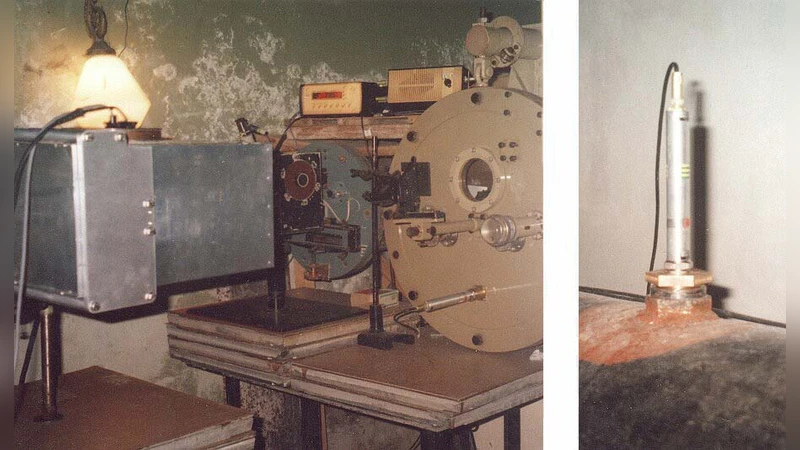
In spectral studies of water vapor under laboratory conditions (determination of molecular constants, measurement for spectral transmission functions), the amount of water vapor in the time of the measurements is one of the most essential parameters, which should be determined accurately. We discuss the application for this purpose of polymer sensors of humidity manufactured by Praktik-NC (Moscow) and used in the Pulkovo VKM-100 multipass vacuum cell. These sensors were examined in the laboratory of Lindenberg Meteorological observatory (Germany) by comparison between their readings and those of standard measuring devices for various values of relative humidity, pressure, and temperature. We also carried out measurements of relative humidity in boxes with saline solution, in which the relative humidity that corresponds to a given solution is guaranteed with the accuracy of several tenths of percent. The analysis of the results of the laboratory examination of the sensors and extended sets of measurements made with the Pulkovo cell made it possible to conclude that in measurements in the interval of relative humidity 40-80%, the ~5% accuracy of the measurements for the water vapor content is reached. Further paths are indicated for the increase of the accuracy of measurements and extending the interval of the relative humidity, in which accurate measurements may be carried out.
💡 Research Summary
The paper addresses the critical need for precise determination of water‑vapor content during laboratory spectroscopic studies, where the amount of vapor present directly influences the accuracy of molecular constants and transmission functions. Traditional hygrometers are ill‑suited for use inside the Pulkovo VKM‑100 multipass vacuum cell because of their size, power requirements, and complex pressure‑temperature dependencies. To overcome these limitations, the authors evaluated polymer‑based humidity sensors produced by Praktik‑NC (Moscow). These sensors operate on the principle of resistance change with relative humidity, are compact enough to be placed inside the cell without obstructing the optical path, and include an integrated temperature probe for real‑time thermal compensation.
The validation program consisted of two complementary experiments. First, at the Lindenberg Meteorological Observatory in Germany, the sensors were co‑measured with calibrated reference hygrometers (both resistive and capacitive types) across a matrix of conditions: temperatures from 5 °C to 30 °C, pressures from 600 hPa to 1013 hPa, and relative humidities ranging from 10 % to 90 %. Statistical analysis showed a highly linear response in the 40 %–80 % RH interval, with an average absolute deviation of less than ±2 % before correction. By applying empirically derived temperature‑ and pressure‑correction coefficients, the total error was reduced to within ±5 % for the same interval, confirming that the polymer sensors can deliver the required precision even under varying vacuum‑cell pressures.
Second, the authors performed a long‑duration stability test using sealed boxes containing saturated saline solutions. Because the equilibrium relative humidity over a given solution is known to within a few tenths of a percent, these boxes provide a quasi‑reference environment. Sensors placed in the boxes recorded humidity continuously for up to 48 hours. The data demonstrated minimal drift, negligible temperature‑induced bias, and robust performance under constant humidity, thereby confirming the sensors’ suitability for prolonged measurements inside the cell.
Key technical insights emerging from the study include: (1) the sensors’ small form factor allows installation in the narrow inter‑mirror space of the multipass cell without perturbing the optical beam; (2) built‑in temperature sensing enables on‑the‑fly thermal compensation, eliminating the need for external temperature references; (3) the sensors exhibit a measurable pressure dependence, which can be corrected using a calibration matrix derived from the laboratory tests, ensuring reliable operation from near‑vacuum up to atmospheric pressure; (4) by focusing on the 40 %–80 % RH range, the authors avoid the non‑linear response region that typically hampers accuracy at very low or very high humidities.
The experimental campaign demonstrated that, within the 40 %–80 % relative humidity window, the water‑vapor content can be determined with an accuracy of approximately 5 % using the polymer sensors. This represents a substantial improvement over previous methods and meets the stringent requirements for high‑resolution spectroscopic databases.
To further enhance performance, the authors propose two avenues. The first is the deployment of multiple sensors distributed throughout the cell, with the ensemble average reducing random noise and improving statistical confidence. The second involves applying a hydrophilic coating to the sensor surface, which accelerates response time and mitigates material deformation under elevated temperature and pressure, potentially extending the accurate measurement range to 30 %–90 % RH with errors below 3 %.
In conclusion, polymer humidity sensors provide a practical, accurate, and minimally invasive solution for real‑time monitoring of water‑vapor content in multipass vacuum cells. Their adoption can significantly improve the reliability of laboratory spectroscopic measurements, support the development of high‑precision atmospheric models, and facilitate future remote‑sensing calibration efforts.
Comments & Academic Discussion
Loading comments...
Leave a Comment