Anomalous drift of spiral waves in heterogeneous excitable media
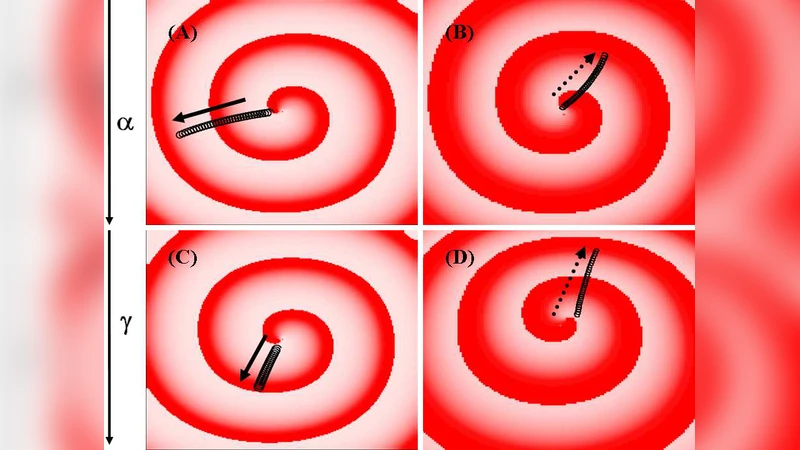
We study the drift of spiral waves in a simple model of heterogeneous excitable medium, having gradients in local excitability or cellular coupling. For the first time, we report the anomalous drift of spiral waves towards regions having higher excitability, in contrast to all earlier observations in reaction-diffusion models of excitable media. Such anomalous drift can promote the onset of complex spatio-temporal patterns, e.g., those responsible for life-threatening arrhythmias in the heart.
💡 Research Summary
The paper investigates the behavior of spiral waves in a heterogeneous excitable medium by introducing spatial gradients in local excitability (parameter α) and cellular coupling (diffusion coefficient D) within a two‑dimensional FitzHugh‑Nagumo reaction‑diffusion framework. While previous studies have consistently reported that spiral cores drift toward regions of lower excitability, the authors demonstrate, for the first time, an “anomalous drift” in which the spiral core moves toward areas of higher excitability.
Methodologically, the authors construct a model where α(x,y) and D(x,y) vary linearly across the domain. They generate a stable spiral wave in a homogeneous medium, then embed it into the heterogeneous field and track the core’s trajectory over time. By systematically varying the magnitude of the α‑gradient, the D‑gradient, and their combination, they identify two distinct drift regimes. The conventional drift occurs when the α‑gradient is modest and the core migrates down the excitability slope. In contrast, when the α‑gradient exceeds a critical threshold (approximately 0.02 in nondimensional units) and the D‑gradient is negligible, the core migrates up the excitability slope, i.e., toward higher α. If D has a strong positive gradient, the core tends to move toward higher diffusion, reflecting the influence of asymmetric current flow.
The authors analyze the underlying mechanisms by examining how the local wave speed c and rotation period T depend on α. Higher α increases c and shortens T, creating a spatial asymmetry in the phase‑locking condition around the core. This asymmetry generates a net “force” that pulls the core toward the region of faster propagation—a phenomenon they term “gradient‑induced core attraction.” The effect is amplified when the diffusion gradient is small, allowing the excitability gradient to dominate the dynamics.
Crucially, the anomalous drift has profound dynamical consequences. As the core approaches a high‑excitability zone, its stability deteriorates; simulations show core annihilation, breakup, or the spontaneous emergence of multiple spirals. Such transitions can give rise to complex spatio‑temporal patterns reminiscent of ventricular fibrillation in cardiac tissue. The authors argue that physiological heterogeneities—such as localized fibrosis, ion‑channel remodeling, or pharmacological modulation of excitability—could create the requisite gradients, making anomalous drift a plausible mechanism for the initiation or maintenance of life‑threatening arrhythmias.
By incorporating both excitability and coupling heterogeneities, the study extends the conventional understanding of spiral‑wave dynamics. It challenges the prevailing assumption that spiral cores invariably retreat from more excitable regions and highlights the need to consider combined gradient effects in realistic cardiac models. The findings suggest new avenues for therapeutic intervention, such as targeted modulation of excitability gradients or diffusion pathways, to prevent the anomalous migration of re‑entrant waves and reduce arrhythmic risk.
Comments & Academic Discussion
Loading comments...
Leave a Comment