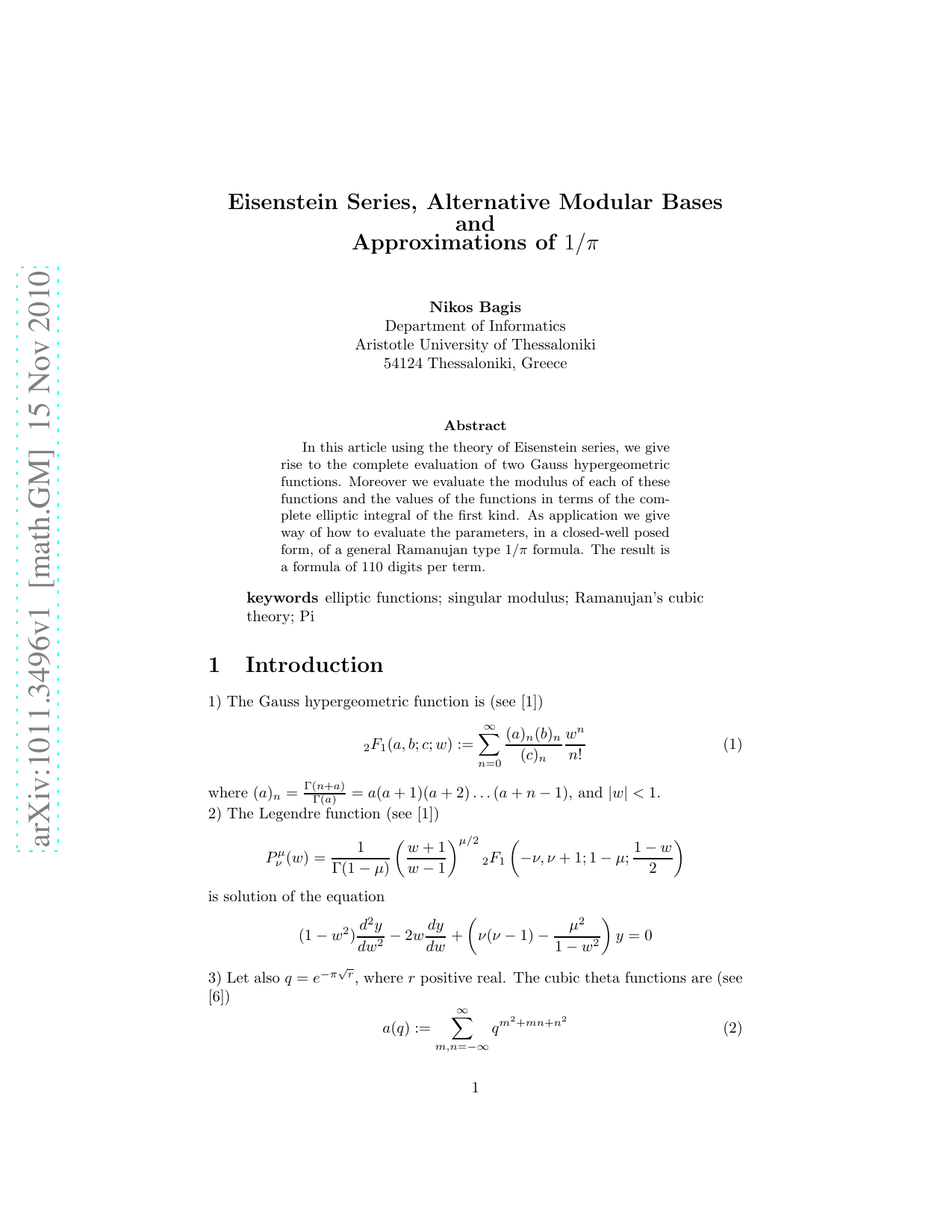
In this article using the theory of Eisenstein series, we give rise to the complete evaluation of two Gauss hypergeometric functions. Moreover we evaluate the modulus of each of these functions and the values of the functions in terms of the complete elliptic integral of the first kind. As application we give way of how to evaluate the parameters, in a closed-well posed form, of a general Ramanujan type $1/\pi$ formula. The result is a formula of 110 digits per term.
Deep Dive into Eisenstein Series, Alternative Modular Bases and Approximations of $1/pi$.
In this article using the theory of Eisenstein series, we give rise to the complete evaluation of two Gauss hypergeometric functions. Moreover we evaluate the modulus of each of these functions and the values of the functions in terms of the complete elliptic integral of the first kind. As application we give way of how to evaluate the parameters, in a closed-well posed form, of a general Ramanujan type $1/\pi$ formula. The result is a formula of 110 digits per term.
1) The Gauss hypergeometric function is (see [1])
where (a) n = Γ(n+a) Γ(a) = a(a + 1)(a + 2) . . . (a + n -1), and |w| < 1.
The Legendre function (see [1])
Let also q = e -π √ r , where r positive real. The cubic theta functions are (see [6])
(2) c(q) := ∞ m,n=-∞ q (m+1/3) 2 +(m+1/3)(n+1/3)+(n+1/3) 2 (3) and the cubic singular modulus is given by
The function
is called cubic elliptic function and is similar in properties to those of the elliptic integral of the first kind K(w) (see [1], [4], [8], [9], [10]):
We set m r to be the solution of
and call the k r = (m r ) 1/2 singular moduli.
As with the elliptic integral K, using the cubic elliptic theory we give evaluations of the singular modulus α r for certain r (see [5], [6]). Also we derive a formula for finding
We also consider and treat with u(w) := P -1/6 (w) = 2 F 1 1 6 , 5 6 ; 1; w as in the cubic case. The β r are solutions of the equation
The cases 2 F 1 1 2 , 1 2 ; 1; w and 2 F 1 1 4 , 3 4 ; 1; w are trivial and easily can studied. Moreover the first is K itself. There are also other hypergeometric functions that can be evaluated with K. For example
Where E is the complete elliptic integral of the second kind.
In most of our results we use Mathematica and in some cases we have no direct proofs.
If we set q 1 = e 2πiτ , τ = √ -r then (see [5],[6]):
where
(10)
or from the Theory of Eisenstein Series holds
where ζ(s) is the Riemann’s Zeta function and B n are the Bernoulli numbers, (see [1], [9]). Hence
Hence
Now using the above relations we have
or Proposition 1.
In the appendix I have construct a table with the Mathematica of a r for r = 1, 2, . . . , 37, and r = 40, 44, 49, 59. We set z 3 := 2 F 1 (1/3, 2/3; 1; α 3r ) and we begin to search relations between F := 2 π K and z, and u.
It is known that (see [4] pg. 456), (here
Hence the number
according to Ramanujan is algebraic, for r positive rational. The function a(r) is called elliptic alpha function (see [8]). Hence because
Proof.
Use (20),( 22)
In [4] chapter 21 one can see a very large number of hidden identities very useful for the evaluation of a(n). More precisely using ( 24) and ( 25) we can evaluate
is the multiplier of the modular equation of n-th degree, in the base K. Examples are (see [4] pg. 460 Entry 3.):
Where m 3 is root of the polynomial
The system of equations:
have solutions (a 3r , z 3 ) which can expressed in radicals of t 1 and t 2 .
Proof.
Use Mathematica to solve the system with the command ‘Solve’. The solution is very complicated to present it here.
Theorem 3.
Note.
For how we arrive to this identity, observe that if q = e -π √ r , then 1 + 240
Example.
u(β 16 ) = √ 2 177 + 1242
Note.
- Relations (a1),( 20),( 21),( 22),( 23) may lead us to the concluding result that exists a number ξ such that 1 -504
n 5 q 2n 1 -q 2n = (1 + ξβ r )u (β r ) 6 .
By setting values one can see that ξ = -2.
- Using the triplication formula for α (see [6])
and in view of Theorem 4 we have if
Also in [6] one can find the 2-degree modular equation for α r which is
3 Ramanujan type 1/π series When q = e 2πiτ , the modular j-invariant is defined by
Also we define
For the a(r) function see relation (25).
Theorem 5.(see [7], [8]) 3) For r = 5 we have
132566687 Some Results. The duplication formula for k r is
For r = 108
For r = 288
For r = 1728 we set
From (31) we have
1/3 and A = 1 + P 3 8(-69 + P ) 3 1/3 then α 216 = P 3 8(69 -P ) 3 and
- From the relations (k432), (a432), (α144) we get
If we set the values J 432 and T 432 in Theorem 5 we get a formula that gives 53 digits per term.
- It is
Set
then from the triplication formula (31) we get
Setting the values of T 1728 and J 1728 in the relation (36) of Theorem 5 we get a formula which gives 110 digits per term. Using the 2,3,5,7 degree modular equations for the cubic base (see [6]) we can evaluate higher order values of α r .
This content is AI-processed based on ArXiv data.