Intrinsic Geometric Analysis of the Network Reliability and Voltage Stability
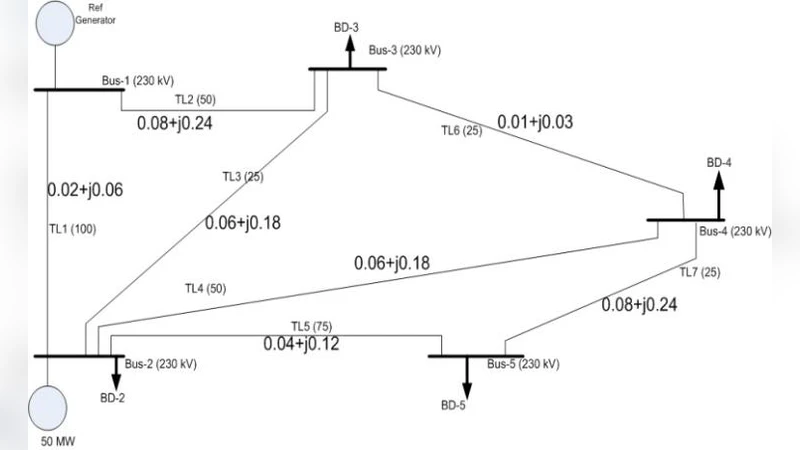
This paper presents the intrinsic geometric model for the solution of power system planning and its operation. This problem is large-scale and nonlinear, in general. Thus, we have developed the intrinsic geometric model for the network reliability and voltage stability, and examined it for the IEEE 5 bus system. The robustness of the proposed model is illustrated by introducing variations of the network parameters. Exact analytical results show the accuracy as well as the efficiency of the proposed solution technique.
💡 Research Summary
The paper introduces an intrinsic geometric framework for addressing the large‑scale, highly nonlinear problems that arise in power‑system planning and operation, specifically focusing on network reliability and voltage stability assessment. Traditional approaches—such as linearized power‑flow approximations, sensitivity matrices, and P‑V curve analyses—often struggle to capture the coupled effects of multiple parameter variations and to provide a unified metric for both reliability and stability. To overcome these limitations, the authors reinterpret the Jacobian of the power‑flow equations as a Riemannian metric on the system’s state space. This metric defines a distance between operating points, reflecting how sensitive the network is to changes in line impedances, loads, and other parameters.
From this metric, the authors derive the full Riemann curvature tensor and its scalar contraction. The scalar curvature serves as a concise indicator of the system’s proximity to instability: positive curvature corresponds to a locally convex, stable region, whereas negative curvature signals a concave region where voltage collapse or other instability mechanisms are imminent. The distance component of the metric, on the other hand, quantifies the overall “reliability distance” – larger distances imply that the current operating point is farther from nominal conditions and that the network is more vulnerable to disturbances.
To validate the methodology, the IEEE 5‑bus test system is employed. The authors construct the Jacobian based on realistic line impedances, bus voltages, and power injections, then compute the metric tensor (g_{ij}) and the associated curvature quantities. Two principal experiment families are examined: (1) incremental increase of a selected line’s reactance, and (2) uniform scaling of total load. In the first scenario, as the reactance surpasses a critical threshold, the scalar curvature abruptly switches from positive to strongly negative, indicating an approaching voltage‑collapse point. In the second scenario, the distance measure grows steadily with load, reflecting a degradation of network reliability. A combined scenario (simultaneous reactance and load increase) demonstrates that the curvature tensor captures the synergistic, nonlinear interaction between parameters—something that separate sensitivity analyses would miss.
The geometric approach offers several practical advantages. Because curvature aggregates multi‑parameter effects into a single scalar, operators receive an early warning signal that is easy to monitor in real time. The distance metric can be directly incorporated into optimization objectives for network reconfiguration, expansion planning, or corrective control, enabling the design of solutions that are inherently robust to parameter fluctuations. Moreover, the framework is mathematically exact; the authors provide closed‑form expressions for the metric and curvature in terms of the Jacobian entries, allowing for analytical insight into how specific network elements influence overall stability.
Nevertheless, the authors acknowledge computational challenges. For large‑scale systems, the Jacobian dimension grows with the number of buses, and evaluating the full curvature tensor involves fourth‑order tensor operations that can become prohibitive. To mitigate this, they propose dimensionality‑reduction techniques such as principal component analysis on the Jacobian and the use of parallel processing architectures to distribute the tensor calculations. They also suggest extending the deterministic model to a stochastic setting to account for renewable generation variability and load uncertainty, which would further enhance the method’s applicability to modern grids.
In conclusion, the paper presents a novel, mathematically rigorous tool that unifies reliability and voltage‑stability assessment under a single geometric lens. By translating the nonlinear power‑flow problem into Riemannian geometry, the authors provide operators and planners with intuitive, quantitative indicators—distance and curvature—that capture both the magnitude of parameter deviations and the system’s intrinsic tendency toward instability. The successful demonstration on the IEEE 5‑bus system validates the approach’s accuracy and computational efficiency, and the discussion of scalability points toward future research that could bring this technique to real‑world, large‑scale transmission and distribution networks. This work therefore represents a significant step toward more resilient and intelligently managed power systems.
Comments & Academic Discussion
Loading comments...
Leave a Comment