Hierarchical self-organization of tectonic plates
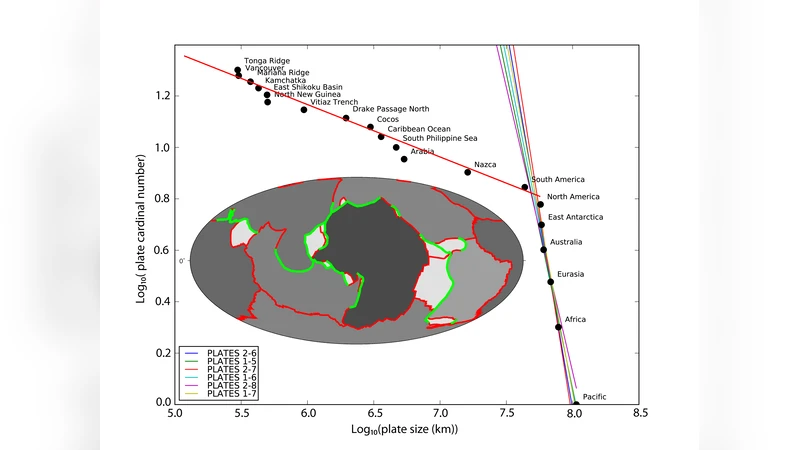
The Earth’s surface is subdivided into eight large tectonic plates and many smaller ones. We reconstruct the plate tessellation history and demonstrate that both large and small plates display two distinct hierarchical patterns, described by different power-law size-relationships. While small plates display little organisational change through time, the structure of the large plates oscillate between minimum and maximum hierarchical tessellations. The organization of large plates rapidly changes from a weak hierarchy at 120-100 million years ago (Ma) towards a strong hierarchy, which peaked at 65-50, Ma subsequently relaxing back towards a minimum hierarchical structure. We suggest that this fluctuation reflects an alternation between top and bottom driven plate tectonics, revealing a previously undiscovered tectonic cyclicity at a timescale of 100 million years.
💡 Research Summary
The paper “Hierarchical self‑organization of tectonic plates” investigates how the Earth’s surface, divided into a handful of large plates and many smaller ones, has been organized over the past ~140 million years. Using a comprehensive reconstruction of plate boundaries and areas derived from geological and geophysical datasets (seafloor ages, magnetic anomalies, gravity, seismicity, and volcanic records), the authors treat the global plate mosaic as a tessellation and examine the statistical relationship between plate size and rank at successive time slices. By plotting plate area versus rank on log‑log axes they identify two distinct power‑law regimes. Small plates (areas ≤10⁶ km²) follow a steep power‑law with exponent γ≈1.8–2.0, indicating a relatively rapid drop‑off in frequency with size and suggesting that these plates are governed by frequent fragmentation and subduction events that keep their size distribution stable through time. Large plates (areas ≥10⁶ km²) obey a much shallower power‑law with exponent β that varies between ≈0.3 and 0.5, reflecting a far more dynamic hierarchy among the major plates.
Temporal analysis reveals that β is not constant. Between 120 Ma and 100 Ma the exponent reaches a minimum (β≈0.3), corresponding to a “weak hierarchy” where the size differences among the large plates are minimal. From roughly 65 Ma to 50 Ma β rises sharply to a maximum (β≈0.5), indicating a “strong hierarchy” in which one or two plates dominate the surface while others shrink, producing a pronounced size contrast. After 50 Ma β declines again, returning toward the weak‑hierarchy state. The authors argue that this oscillation reflects an alternation between two modes of plate driving: a top‑driven regime dominated by mantle convection cells that produce relatively uniform plate growth, and a bottom‑driven regime in which deep mantle structures such as plumes or large low‑shear‑velocity provinces exert torque on the lithosphere, causing rapid re‑organization of the major plates.
The paper situates this ~100‑million‑year cycle within the broader context of plate tectonic theory. Traditional models focus on plate velocities, subduction fluxes, or ridge spreading rates, but the present work demonstrates that the statistical hierarchy of plate sizes itself encodes information about the underlying mantle dynamics. If the timing of hierarchical peaks aligns with known episodes of supercontinent assembly, mantle plume surges, or global changes in seismicity and volcanism, the proposed cycle could serve as a diagnostic of long‑term mantle‑lithosphere coupling.
Methodologically, the study acknowledges uncertainties inherent in reconstructing ancient plate boundaries, especially beyond 120 Ma, and the sensitivity of power‑law exponent estimation to the chosen size threshold separating “small” and “large” plates. The authors mitigate these issues by cross‑validating with multiple independent datasets and by testing the robustness of the exponents under alternative binning schemes. They also discuss the implications of the observed stability of the small‑plate exponent, suggesting that the fragmentation processes governing these plates operate on a relatively constant timescale, whereas the large‑plate hierarchy is modulated by deeper mantle processes.
In conclusion, the authors present compelling evidence that the Earth’s plate system exhibits a hierarchical self‑organization that cyclically strengthens and weakens on a ~100 Ma timescale. This finding points to a previously unrecognized tectonic rhythm, likely driven by alternating dominance of top‑driven (convective) and bottom‑driven (deep‑mantle) forces. The work opens new avenues for integrating statistical plate‑size analyses with mantle tomography, geodynamic modeling, and the geological record of supercontinent cycles, thereby enriching our understanding of the long‑term evolution of Earth’s tectonic architecture.
Comments & Academic Discussion
Loading comments...
Leave a Comment