Importance of Meridional Circulation in Flux Transport Dynamo: The Possibility of a Maunder-like Grand Minimum
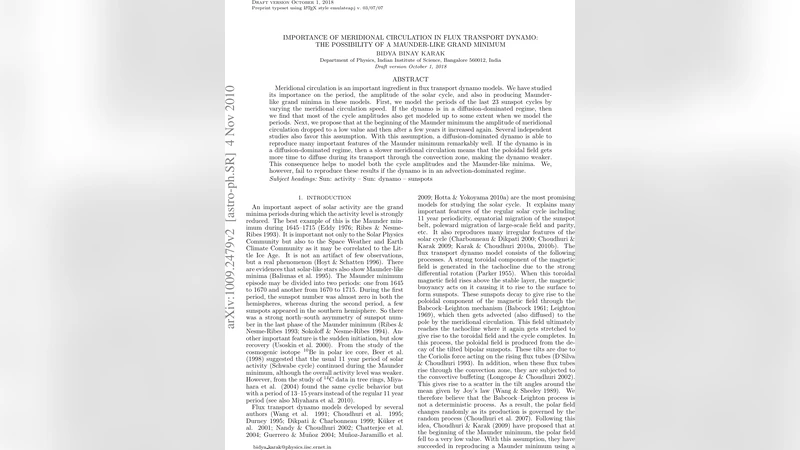
Meridional circulation is an important ingredient in flux transport dynamo models. We have studied its importance on the period, the amplitude of the solar cycle, and also in producing Maunder-like grand minima in these models. First, we model the periods of the last 23 sunspot cycles by varying the meridional circulation speed. If the dynamo is in a diffusion-dominated regime, then we find that most of the cycle amplitudes also get modeled up to some extent when we model the periods. Next, we propose that at the beginning of the Maunder minimum the amplitude of meridional circulation dropped to a low value and then after a few years it increased again. Several independent studies also favor this assumption. With this assumption, a diffusion-dominated dynamo is able to reproduce many important features of the Maunder minimum remarkably well. If the dynamo is in a diffusion-dominated regime, then a slower meridional circulation means that the poloidal field gets more time to diffuse during its transport through the convection zone, making the dynamo weaker. This consequence helps to model both the cycle amplitudes and the Maunder-like minima. We, however, fail to reproduce these results if the dynamo is in an advection-dominated regime.
💡 Research Summary
The paper investigates the pivotal role of meridional circulation in flux‑transport dynamo models of the Sun, focusing on its influence on the solar cycle period, amplitude, and the occurrence of Maunder‑like grand minima. The authors first attempt to reproduce the periods of the last 23 sunspot cycles (spanning roughly 1749–2008) by varying only the meridional flow speed for each cycle. They find that when the dynamo operates in a diffusion‑dominated regime—where the poloidal field generated at the surface diffuses through the convection zone before being advected to the tachocline—the model can match the observed periods and, to a notable extent, the observed cycle amplitudes. In this regime, a slower meridional flow gives the poloidal field more time to diffuse, weakening the toroidal field that fuels the next sunspot cycle; consequently, longer periods are accompanied by reduced amplitudes, a pattern that mirrors the historical record. By contrast, in an advection‑dominated regime, where the flow transports magnetic flux more efficiently than diffusion, changing the flow speed has little impact on amplitude and fails to reproduce the observed period‑amplitude relationship.
Building on this result, the authors propose a simple scenario for the onset of the Maunder Minimum (1645‑1715): the meridional circulation speed dropped abruptly to a low value at the beginning of the minimum, remained reduced for several years, and then gradually recovered. Independent reconstructions of solar activity and geomagnetic indices support the plausibility of a temporary slowdown in the large‑scale flow. When this hypothesis is implemented in a diffusion‑dominated dynamo model, the simulation reproduces several hallmark features of the Maunder Minimum: a dramatic drop in sunspot numbers, pronounced hemispheric asymmetry, a prolonged period of weak magnetic activity, and a relatively rapid resurgence once the flow speed returns to normal. The underlying physics is straightforward—during the low‑flow interval the poloidal field experiences extended diffusion, losing a substantial fraction of its strength before it can be sheared into toroidal field, thereby suppressing the next cycle’s sunspot production. The model also captures the observed gradual recovery of activity after the minimum, as the restored flow shortens the diffusion time and allows the dynamo to regain strength.
Conversely, when the same low‑flow scenario is applied to an advection‑dominated dynamo, the model does not generate a deep minimum; the toroidal field remains sufficiently strong because advection dominates over diffusion, preventing the required field decay. This failure underscores that the diffusion‑dominated regime is essential for reproducing grand‑minimum‑type behavior within the flux‑transport framework.
The study’s conclusions have several implications. First, they reinforce the notion that meridional circulation is a primary control parameter for long‑term solar variability, capable of modulating both cycle length and amplitude. Second, they suggest that modest variations in flow speed—well within the range inferred from helioseismic measurements—can trigger profound changes in solar magnetism, including the emergence of grand minima. Third, the work provides a physically grounded mechanism that can be incorporated into solar‑activity forecasts and into stellar dynamo models for other Sun‑like stars, where similar transport processes may operate. Finally, the authors highlight the need for further work to delineate the precise boundary between diffusion‑ and advection‑dominated regimes, possibly through high‑resolution three‑dimensional magnetohydrodynamic simulations and more detailed observational constraints on the temporal evolution of meridional flow.
Comments & Academic Discussion
Loading comments...
Leave a Comment