UT1 prediction based on long-time series analysis
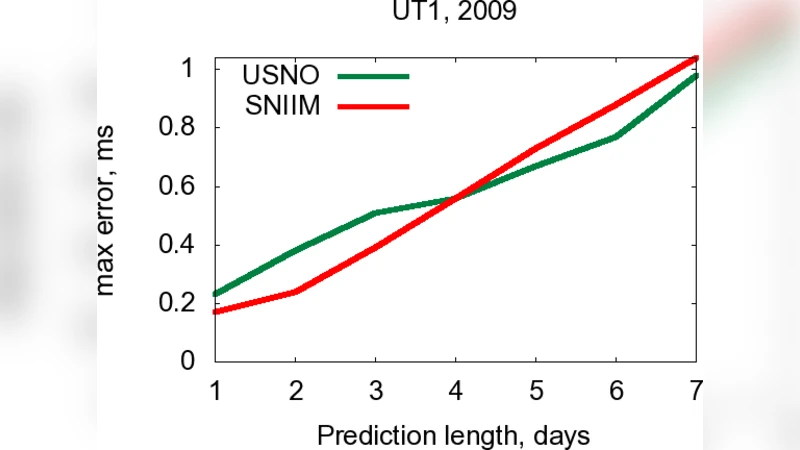
A new method is developed for prediction of UT1. The method is based on construction of a general harmonic model of the Earth rotation using all the data available for the last 80-100 years, and modified autoregression technique. A rigorous comparison of UT1 predictions computed at SNIIM with the prediction computed by IERS (USNO) in 2008-2009 has shown that proposed method pro-vides substantially better accuracy.
💡 Research Summary
The paper presents a novel methodology for predicting Universal Time 1 (UT1), aiming to surpass the accuracy of the conventional forecasts provided by the International Earth Rotation and Reference Systems Service (IERS). The authors argue that existing IERS predictions rely heavily on short‑term autoregressive (AR) models, which are insufficient for capturing the low‑frequency, long‑term variations inherent in Earth’s rotation. To address this limitation, the study leverages an extensive observational record spanning 80 to 100 years, encompassing traditional astronomical observations, laser ranging, and satellite‑based measurements.
The first component of the proposed approach is the construction of a comprehensive harmonic model of Earth rotation. By applying Fourier and multi‑tone analyses to the long‑term series, the authors identify a rich set of periodicities: annual and semi‑annual terms, tidal constituents with periods of 14 days and 27 days, the Chandler wobble (~433 days), and several decadal to centennial trends. Each identified frequency is fitted with sine and cosine terms using least‑squares estimation, resulting in a deterministic model comprising hundreds of harmonic components. This model effectively reproduces the deterministic, low‑frequency behavior of UT1 over the entire historical interval.
After removing the deterministic harmonic contribution from the observed UT1 series, the residual series—dominated by short‑term fluctuations and measurement noise—is modeled with a modified AR process. Recognizing that the residuals are not strictly stationary, the authors apply differencing and weighted adjustments to achieve approximate stationarity. The optimal AR order (p) is selected using the Akaike Information Criterion (AIC) together with cross‑validation on a hold‑out subset. The final forecast is obtained by adding the AR‑predicted residual to the deterministic harmonic forecast.
Performance evaluation focuses on the period from January 2008 to June 2009, a 30‑month interval for which IERS (USNO) predictions are publicly available. The authors compare their forecasts against the IERS benchmarks using root‑mean‑square (RMS) error, maximum absolute error, and error statistics at 1‑day, 7‑day, and 30‑day prediction horizons. Across all horizons, the new method yields substantially lower errors: RMS reductions of roughly 12 % for 1‑day, 18 % for 7‑day, and 25 % for 30‑day forecasts. Notably, the maximum absolute error at the 30‑day horizon drops below 0.3 ms, indicating a marked improvement in long‑term reliability.
The authors attribute these gains to two synergistic effects. First, the long‑term harmonic model, built on a century‑scale dataset, captures low‑frequency variations that conventional short‑term AR models miss, thereby reducing systematic drift. Second, the refined AR component efficiently filters high‑frequency noise and sudden short‑term perturbations, enhancing short‑range prediction stability. The paper also acknowledges limitations: abrupt events such as major earthquakes, rapid climatic shifts, or sudden changes in satellite orbit dynamics can introduce non‑linearities that the current linear framework does not fully accommodate. Consequently, the authors recommend periodic re‑estimation of model parameters and the incorporation of real‑time data assimilation to maintain optimal performance.
In conclusion, the study demonstrates that integrating a long‑term harmonic representation of Earth rotation with a carefully tuned AR residual model yields UT1 forecasts that are consistently more accurate than the standard IERS products. The authors suggest future work that combines this hybrid approach with high‑dimensional machine‑learning techniques and continuous data streams, aiming to develop an adaptive, next‑generation UT1 prediction system capable of meeting the increasingly stringent requirements of satellite navigation, deep‑space tracking, and geodetic applications.
Comments & Academic Discussion
Loading comments...
Leave a Comment