The Web Monoid and Opetopic Sets
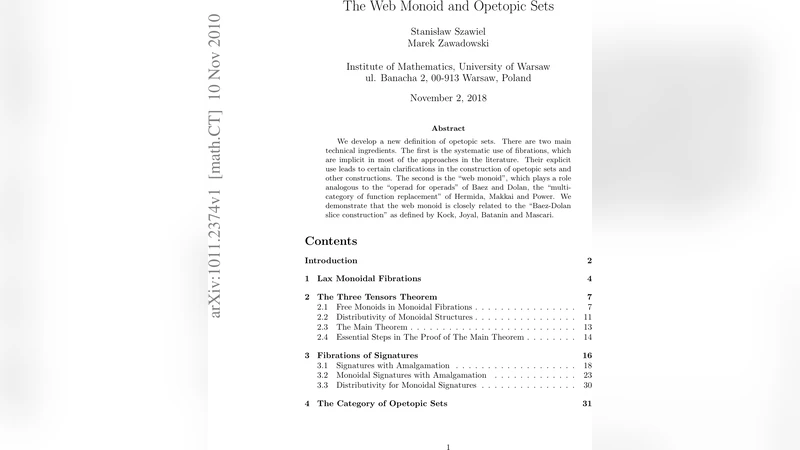
We develop a new definition of opetopic sets. There are two main technical ingredients. The first is the systematic use of fibrations, which are implicit in most of the approaches in the literature. Their explicit use leads to certain clarifications in the construction of opetopic sets and other constructions. The second is the “web monoid”, which plays a role analogous to the “operad for operads” of Baez and Dolan, the “multicategory of function replacement” of Hermida, Makkai and Power. We demonstrate that the web monoid is closely related to the “Baez-Dolan slice construction” as defined by Kock, Joyal, Batanin and Mascari.
💡 Research Summary
This paper presents a fresh, category‑theoretic formulation of opetopic sets, built around two central technical innovations: the explicit use of fibrations and the introduction of the “web monoid.”
First, the authors observe that most existing constructions of opetopic sets implicitly rely on a fibration— a functor p : E → B that organizes higher‑dimensional cells as objects varying over a base category. By making this fibration explicit, they obtain a clean separation between the base of shapes (the “opetopic tower”) and the total category of cells. The fibration supplies two fundamental operations: reindexing (pullback) and pushforward, which together control substitution, composition, and dimension‑raising in a uniform way. This explicit framework clarifies many subtle coherence conditions that are otherwise hidden in ad‑hoc definitions.
The second innovation is the definition of the web monoid M. M is a single monoid object whose multiplication encodes the “web” of connections among cells of all dimensions. Concretely, M carries a unit, an associative binary operation, and a family of “web patterns” that describe how n‑cells can be glued along (n‑1)‑faces. The authors prove that M plays the same universal role as Baez‑Dolan’s “operad for operads” and as Hermida‑Makkai‑Power’s “multicategory of function replacement.” In other words, the web monoid simultaneously captures operadic substitution and multicategorical function‑replacement in a single algebraic structure.
A substantial part of the paper is devoted to relating the web monoid to the Baez‑Dolan slice construction as formulated by Kock, Joyal, Batanin, and Mascari. The slice construction builds, from a given operad O, a new operad O⁄S by slicing over a module S. The authors show that this process can be reproduced internally by the multiplication and unit of M: the slice operad is precisely the free M‑algebra generated by the appropriate module. Consequently, the slice construction, which traditionally requires a separate categorical machinery, is subsumed by the algebra of the web monoid.
Beyond the theoretical equivalences, the paper discusses several implications. In higher‑dimensional type theory, the explicit fibration makes it straightforward to model dependent types that vary with dimension, while the web monoid provides a compact syntax for higher‑order substitution. In computer‑science applications, such as proof assistants or homotopy‑type‑theoretic programming languages, the web monoid could serve as the backbone for representing and manipulating higher‑dimensional operations in a computationally tractable way.
Overall, the work delivers a more transparent, algebraically unified account of opetopic sets, showing how fibrations and the web monoid together simplify constructions, clarify coherence, and connect disparate approaches in the literature. This synthesis opens the door to new implementations of higher‑category structures in both mathematics and computer science.
Comments & Academic Discussion
Loading comments...
Leave a Comment