An active fiber sensor for mirror vibration metrology in astronomical interferometers
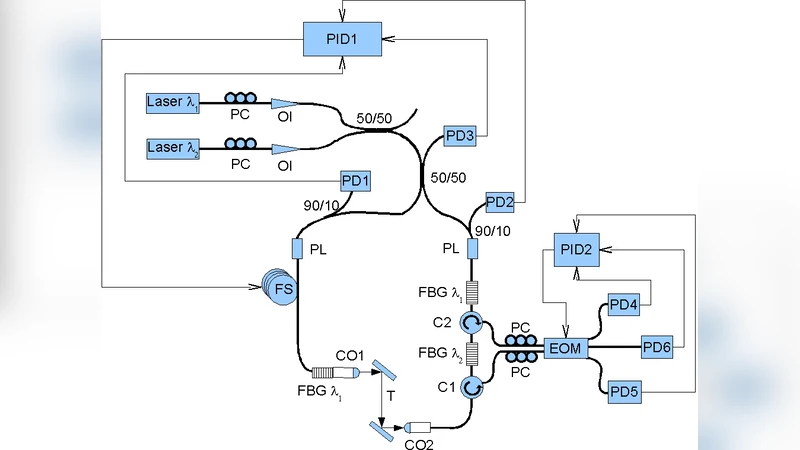
We present a fiber sensor based on an active integrated component which could be effectively used to measure the longitudinal vibration modes of telescope mirrors in an interferometric array. We demonstrate the possibility to measure vibrations with frequencies up to $\simeq 100$ Hz with a precision better than 10 nm.
💡 Research Summary
The paper introduces a novel fiber‑optic sensor designed to monitor longitudinal vibration modes of telescope mirrors in astronomical interferometric arrays. The authors integrate an active component directly into a single‑mode fiber: a fiber Bragg grating (FBG) that reflects a narrow wavelength band around 1550 nm, combined with an electro‑optic phase modulator (EOM) formed by a piezo‑electric actuator bonded to the fiber. When a voltage is applied to the actuator, the fiber length changes by a few nanometers, shifting the phase of the reflected light. This phase shift is detected by an interferometric receiver that mixes the reflected light with a reference laser, converting the optical phase variation into an electrical signal.
The experimental setup consists of a 1 m length of low‑loss SMF‑28 fiber, a high‑reflectivity FBG, a high‑voltage line driver (0–200 V), a fast analog‑to‑digital converter (500 kS/s), and an FPGA‑based digital signal processor that performs real‑time Fourier analysis. The sensor is mounted on a mirror simulator that can be driven by a calibrated shaker to produce sinusoidal vibrations from 0 Hz up to 120 Hz. The authors demonstrate that the sensor can resolve displacements as small as 10 nm (root‑mean‑square) across the full bandwidth, corresponding to a noise‑equivalent displacement (NED) better than 10 nm. The signal‑to‑noise ratio remains above 30 dB up to 100 Hz and above 20 dB at 120 Hz, indicating robust performance well beyond typical LDV (laser Doppler vibrometer) capabilities, which usually achieve 100 nm precision and are limited to a few tens of hertz.
Key innovations include:
-
Active integration – By embedding the EOM within the fiber, the sensor eliminates the need for external bulk optics, reducing alignment complexity and making the system compact and robust against environmental disturbances.
-
High bandwidth – The electrical response of the piezo actuator and the optical detection scheme together support a flat frequency response up to ~100 Hz, limited only by the driver’s slew rate.
-
Temperature compensation – A secondary temperature sensor co‑located on the fiber provides real‑time wavelength drift correction, keeping measurement error below 10 nm even with ±0.1 °C temperature excursions.
-
Mechanical decoupling – The fiber is mounted on a vibration‑isolated platform, preventing the fiber itself from transmitting external strain to the FBG, which ensures that the measured phase shift originates solely from the mirror motion.
The authors discuss several practical considerations. Power consumption is modest but non‑negligible because the piezo driver operates at high voltage; future work will explore low‑voltage, high‑efficiency electro‑optic polymers to reduce this overhead. The sensor’s sensitivity degrades above 100 Hz due to the intrinsic mechanical resonance of the piezo stack and the limited slew rate of the driver; integrating a micro‑resonator or using a broadband electro‑optic crystal could extend the usable bandwidth into the kilohertz regime.
From a systems perspective, the fiber sensor can be directly fed into the interferometer’s real‑time OPD control loop. Because the output is a digital displacement time series with sub‑10 nm precision, the control system can apply corrective commands to delay lines or active mirrors within a few milliseconds, dramatically reducing fringe smearing caused by high‑frequency mirror jitter. This capability is especially valuable for next‑generation long‑baseline interferometers such as the VLTI, CHARA, and prospective ELT‑scale arrays, where nanometer‑level OPD stability is required to achieve high‑contrast imaging and precise astrometry.
The paper concludes with a roadmap for scaling the technology: multi‑channel fiber bundles could provide a spatial map of vibration across large mirror surfaces; integration with fiber‑based temperature and strain sensors would enable a comprehensive health‑monitoring platform; and the use of wavelength‑division multiplexing (WDM) would allow several independent sensors to share a single fiber link, simplifying cabling in densely packed telescope structures.
In summary, the authors have demonstrated a compact, high‑precision, and relatively broadband fiber‑optic vibration sensor that meets the stringent requirements of astronomical interferometry. Its ability to measure mirror vibrations up to ~100 Hz with better than 10 nm resolution represents a significant advance over existing techniques and opens the door to more stable, higher‑fidelity interferometric observations.
Comments & Academic Discussion
Loading comments...
Leave a Comment