Spectral properties of gas-phase condensed fullerene-like carbon nanoparticles from far-ultraviolet to infrared wavelengths
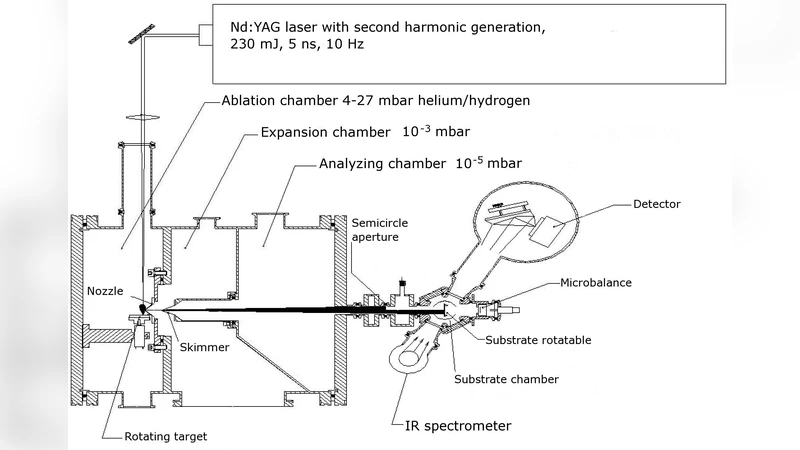
Carbon solids are ubiquitous material in the interstellar space. However, the formation pathway of carbonaceous matter in astrophysical environments as well as in terrestrial gas-phase condensation reactions is not yet understood. Laser ablation of graphite in different quenching gas atmospheres such as pure He, He/H$_2$, and He/H$_2$O at varying pressures is used to synthesize very small, fullerene-like carbon nanoparticles. The particles are characterized by very small diameters between 1 and 4 nm and a disturbed onion-like structure. The soot particles extracted from the condensation zone obviously represent a very early stage of particle condensation. The spectral properties have been measured from the far-ultraviolet (FUV) ($\lambda$=120 nm) to the mid-infrared (MIR) ($\lambda$=15 ~$\mu$m). The seed-like soot particles show strong absorption bands in the 3.4 ~$\mu$m range. The profile and the intensity pattern of the 3.4 ~$\mu$m band of the diffuse interstellar medium can be well reproduced by the measured 3.4 ~$\mu$m profile of the condensed particles, however, all the carbon which is left to form solids is needed to fit the intensity of the interstellar bands. In contrast to the assumption that onion-like soot particles could be the carrier of the interstellar ultraviolet (UV) bump, our very small onion-like carbon nanoparticles do not show distinct UV bands due to ($\pi-\pi$*) transitions.
💡 Research Summary
The paper investigates the formation and optical properties of ultra‑small, fullerene‑like carbon nanoparticles that may serve as analogues of interstellar carbonaceous dust. Using pulsed laser ablation of a graphite target, carbon vapour was generated and rapidly quenched in three different gas atmospheres: pure helium, helium‑hydrogen mixtures, and helium‑water mixtures, each at pressures ranging from 0.1 to 1 bar. Transmission electron microscopy revealed that the resulting particles are extremely small (1–4 nm in diameter) and possess a disturbed onion‑like (multi‑shell) morphology. The shells are irregular, contain numerous defects, and the particles appear to represent an early condensation stage rather than fully developed, well‑ordered fullerenes.
Broadband spectroscopy was performed from the far‑ultraviolet (120 nm) through the mid‑infrared (15 µm). The most striking feature is a strong absorption band near 3.4 µm (≈2950 cm⁻¹), which corresponds to aliphatic C–H stretching vibrations. The laboratory band profile—peak position, width, and sub‑structure—matches the diffuse interstellar medium (DISM) 3.4 µm feature remarkably well. This suggests that such nano‑soot particles could be realistic carriers of the interstellar aliphatic hydrocarbon signature. However, when the absolute intensity is considered, the laboratory sample accounts for only a small fraction of the total carbon budget required to reproduce the interstellar band strength; essentially all available carbon would need to be locked into solid form to match the observed intensity.
In contrast to the long‑standing hypothesis that onion‑type carbon grains are responsible for the prominent interstellar ultraviolet extinction bump at 217.5 nm, the measured UV–visible spectra of these ultra‑small particles show no distinct π–π* resonance. The lack of a sharp UV feature is attributed to quantum‑size effects: when particle dimensions fall below ~5 nm, electronic states become strongly confined, leading to a broad, featureless absorption background rather than a discrete transition. Even the samples prepared in He/H₂O, which contain some oxygen and display weak C=O vibrational bands in the infrared, do not exhibit any UV bump.
The authors conclude that (1) sub‑5 nm fullerene‑like carbon nanoparticles can faithfully reproduce the 3.4 µm aliphatic band of the interstellar medium, supporting a scenario where early‑stage soot particles contribute to the observed hydrocarbon absorption; (2) such particles are unlikely to be the carriers of the UV extinction bump, implying that larger, more ordered carbon structures—or perhaps different materials altogether—are needed to explain that feature; and (3) the experimental approach provides a valuable laboratory analogue for studying the earliest stages of carbon dust condensation under astrophysical conditions.
Future work is suggested to monitor the evolution of particle size and structure during controlled growth, to compare the spectra of larger onion‑type grains with the UV bump, and to simulate low‑temperature, low‑pressure interstellar environments over longer timescales. This would help bridge the gap between laboratory‑produced nano‑soot and the mature carbonaceous grains observed throughout the galaxy.
Comments & Academic Discussion
Loading comments...
Leave a Comment