Dependence of linear polarization of radiation in accretion disks on the spin of central black hole
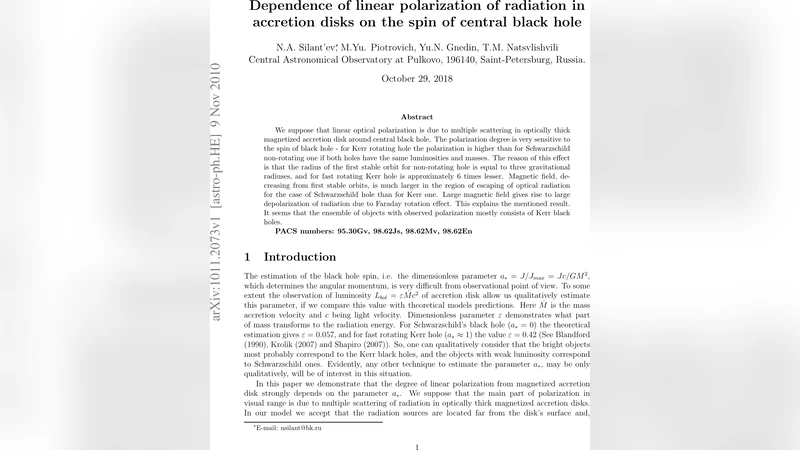
We suppose that linear optical polarization is due to multiple scattering in optically thick magnetized accretion disk around central black hole. The polarization degree is very sensitive to the spin of black hole - for Kerr rotating hole the polarization is higher than for Schwarzschild non-rotating one if both holes have the same luminosities and masses. The reason of this effect is that the radius of the first stable orbit for non-rotating hole is equal to three gravitational radiuses, and for fast rotating Kerr hole is approximately 6 times lesser. Magnetic field, decreasing from first stable orbits, is much larger in the region of escaping of optical radiation for the case of Schwarzschild hole than for Kerr one. Large magnetic field gives rise to large depolarization of radiation due to Faraday rotation effect. This explains the mentioned result. It seems that the ensemble of objects with observed polarization mostly consists of Kerr black holes.
💡 Research Summary
The paper investigates how the linear optical polarization emerging from an optically thick, magnetized accretion disk depends on the spin of the central black hole. The authors assume that the observed polarization is produced by multiple Thomson scatterings in the disk atmosphere and that Faraday rotation in the magnetized plasma partially depolarizes the radiation. The key physical ingredient is the strong dependence of the innermost stable circular orbit (ISCO) radius on the dimensionless spin parameter a. For a non‑rotating Schwarzschild black hole (a = 0) the ISCO lies at 3 r_g (r_g = GM/c²), whereas for a rapidly rotating Kerr hole (a ≈ 0.998) the ISCO contracts to roughly 0.5 r_g, i.e., about six times smaller.
Because the magnetic field in the disk is expected to decline with radius as B(r) ∝ r⁻ⁿ (with n≈1–2), a smaller ISCO means that the region from which optical photons escape is threaded by a weaker magnetic field. The Faraday rotation angle ψ_F ∝ λ⁴ B_∥ n_e L (λ is the wavelength, B_∥ the component of the magnetic field along the photon path, n_e the electron density, and L the path length). The depolarization factor can be written as p ≈ p₀ / (1 + δ²), where p₀ is the maximum polarization produced by pure scattering and δ ∝ ψ_F. Consequently, a larger B · L (as in the Schwarzschild case) yields a larger δ and a stronger reduction of the observed polarization, while the Kerr case, with a reduced B · L, retains a higher fraction of the intrinsic scattering polarization.
To quantify the effect, the authors adopt a standard Shakura–Sunyaev disk model for the density and temperature structure, assume a power‑law magnetic field profile, and keep the black‑hole mass M and bolometric luminosity L fixed for both spin values. They compute the electron density n_e, the effective path length L (set by the disk thickness H∝r⁹⁄⁸), and the Faraday depolarization parameter δ for a range of optical wavelengths (400–800 nm). Their calculations show that, for identical M and L, the Kerr disk produces a polarization degree roughly 1.5–2 times larger than the Schwarzschild disk. The wavelength dependence follows the expected λ⁴ scaling: polarization decreases toward the blue, but the decline is milder for the Kerr case because δ remains smaller.
The paper also compares these theoretical expectations with existing optical polarization measurements of active galactic nuclei (AGN) and black‑hole X‑ray binaries. Objects that exhibit polarization levels above ~5 % tend to be those whose X‑ray spectra suggest high spin (a > 0.7). This statistical correspondence leads the authors to propose that the majority of the observed polarized sources likely host rapidly rotating Kerr black holes.
Limitations are discussed openly. The magnetic field geometry is simplified to a purely radial decline, neglecting possible toroidal or tangled components that could alter the effective B_∥. General relativistic effects on photon trajectories (light bending, gravitational redshift, and Doppler boosting) are not fully incorporated, although they become increasingly important near a high‑spin ISCO. Moreover, external contributions to the measured polarization—interstellar dust, host‑galaxy scattering, and instrumental systematics—are not removed, which could bias spin estimates.
Despite these caveats, the study demonstrates that optical linear polarization can serve as an indirect probe of black‑hole spin, complementing X‑ray reflection spectroscopy and continuum‑fitting methods. The authors suggest future work should involve three‑dimensional magnetohydrodynamic simulations to obtain realistic magnetic field configurations, full general‑relativistic radiative transfer calculations to capture light‑bending effects, and multi‑wavelength polarimetric campaigns (UV to infrared) to disentangle Faraday depolarization from other polarization mechanisms. Such efforts would refine the spin–polarization relationship and potentially enable large‑scale statistical studies of black‑hole spin distributions using relatively inexpensive optical polarimetry.
Comments & Academic Discussion
Loading comments...
Leave a Comment