An Optimization-Based Framework for Automated Market-Making
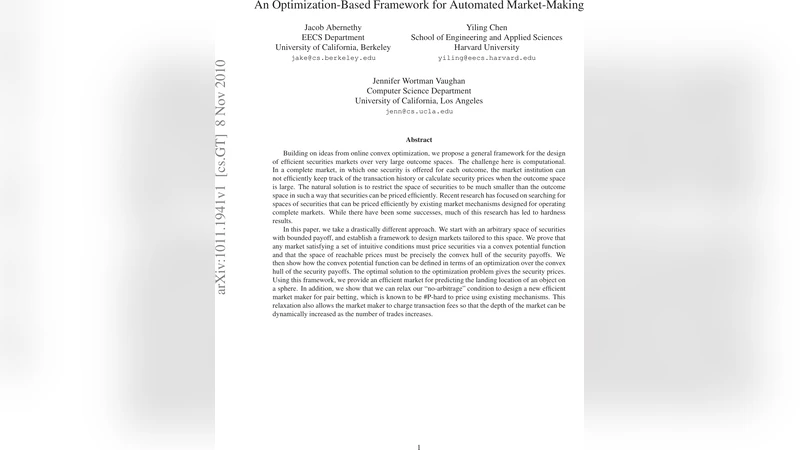
Building on ideas from online convex optimization, we propose a general framework for the design of efficient securities markets over very large outcome spaces. The challenge here is computational. In a complete market, in which one security is offered for each outcome, the market institution can not efficiently keep track of the transaction history or calculate security prices when the outcome space is large. The natural solution is to restrict the space of securities to be much smaller than the outcome space in such a way that securities can be priced efficiently. Recent research has focused on searching for spaces of securities that can be priced efficiently by existing mechanisms designed for complete markets. While there have been some successes, much of this research has led to hardness results. In this paper, we take a drastically different approach. We start with an arbitrary space of securities with bounded payoff, and establish a framework to design markets tailored to this space. We prove that any market satisfying a set of intuitive conditions must price securities via a convex potential function and that the space of reachable prices must be precisely the convex hull of the security payoffs. We then show how the convex potential function can be defined in terms of an optimization over the convex hull of the security payoffs. The optimal solution to the optimization problem gives the security prices. Using this framework, we provide an efficient market for predicting the landing location of an object on a sphere. In addition, we show that we can relax our “no-arbitrage” condition to design a new efficient market maker for pair betting, which is known to be #P-hard to price using existing mechanisms. This relaxation also allows the market maker to charge transaction fees so that the depth of the market can be dynamically increased as the number of trades increases.
💡 Research Summary
The paper tackles the computational bottleneck that plagues automated market makers (AMMs) when the outcome space is large. In a traditional complete market each possible outcome is represented by its own security, which makes tracking trades and computing prices infeasible for high‑dimensional or continuous outcome domains. Prior work has therefore tried to find small subsets of securities that can still be priced by mechanisms designed for complete markets (e.g., LMSR). While there are isolated successes, most attempts lead to hardness results (NP‑hard, #P‑hard) because the pricing problem inherits the complexity of the underlying outcome space.
Instead of searching for “compatible” security spaces, the authors adopt a top‑down approach: they start with an arbitrary, bounded‑payoff security space chosen by the market designer and ask what kind of market maker can be built around it. By formalizing a handful of intuitive market axioms—no‑arbitrage, price continuity, trade feasibility, and the requirement that prices lie within the convex hull of security payoffs—they prove two fundamental theorems.
-
Convex Potential Theorem: Any market satisfying the axioms must price securities through the gradient of a convex potential function φ. In other words, the price vector p is given by p = ∇φ(θ) where θ encodes the market state (e.g., the vector of outstanding shares). This result generalizes the well‑known Logarithmic Market Scoring Rule (LMSR), which corresponds to a specific choice φ(θ)=b·log(∑_i e^{θ_i}).
-
Reachable Price Set Theorem: The set of all attainable price vectors is exactly the convex hull of the payoff vectors of the chosen securities. Consequently, any price that can be realized must be a convex combination of the securities’ payoffs, and conversely every point in that convex hull can be achieved by an appropriate market state.
These theorems reduce the pricing problem to a convex optimization: given a market state θ, the market maker solves
min_{x ∈ Conv(P)} φ(x) – θ·x
where Conv(P) denotes the convex hull of the payoff vectors. Because φ is convex and the feasible region is a polytope (or a more general convex set), standard polynomial‑time algorithms (interior‑point methods, gradient descent, mirror descent, etc.) can compute the optimal x, which directly yields the security prices.
To demonstrate practicality, the authors present two case studies.
Case Study 1 – Predicting a Landing Location on a Sphere
The outcome space is the continuous surface of a sphere, an infinite set. The designers introduce a small set of linear securities that report the Cartesian coordinates of the landing point. The payoff vectors of these securities span the sphere’s surface, so their convex hull is the entire sphere. Solving the convex program yields a price vector that corresponds to the market’s current belief about the expected landing coordinates. Simulations show rapid convergence of prices toward the true location as trades accumulate, while computational effort remains modest compared to a naïve complete‑market implementation.
Case Study 2 – Pair‑Betting Market
In pair betting, traders wager on which of two events will occur first. Pricing such a market with traditional cost‑based mechanisms is known to be #P‑hard. The authors relax the strict no‑arbitrage condition by allowing a bounded arbitrage margin and by imposing a transaction fee on each trade. Under this “arbitrage‑relaxed” regime the pricing problem again becomes a convex program over the convex hull of the pair‑betting payoff vectors. The fee revenue is used to dynamically increase market depth, i.e., to make the price less sensitive to large trades, thereby preserving liquidity. Empirical results show that the relaxed market can compute prices in seconds even for large numbers of participants, a task infeasible for exact mechanisms.
Beyond the two examples, the framework subsumes existing AMM designs. LMSR emerges as a special case with a logarithmic potential; other convex potentials can encode different risk‑aversion profiles or incorporate external constraints (e.g., budget limits). The ability to add transaction fees while preserving a convex formulation also opens a path toward revenue‑generating AMMs that can adapt their depth over time.
In summary, the paper provides a unifying theory: Security space → Convex hull → Convex potential → Convex optimization → Prices. By grounding market design in convex geometry and optimization, it offers a systematic way to construct efficient, scalable AMMs for any bounded‑payoff security set, regardless of the size or continuity of the underlying outcome space. This contribution has immediate implications for prediction markets, sports betting platforms, climate‑risk hedging, and any domain where complex, high‑dimensional outcomes must be priced in real time.