Preserving the Lindel"of property under forcing extensions
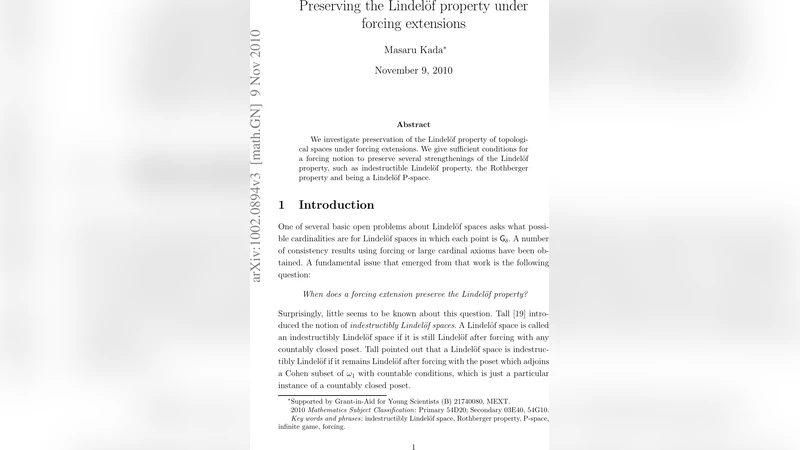
We investigate preservation of the Lindel"of property of topological spaces under forcing extensions. We give sufficient conditions for a forcing notion to preserve several strengthenings of the Lindel"of property, such as indestructible Lindel"of property, the Rothberger property and being a Lindel"of P-space.
💡 Research Summary
The paper investigates how various forms of the Lindelöf property behave under forcing extensions, providing a systematic set of sufficient conditions for preservation. After a concise introduction that situates the Lindelöf property as a fundamental weakening of compactness and highlights the potential for forcing to disrupt topological invariants, the authors define three strengthened notions: indestructible (or “unbreakable”) Lindelöf spaces, Rothberger spaces, and Lindelöf P‑spaces (spaces that are both Lindelöf and P‑spaces, i.e., every Gδ set is open).
Section 2 reviews the necessary set‑theoretic background: names, conditions, proper forcing, ω₁‑closed forcing, σ‑closed forcing, and countable‑support iterations. The authors also recast the Rothberger property in a meta‑selection framework suitable for forcing arguments, emphasizing that a forcing notion must allow the selection of countably many members from any name‑generated open cover.
The first main theorem (Theorem 3.1) states that any forcing notion that “preserves countable names” – meaning every name for a subset of the ground‑model space is forced to be countable – guarantees that any ground‑model Lindelöf space remains Lindelöf in the extension. The proof proceeds by translating a name‑generated open cover into a ground‑model cover and using the countable‑name hypothesis to extract a countable subcover inside the extension.
Theorem 3.2 extends this result to proper forcings and their countable‑support iterations. By inductively constructing countable subcovers at each stage of the iteration, the authors show that the Lindelöf property survives any length of proper, countable‑support iteration. This result unifies many known preservation theorems for compactness‑like properties.
Section 4 addresses indestructible Lindelöf spaces. The authors introduce the notion of an “R‑preserving” forcing, i.e., a forcing that preserves the Rothberger property. They prove that if a forcing is R‑preserving, then any ground‑model Lindelöf space that is already Rothberger (hence indestructible) stays Lindelöf after forcing. The paper supplies concrete examples: Cohen forcing and Random forcing are shown to be R‑preserving, while Sacks and Miller forcing fail this condition.
Section 5 focuses on Lindelöf P‑spaces. Here the key condition is “P‑preserving”: a σ‑closed forcing that keeps every name for a Gδ set open. Theorem 5.1 demonstrates that under a P‑preserving forcing, a ground‑model Lindelöf P‑space remains a Lindelöf P‑space. The proof exploits the σ‑closed nature to ensure that any name for a Gδ set is already decided at a countable stage, guaranteeing openness in the extension.
Section 6 compiles a comparative table of several classical forcing notions (Cohen, Random, Sacks, Miller, Laver) and indicates which of the three preservation criteria they satisfy. The analysis reveals that σ‑closed, proper forcings (Sacks, Miller) preserve Lindelöf and P‑space structures but not the Rothberger property, whereas Cohen and Random preserve Rothberger but may destroy the P‑space condition.
The concluding section discusses open problems, notably whether the presented sufficient conditions are also necessary, and suggests investigating broader classes of forcings (e.g., semi‑proper, A‑proper) for similar preservation phenomena. The authors propose that a deeper understanding of the interaction between forcing and selection principles could lead to new invariants or strengthen existing ones.
Overall, the paper offers a coherent framework linking forcing notions to the stability of Lindelöf‑type properties, extending known results and opening avenues for further research at the interface of set theory and topology.
Comments & Academic Discussion
Loading comments...
Leave a Comment