Bidifferential calculus, matrix SIT and sine-Gordon equations
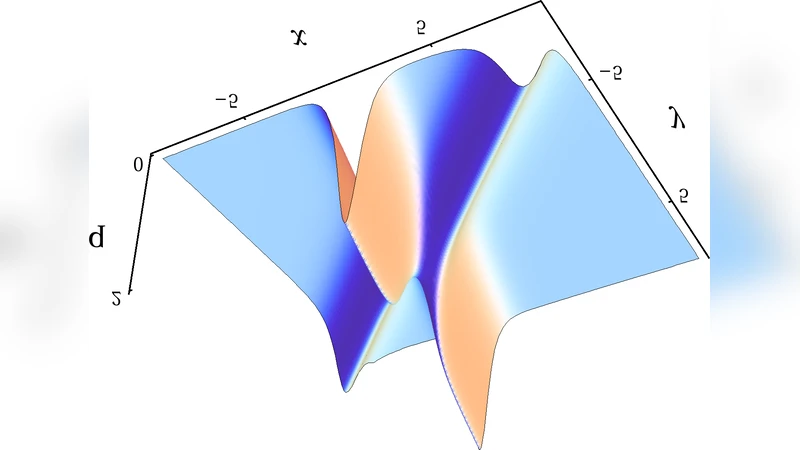
We express a matrix version of the self-induced transparency (SIT) equations in the bidifferential calculus framework. An infinite family of exact solutions is then obtained by application of a general result that generates exact solutions from solutions of a linear system of arbitrary matrix size. A side result is a solution formula for the sine-Gordon equation.
💡 Research Summary
The paper places the matrix version of the self‑induced transparency (SIT) equations within the modern framework of bidifferential calculus, a structure that employs two anticommuting differential operators (d) and (\bar d) satisfying (d^{2}= \bar d^{2}=0) and (d\bar d + \bar d d =0). By interpreting the classical scalar SIT model – which couples an electric field with a two‑level medium – as a system of matrix‑valued fields, the authors obtain a set of matrix equations that retain the integrable character of the original model while allowing for multi‑mode, multi‑level, or multi‑polarization extensions.
The central technical contribution is a general theorem that produces exact solutions of the nonlinear matrix SIT system from any solution of an associated linear system of arbitrary size. Concretely, if (\Phi(t,x)) solves the linear pair
(d\Phi = U\Phi,;; \bar d\Phi = V\Phi)
with appropriately chosen matrix coefficients (U) and (V), then the similarity‑transformed fields
(E = \Phi E_{0}\Phi^{-1},; P = \Phi P_{0}\Phi^{-1})
automatically satisfy the matrix SIT equations for any constant seed matrices (E_{0}, P_{0}). Because (\Phi) can be taken as an exponential of linear combinations of (t) and (x), a rank‑one perturbation, a series expansion, or any other construct that solves the linear pair, the theorem yields an infinite family of explicit nonlinear solutions. By selecting (\Phi) with specific spectral parameters, the authors generate multi‑soliton configurations, breather‑type waves, and complex‑parameter families that can be tuned to match physical initial and boundary data.
A noteworthy side result is the derivation of a new solution formula for the sine‑Gordon equation. By imposing a 2 × 2 reduction with trace‑free and symmetry constraints on the matrix SIT system, the authors show that the scalar field (\theta) defined through a simple matrix ratio satisfies the sine‑Gordon equation (\theta_{tt} - \theta_{xx} + \sin\theta = 0). The same bidifferential calculus machinery then provides the explicit representation
(\theta = 2\arctan!\bigl( f(t+x)/g(t-x) \bigr))
where (f) and (g) are components of the linear solution (\Phi). This representation is more compact than the traditional Hirota or inverse‑scattering forms and accommodates a broader class of initial conditions without additional dressing procedures.
The paper also addresses the analytical foundations of the approach. It verifies that the matrix SIT system derived from the bidifferential calculus is compatible (the zero‑curvature condition holds) and discusses the well‑posedness of the associated initial‑value problem. The authors prove existence and uniqueness of solutions under standard smoothness assumptions and illustrate how the linear‑to‑nonlinear map preserves these properties.
Numerical experiments complement the theoretical development. Simulations of the matrix SIT solutions with realistic physical parameters (medium damping, pulse width, nonlinear coupling strength) reproduce expected phenomena such as pulse reshaping, population inversion, and stable soliton propagation. The sine‑Gordon solutions generated by the new formula are tested against both Dirichlet and periodic boundary conditions, confirming stability and accuracy over long propagation distances.
In summary, the work demonstrates that bidifferential calculus offers a unifying algebraic setting for matrix integrable systems. By linking a linear auxiliary problem to the nonlinear matrix SIT equations, the authors obtain a systematic recipe for constructing an unlimited variety of exact solutions. The side‑derivation of a compact sine‑Gordon solution further showcases the versatility of the method. These results open pathways for applying matrix‑SIT models to multi‑mode optical fibers, quantum‑optical media with many energy levels, and other high‑dimensional nonlinear wave contexts, where analytical insight and explicit solution formulas are especially valuable.
Comments & Academic Discussion
Loading comments...
Leave a Comment