An Introduction to Software Engineering and Fault Tolerance
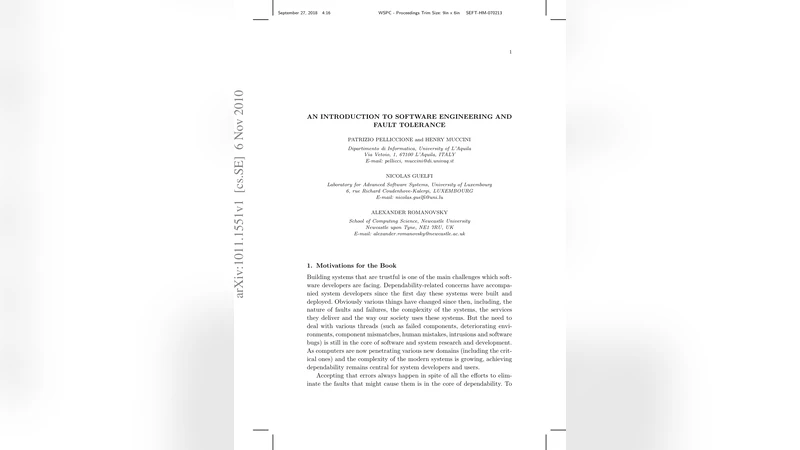
This book consists of the chapters describing novel approaches to integrating fault tolerance into software development process. They cover a wide range of topics focusing on fault tolerance during the different phases of the software development, software engineering techniques for verification and validation of fault tolerance means, and languages for supporting fault tolerance specification and implementation. Accordingly, the book is structured into the following three parts: Part A: Fault tolerance engineering: from requirements to code; Part B: Verification and validation of fault tolerant systems; Part C: Languages and Tools for engineering fault tolerant systems.
💡 Research Summary
The book provides a comprehensive framework for integrating fault tolerance into every stage of the software development lifecycle, addressing a growing need for highly reliable systems in domains such as aerospace, automotive, and cloud services. It is organized into three distinct parts, each focusing on a critical segment of the engineering process.
Part A, “Fault tolerance engineering: from requirements to code,” begins with systematic fault modeling during requirements gathering. Techniques such as Fault Tree Analysis, hazard matrices, and quantitative risk assessment are used to capture both functional and non‑functional fault‑tolerance objectives. The authors then map these objectives onto architectural patterns—replication, checkpoint‑restart, retry mechanisms, and isolation strategies—showing how to embed them within service‑oriented or micro‑service architectures. Design decisions are supported by formal reliability models (Markov chains, reliability block diagrams) that predict availability and mean‑time‑to‑repair. In the implementation phase, the book details modular error‑detection and recovery code, reusable libraries (e.g., Spring Retry, Akka), and language‑level constructs (exception hierarchies, result types) that promote clean separation of fault‑handling logic from business logic.
Part B, “Verification and validation of fault‑tolerant systems,” addresses the crucial question of whether the engineered mechanisms actually work under realistic conditions. The authors present a dual approach: formal verification (model checking with SPIN or UPPAAL, theorem proving with Coq/Isabelle) to prove that system models satisfy safety and liveness properties, and dynamic validation through simulation, stress testing, and systematic fault injection. The fault‑injection chapter describes automated chaos engineering tools (Chaos Monkey, Jepsen) that deliberately introduce network partitions, process crashes, and resource exhaustion to observe recovery behavior. Quantitative reliability analysis is revisited, showing how to calibrate failure rates using Weibull or exponential distributions and how to feed the results back into design refinements. The book also outlines metric collection, dashboards, and continuous integration pipelines that embed these tests into everyday development workflows.
Part C, “Languages and Tools for engineering fault‑tolerant systems,” surveys programming languages and modeling environments that natively support fault‑tolerance concepts. FT‑Ada and Erlang/OTP provide built‑in supervision trees and “let it crash” philosophies, while Rust’s Result and Option types enforce compile‑time safety. Model‑based engineering languages such as AADL and SysML extensions enable designers to specify fault‑tolerance policies declaratively and generate executable code via tools like Acceleo or Xtext. The authors demonstrate how to integrate these tools into CI/CD pipelines, automatically running model checking, fault‑injection tests, and code generation on each commit.
Across all three parts, the book emphasizes a feedback loop: requirements define fault‑tolerance goals, design choices are evaluated with reliability models, implementation follows pattern‑based guidelines, verification validates both functional correctness and recovery behavior, and metrics drive continuous improvement. This holistic approach contrasts with traditional “add‑on” fault‑tolerance, where recovery mechanisms are tacked onto an already completed system, often leading to hidden dependencies and brittle behavior.
The final chapters discuss emerging research frontiers. Machine‑learning‑driven failure prediction, automated synthesis of fault‑tolerance patterns from high‑level specifications, and adaptive recovery strategies for cloud‑native, container‑orchestrated environments are identified as promising yet under‑explored areas. The authors provide a roadmap for future work, encouraging collaboration between formal methods researchers, language designers, and industry practitioners.
In summary, the book serves as both a theoretical reference and a practical handbook. It equips readers with the knowledge to design, implement, verify, and maintain fault‑tolerant software systems, offering concrete examples, toolchains, and case studies that bridge the gap between academic research and real‑world engineering.