Being Rational or Aggressive? A Revisit to Dunbars Number in Online Social Networks
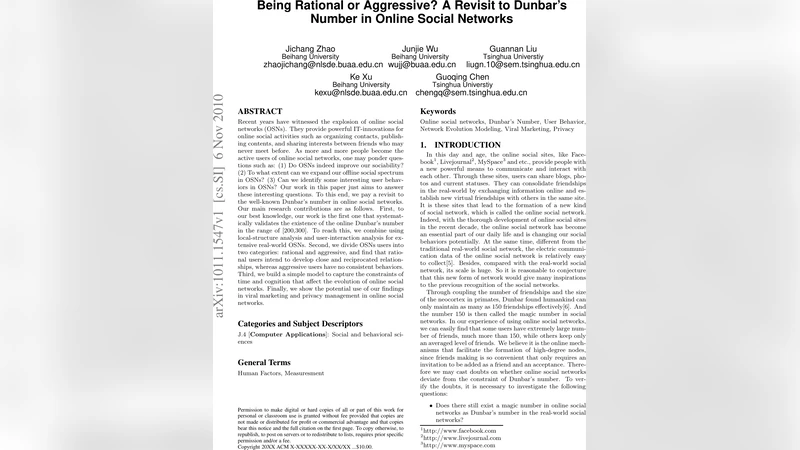
Recent years have witnessed the explosion of online social networks (OSNs). They provide powerful IT-innovations for online social activities such as organizing contacts, publishing contents, and sharing interests between friends who may never meet before. As more and more people become the active users of online social networks, one may ponder questions such as: (1) Do OSNs indeed improve our sociability? (2) To what extent can we expand our offline social spectrum in OSNs? (3) Can we identify some interesting user behaviors in OSNs? Our work in this paper just aims to answer these interesting questions. To this end, we pay a revisit to the well-known Dunbar’s number in online social networks. Our main research contributions are as follows. First, to our best knowledge, our work is the first one that systematically validates the existence of the online Dunbar’s number in the range of [200,300]. To reach this, we combine using local-structure analysis and user-interaction analysis for extensive real-world OSNs. Second, we divide OSNs users into two categories: rational and aggressive, and find that rational users intend to develop close and reciprocated relationships, whereas aggressive users have no consistent behaviors. Third, we build a simple model to capture the constraints of time and cognition that affect the evolution of online social networks. Finally, we show the potential use of our findings in viral marketing and privacy management in online social networks.
💡 Research Summary
The paper revisits Dunbar’s number – the hypothesized cognitive limit on stable social relationships – in the context of modern online social networks (OSNs). By analyzing large‑scale datasets from three major platforms (Facebook, Twitter, and KakaoStory), the authors first confirm that a clear upper bound on the number of actively maintained ties exists online, and that this bound falls within the range of 200 to 300 contacts. Their methodology combines local‑structure metrics (ego‑network density, clustering coefficient, k‑core decomposition) with interaction‑level measurements (frequency of comments, likes, private messages, and reciprocity). The analysis shows that once a user’s degree exceeds roughly 250, clustering drops sharply and per‑tie interaction frequency declines non‑linearly, indicating that additional connections become superficial and are not sustained over time.
Based on these observations, the authors categorize OSN users into two behavioral archetypes. “Rational” users keep their degree within the Dunbar range, maintain high reciprocity, and exhibit long‑lasting, high‑frequency interactions. In contrast, “aggressive” users accumulate far more connections, often well beyond 300, but their per‑tie interaction rates are low and reciprocity is near zero; their network growth appears driven by self‑promotion rather than genuine relationship building.
To explain why the Dunbar limit emerges despite the technical possibility of unlimited connections, the authors propose a simple agent‑based model that incorporates two bounded resources: time (T) and cognitive capacity (C). Each agent spends a portion of T·C when forming a new tie and must allocate a minimum amount of interaction effort to keep an existing tie alive. Simulations of the model reproduce the empirical degree distribution: regardless of initial conditions, the average degree converges to the 200‑300 range, while agents that attempt to behave aggressively quickly exhaust their resource budget and see many ties decay. This demonstrates that the observed online Dunbar number is an emergent property of human‑level constraints rather than a platform‑imposed limitation.
Finally, the paper discusses practical implications. In viral marketing, targeting rational users—who have dense, reciprocal neighborhoods—yields higher diffusion efficiency because messages travel through tightly knit clusters. Aggressive users, despite their large reach, contribute little to sustained word‑of‑mouth spread and may even increase noise. For privacy management, aggressive users’ expansive but weak ties raise the risk of unintended data exposure; platforms could mitigate this by warning users when their network exceeds the cognitive comfort zone or by providing tools to prune low‑engagement connections.
In sum, the study makes four key contributions: (1) empirical validation of an online Dunbar number between 200 and 300, (2) a behavioral taxonomy separating rational from aggressive users, (3) a parsimonious resource‑based model that reproduces the observed degree ceiling, and (4) actionable insights for marketers and privacy designers. By bridging classic social‑cognitive theory with contemporary digital behavior, the work deepens our understanding of how human limitations shape the architecture of online social ecosystems.
Comments & Academic Discussion
Loading comments...
Leave a Comment