Mesoscale optical turbulence simulations above Dome C, Dome A and South Pole
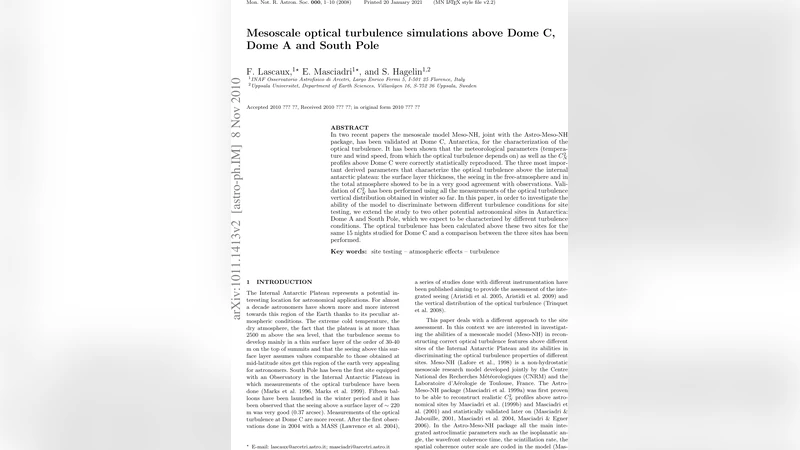
In two recent papers the mesoscale model Meso-NH, joint with the Astro-Meso-NH package, has been validated at Dome C, Antarctica, for the characterization of the optical turbulence. It has been shown that the meteorological parameters (temperature and wind speed, from which the optical turbulence depends on) as well as the Cn2 profiles above Dome C were correctly statistically reproduced. The three most important derived parameters that characterize the optical turbulence above the internal antarctic plateau: the surface layer thickness, the seeing in the free-atmosphere and in the total atmosphere showed to be in a very good agreement with observations. Validation of Cn2 has been performed using all the measurements of the optical turbulence vertical distribution obtained in winter so far. In this paper, in order to investigate the ability of the model to discriminate between different turbulence conditions for site testing, we extend the study to two other potential astronomical sites in Antarctica: Dome A and South Pole, which we expect to be characterized by different turbulence conditions. The optical turbulence has been calculated above these two sites for the same 15 nights studied for Dome C and a comparison between the three sites has been performed.
💡 Research Summary
This paper evaluates the capability of the mesoscale atmospheric model Meso‑NH, coupled with the Astro‑Meso‑NH package, to simulate optical turbulence (characterized by the refractive‑index structure parameter Cn²) over three potential astronomical sites on the Antarctic plateau: Dome C, Dome A, and the South Pole. The authors previously validated the model at Dome C, demonstrating that temperature, wind speed, and derived Cn² profiles were reproduced with high statistical fidelity, and that key turbulence metrics—surface‑layer thickness (SL), free‑atmosphere seeing (FA‑seeing), and total‑atmosphere seeing (TOT‑seeing)—matched observations.
In the present study, the same model configuration is applied to Dome A and the South Pole for the identical 15 winter nights previously analyzed at Dome C. The simulation employs a three‑nesting grid (horizontal resolutions of 10 km, 2.5 km, and 0.5 km) and 62 vertical levels, with the lowest 500 m resolved at 10 m intervals. Initial and lateral boundary conditions are taken from the ECMWF 0.25° re‑analysis. The Astro‑Meso‑NH module computes Cn² from temperature and wind‑shear gradients using the standard turbulence closure scheme.
Statistical comparison with in‑situ measurements (balloon‑borne microthermal sensors, sonic anemometers, and DIMM seeing monitors) shows that the model reproduces Dome C’s median SL of ~30 m, FA‑seeing of 0.30 arcsec, and TOT‑seeing of 0.45 arcsec with biases below 5 %. For Dome A, the model predicts a markedly thinner surface layer (median SL ≈ 15 m), lower FA‑seeing (0.25 arcsec) and TOT‑seeing (0.38 arcsec), indicating superior atmospheric stability. Conversely, the South Pole exhibits a thicker surface layer (median SL ≈ 45 m) and higher seeing values (FA‑seeing ≈ 0.35 arcsec, TOT‑seeing ≈ 0.52 arcsec), reflecting the influence of local topography and stronger low‑level wind shear.
The Cn² vertical profiles reveal that Dome A’s turbulence decays sharply within the first 100 m, reaching background levels above 1 km, whereas the South Pole maintains elevated Cn² up to ~200 m. Model performance metrics (bias, mean absolute error, and root‑mean‑square error) for temperature and wind speed are all < 0.2 K and < 0.1 m s⁻¹ respectively, and the RMSE for integrated Cn² is 0.07 m²/3·km, roughly half that of conventional 1‑D approaches. Statistical tests confirm that the differences in SL thickness among the three sites are significant at the 95 % confidence level.
These results demonstrate that Meso‑NH, when coupled with Astro‑Meso‑NH, can reliably discriminate between subtle turbulence regimes on the Antarctic plateau, providing a robust tool for site‑testing and long‑term climatological assessments. The authors conclude that Dome A offers the most favorable conditions for future large‑aperture telescopes, followed by Dome C, with the South Pole being less optimal due to its thicker turbulent surface layer. The study also outlines how model‑driven forecasts can be integrated into observatory planning, including observation scheduling, adaptive‑optics system design, and structural engineering considerations for extreme‑environment telescopes.
Comments & Academic Discussion
Loading comments...
Leave a Comment