Embeddings of finite-dimensional compacta in Euclidean spaces
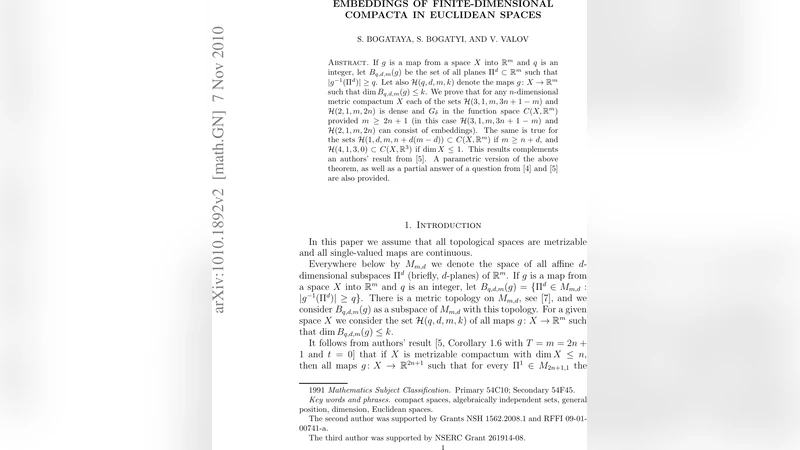
If $g$ is a map from a space $X$ into $\mathbb R^m$ and $q$ is an integer, let $B_{q,d,m}(g)$ be the set of all lines $\Pi^d\subset\mathbb R^m$ such that $|g^{-1}(\Pi^d)|\geq q$. Let also $\mathcal H(q,d,m,k)$ denote the maps $g\colon X\to\mathbb R^m$ such that $\dim B_{q,d,m}(g)\leq k$. We prove that for any $n$-dimensional metric compactum $X$ each of the sets $\mathcal H(3,1,m,3n+1-m)$ and $\mathcal H(2,1,m,2n)$ is dense and $G_\delta$ in the function space $C(X,\mathbb R^m)$ provided $m\geq 2n+1$ (in this case $\mathcal H(3,1,m,3n+1-m)$ and $\mathcal H(2,1,m,2n)$ can consist of embeddings). The same is true for the sets $\mathcal H(1,d,m,n+d(m-d))\subset C(X,\mathbb R^m)$ if $m\geq n+d$, and $\mathcal H(4,1,3,0)\subset C(X,\mathbb R^3)$ if $\dim X\leq 1$.
💡 Research Summary
The paper investigates how finely one can control the intersections of a continuous map from a compact metric space into Euclidean space with linear subspaces. For a map (g\colon X\to\mathbb R^{m}) and an integer (q), the authors define
\
Comments & Academic Discussion
Loading comments...
Leave a Comment