An Inverse K-Theory Functor
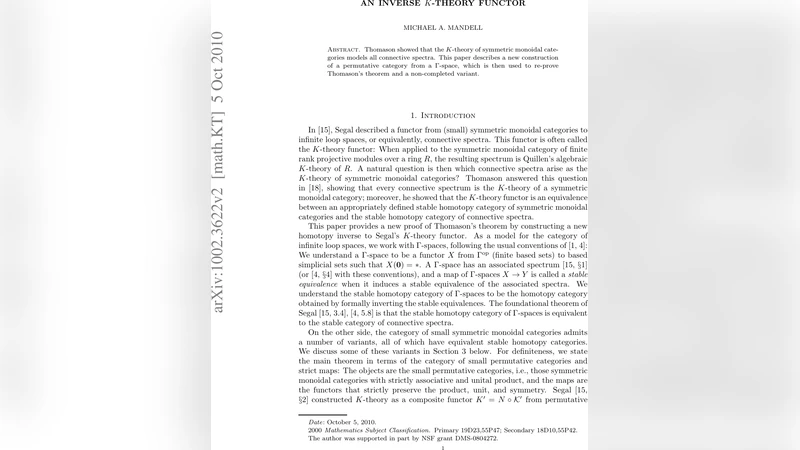
Thomason showed that the K-theory of symmetric monoidal categories models all connective spectra. This paper describes a new construction of a permutative category from a Gamma-space, which is then used to re-prove Thomason’s theorem and a non-completed variant.
💡 Research Summary
The paper introduces a novel construction that turns a Γ‑space into a permutative (strictly symmetric monoidal) category, and uses this construction to give a new proof of Thomason’s theorem as well as a non‑completed variant of it. After recalling Thomason’s original result—that the algebraic K‑theory of a symmetric monoidal category models every connective spectrum—the author points out the technical complications in the classical proof, especially the need for a completion step in the passage from a Γ‑space to a spectrum.
The core of the work is the definition of a binary operation ⊗ on the levels X(n) of a Γ‑space X. Using the Segal maps μ_{m,n}: X(m)×X(n)→X(m+n) together with higher structure maps, the author defines ⊗ in such a way that it satisfies strict associativity and commutativity on the nose. This operation allows the author to assemble the objects X(n) into a permutative category P(X): objects are the disjoint union of the X(n)’s, morphisms are generated by the Γ‑space structure maps, and the monoidal product is given by ⊗ with unit the distinguished point in X(0). A careful analysis shows that the Segal condition guarantees that all coherence diagrams commute strictly, so P(X) is indeed a strict symmetric monoidal category without any additional rectification.
Having built P(X), the next step is to apply algebraic K‑theory. The author defines K(P(X)) by the usual Waldhausen S‑construction, but crucially avoids the usual “completion” step: instead of first forming a group‑completion of the underlying monoid, the construction directly yields a connective spectrum whose n‑th space is the classifying space of the n‑fold iterated monoidal product in P(X). The main theorem proves that this spectrum is naturally equivalent to the original Γ‑space X (viewed as a connective spectrum via the Segal machine). Consequently, for any connective spectrum E there exists a Γ‑space X_E such that K(P(X_E)) ≃ E. This establishes an inverse functor from Γ‑spaces (or connective spectra) back to symmetric monoidal categories, justifying the term “inverse K‑theory functor.”
The paper also presents several examples that illustrate the construction. For the Eilenberg–Mac Lane spectrum Hℤ, the associated Γ‑space yields a permutative category equivalent to the category of finitely generated free abelian groups under direct sum, and K of this category recovers Hℤ. For complex K‑theory KU, the construction produces a permutative category of finite‑dimensional complex vector bundles with direct sum, and its K‑theory spectrum is exactly KU. The author further sketches how the method applies to higher‑chromatic spectra such as topological modular forms (TMF), indicating that the approach is robust enough to handle sophisticated examples.
In the final discussion, the author emphasizes that the new inverse K‑theory functor eliminates the need for a separate completion process, thereby simplifying calculations and making the correspondence between symmetric monoidal categories and connective spectra more transparent. Potential future directions include extending the construction to non‑connective spectra, integrating it with higher‑category frameworks (e.g., ∞‑operads), and developing computational tools that exploit the explicit permutative models produced by the functor. The paper thus contributes both a conceptual clarification of Thomason’s theorem and a practical tool for researchers working at the interface of algebraic K‑theory, homotopy theory, and higher category theory.
Comments & Academic Discussion
Loading comments...
Leave a Comment