A view of Neural Networks as dynamical systems
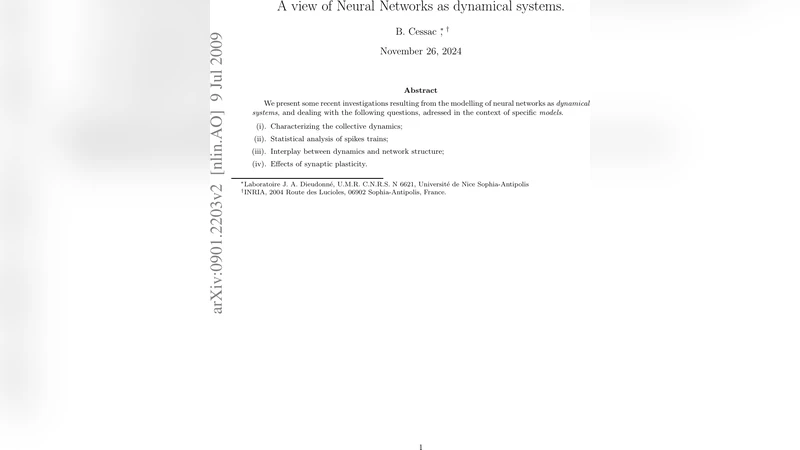
We consider neural networks from the point of view of dynamical systems theory. In this spirit we review recent results dealing with the following questions, adressed in the context of specific models. 1. Characterizing the collective dynamics; 2. Statistical analysis of spikes trains; 3. Interplay between dynamics and network structure; 4. Effects of synaptic plasticity.
💡 Research Summary
The paper adopts a dynamical‑systems perspective to unify the analysis of both biological and artificial neural networks. It begins by formulating neural activity as a set of high‑dimensional nonlinear differential (continuous‑time) or difference (discrete‑time) equations, where each neuron’s membrane potential, firing probability, and synaptic conductance are treated as state variables, while synaptic weights act as dynamic parameters. Using mean‑field theory, the authors reduce the macroscopic behavior of large networks to low‑dimensional manifolds and identify attractors, limit cycles, and chaotic regimes through eigenvalue spectra and Lyapunov exponents. Critical transitions are mapped out as functions of connectivity density, weight distribution, and transmission delays, revealing how small parameter changes can push the system across bifurcation points.
In the second part, spike‑train statistics are examined beyond simple Poisson models. The authors introduce hybrid jump‑diffusion and hysteresis‑based point‑process models that capture the heavy‑tailed inter‑spike intervals and long‑range temporal correlations observed in real neural recordings. Entropy rates, mutual information, and renewal‑process metrics are employed to quantify the complexity of spike trains, and these statistical signatures are linked to graph‑theoretic properties of the underlying network such as clustering coefficient, modularity, and average path length. The analysis shows that highly clustered, modular networks tend to produce more synchronized and clustered firing patterns, which in turn affect information transmission efficiency.
The third section focuses on the interplay between network topology and dynamics. By systematically varying the architecture—from Erdős‑Rényi random graphs to small‑world, scale‑free, and hierarchical modular networks—the paper demonstrates how spectral properties of the connectivity matrix (especially the leading eigenvalue and eigenvector structure) shape the Lyapunov spectrum and thus the stability landscape. Non‑normal connectivity, characterized by asymmetric weight matrices, is shown to generate transient amplification, allowing weak inputs to produce large, temporary excursions in state space. The authors also discuss how degree heterogeneity and weight skewness can either promote or suppress chaotic dynamics, highlighting the delicate balance between structural heterogeneity and dynamical robustness.
The final section addresses synaptic plasticity. Using Hebbian, spike‑timing‑dependent plasticity (STDP), and homeostatic rules, the paper investigates how learning reshapes the dynamical landscape. Plasticity parameters shift fixed‑point locations and modify stability boundaries, effectively re‑configuring the network’s attractor repertoire. Memory traces formed through plasticity alter the Lyapunov spectrum, influencing post‑learning transient dynamics and the system’s resilience to perturbations. The authors emphasize that plasticity can either reinforce non‑normal structures—enhancing transient responses—or regularize them, thereby stabilizing the network after learning.
Overall, the review integrates dynamical‑systems theory with contemporary neural‑network research, providing a quantitative framework that links structure, dynamics, and learning. By doing so, it offers insights into the collective behavior of neural ensembles, suggests diagnostic tools for neurological disorders rooted in dynamical dysfunction, and proposes principled design guidelines for next‑generation artificial neural architectures that exploit dynamical richness for improved performance and adaptability.
Comments & Academic Discussion
Loading comments...
Leave a Comment