Geometric Complexity Theory and Tensor Rank
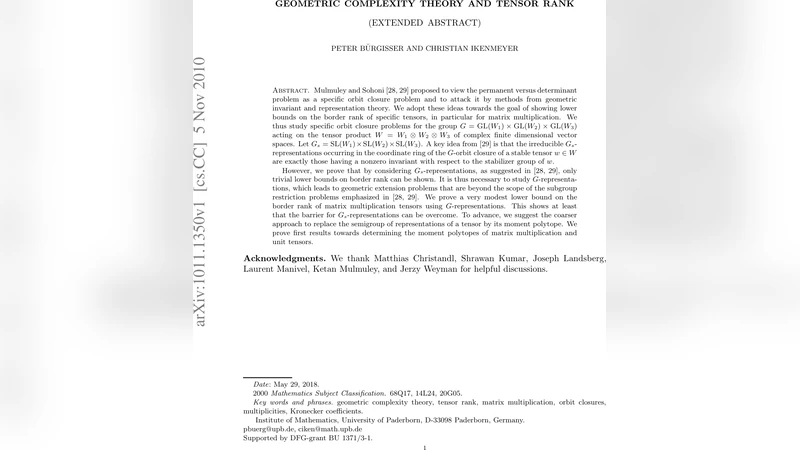
Mulmuley and Sohoni (GCT1 in SICOMP 2001, GCT2 in SICOMP 2008) proposed to view the permanent versus determinant problem as a specific orbit closure problem and to attack it by methods from geometric invariant and representation theory. We adopt these ideas towards the goal of showing lower bounds on the border rank of specific tensors, in particular for matrix multiplication. We thus study specific orbit closure problems for the group $G = GL(W_1)\times GL(W_2)\times GL(W_3)$ acting on the tensor product $W=W_1\otimes W_2\otimes W_3$ of complex finite dimensional vector spaces. Let $G_s = SL(W_1)\times SL(W_2)\times SL(W_3)$. A key idea from GCT2 is that the irreducible $G_s$-representations occurring in the coordinate ring of the $G$-orbit closure of a stable tensor $w\in W$ are exactly those having a nonzero invariant with respect to the stabilizer group of $w$. However, we prove that by considering $G_s$-representations, as suggested in GCT1-2, only trivial lower bounds on border rank can be shown. It is thus necessary to study $G$-representations, which leads to geometric extension problems that are beyond the scope of the subgroup restriction problems emphasized in GCT1-2. We prove a very modest lower bound on the border rank of matrix multiplication tensors using $G$-representations. This shows at least that the barrier for $G_s$-representations can be overcome. To advance, we suggest the coarser approach to replace the semigroup of representations of a tensor by its moment polytope. We prove first results towards determining the moment polytopes of matrix multiplication and unit tensors.
💡 Research Summary
The paper revisits the Geometric Complexity Theory (GCT) program of Mulmuley and Sohoni and adapts its orbit‑closure framework to the problem of proving lower bounds on the border rank of specific tensors, with a focus on the matrix multiplication tensor. The authors consider the natural action of the product group (G = GL(W_1)\times GL(W_2)\times GL(W_3)) on the tensor space (W = W_1\otimes W_2\otimes W_3) and its special linear subgroup (G_s = SL(W_1)\times SL(W_2)\times SL(W_3)). GCT2 predicts that the irreducible (G_s)-representations appearing in the coordinate ring of the orbit closure of a stable tensor (w) are precisely those whose highest weight vectors admit a non‑zero invariant under the stabilizer of (w). The authors verify this prediction but then demonstrate a crucial limitation: when one restricts attention solely to (G_s)-representations, the resulting representation‑theoretic obstructions are too weak to yield any non‑trivial lower bound on the border rank of matrix multiplication. In other words, the “(G_s)-representation barrier’’ prevents the method from improving on the trivial bound.
To overcome this barrier, the paper shifts to studying full (G)-representations. Unlike the special linear case, (G)-representations are not forced to be invariant under the determinant‑one condition, which enlarges the pool of possible highest weights. By constructing explicit (G)-invariant functions that vanish on the orbit closure of tensors of low border rank, the authors obtain a modest but genuine lower bound: (\underline{R}(M_{\langle n\rangle}) \ge 2n-1). Although this bound is far from the best known results, it demonstrates that the obstruction theory can be revived when the larger group is used.
Recognizing that directly handling the semigroup of representations is still extremely difficult, the authors propose a coarser, convex‑geometric approach: replace the semigroup by its moment polytope. The moment polytope records the set of highest weights (as points in a Euclidean space) and encodes inclusion relations between orbit closures as polytope containment. This reduction transforms the representation‑theoretic problem into a question about convex bodies, which is more amenable to computational and combinatorial techniques. The paper presents initial calculations of the moment polytopes for the matrix multiplication tensor and for unit tensors, highlighting structural differences and suggesting how these polytopes might be used to certify stronger border‑rank lower bounds.
In summary, the work shows that the original GCT strategy based on (G_s)-representations is insufficient for tensor rank lower bounds, but that moving to (G)-representations and, more importantly, to moment‑polytope methods opens a viable pathway. The authors outline several future directions: systematic classification of relevant (G)-representations, algorithmic detection of invariant polynomials, deeper analysis of moment polytope geometry, and the development of new geometric tools that go beyond subgroup‑restriction problems. These steps could eventually bridge the gap between GCT’s orbit‑closure perspective and concrete lower bounds for matrix multiplication and related computational problems.
Comments & Academic Discussion
Loading comments...
Leave a Comment