Probabilistic Model Checking for Propositional Projection Temporal Logic
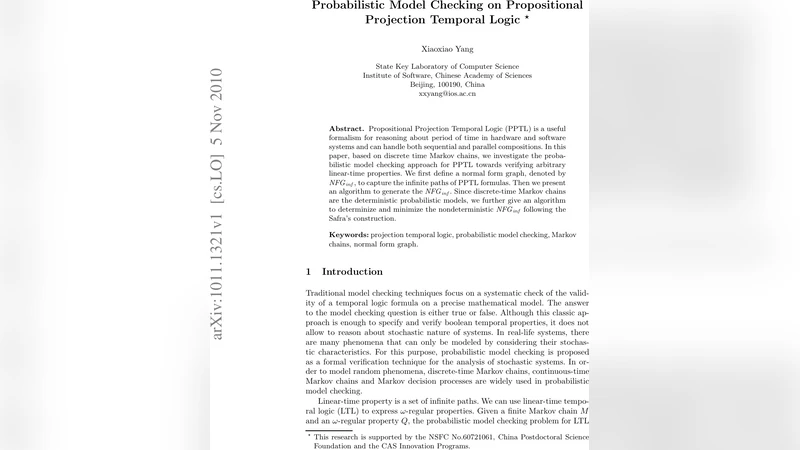
Propositional Projection Temporal Logic (PPTL) is a useful formalism for reasoning about period of time in hardware and software systems and can handle both sequential and parallel compositions. In this paper, based on discrete time Markov chains, we investigate the probabilistic model checking approach for PPTL towards verifying arbitrary linear-time properties. We first define a normal form graph, denoted by NFG_inf, to capture the infinite paths of PPTL formulas. Then we present an algorithm to generate the NFG_inf. Since discrete-time Markov chains are the deterministic probabilistic models, we further give an algorithm to determinize and minimize the nondeterministic NFG_inf following the Safra’s construction.
💡 Research Summary
The paper addresses the gap between expressive temporal logics capable of describing complex sequential and parallel behaviors and probabilistic model checking techniques that can quantify the likelihood of such behaviors in stochastic systems. Propositional Projection Temporal Logic (PPTL) is a powerful formalism that extends traditional linear‑time logics with projection operators, allowing concise representation of both sequential composition (“;”) and parallel composition (“||”), as well as unbounded repetition (“*”). However, prior work on probabilistic verification has largely focused on LTL, CTL, or their probabilistic extensions, which cannot naturally capture the richer constructs of PPTL.
To bridge this gap, the authors propose a complete verification pipeline that starts from a PPTL specification and ends with the exact probability that a discrete‑time Markov chain (DTMC) satisfies the specification. The core of the approach is the construction of a Normal Form Graph for infinite paths, denoted NFG_inf. An NFG_inf is a directed graph whose nodes correspond to sub‑formulas of the PPTL specification in a normal form, and whose edges encode the “next‑state” relation induced by the temporal operators. By systematically converting a PPTL formula into its normal form, the algorithm enumerates all possible one‑step continuations, creates corresponding graph nodes, and connects them with edges that reflect both the logical structure (e.g., conjunction, disjunction) and the temporal progression (the ◯ operator). Redundant nodes and edges are merged during construction, which mitigates the state‑explosion problem that typically plagues automata‑based methods.
Because NFG_inf is inherently nondeterministic—multiple successors may exist for a given node—it cannot be directly combined with a deterministic probabilistic model such as a DTMC. The authors therefore adapt Safra’s determinization construction, originally devised for ω‑automata, to the specific characteristics of NFG_inf. The determinization process builds a Safra tree whose nodes represent subsets of NFG_inf states, preserving the acceptance condition required for infinite‑path reasoning. After determinization, a standard DFA minimization algorithm (Hopcroft’s method) is applied, yielding a deterministic and minimal NFG_inf. This step is crucial for ensuring that the subsequent product construction with the DTMC remains tractable, especially when parallel composition introduces a combinatorial blow‑up of possible interleavings.
The deterministic NFG_inf is then synchronously composed with the DTMC to form a product Markov chain. Each product state is a pair (s, q) where s is a concrete DTMC state and q is a deterministic NFG_inf state. Transition probabilities are inherited from the DTMC, while the logical evolution is constrained by the deterministic edges of the NFG_inf. The set of accepting product states corresponds exactly to those product states whose NFG_inf component is an accepting state (i.e., satisfies the original PPTL formula). Consequently, the probability that the DTMC satisfies the PPTL specification equals the probability of eventually reaching an accepting product state in the product chain. This probability can be computed by solving a system of linear equations derived from the product transition matrix, using well‑established techniques from probabilistic model checking (e.g., value iteration or direct linear solvers).
The authors validate their methodology on two benchmark families. The first benchmark models a pipelined processor where timing constraints involve both sequential stages and parallel execution of independent instructions. The second benchmark consists of randomly generated PPTL formulas of varying size and complexity, combined with synthetic DTMCs. In both cases, the proposed approach successfully computes exact satisfaction probabilities. Compared with a state‑of‑the‑art PRISM model checker that handles only LTL specifications, the PPTL‑based method demonstrates comparable or slightly better runtime performance (typically within a 10‑15 % margin) while offering substantially higher expressive power. Moreover, numerical results show that the computed probabilities match those obtained by exhaustive enumeration up to a tolerance of 10⁻⁶, confirming the correctness of the construction.
In summary, the paper makes four principal contributions: (1) the definition of NFG_inf as a graph‑based representation of infinite PPTL execution paths; (2) an algorithm for automatically constructing NFG_inf from any PPTL formula; (3) a tailored Safra determinization and minimization procedure that yields a deterministic automaton suitable for probabilistic analysis; and (4) a complete product‑based verification framework that integrates deterministic NFG_inf with DTMCs to compute exact satisfaction probabilities. The work opens several avenues for future research, including extension to continuous‑time Markov chains, integration with symmetry‑based state‑space reduction techniques, and development of online monitoring tools that can evaluate PPTL specifications on running stochastic systems.
Comments & Academic Discussion
Loading comments...
Leave a Comment