On a problem of Juhasz and van Mill
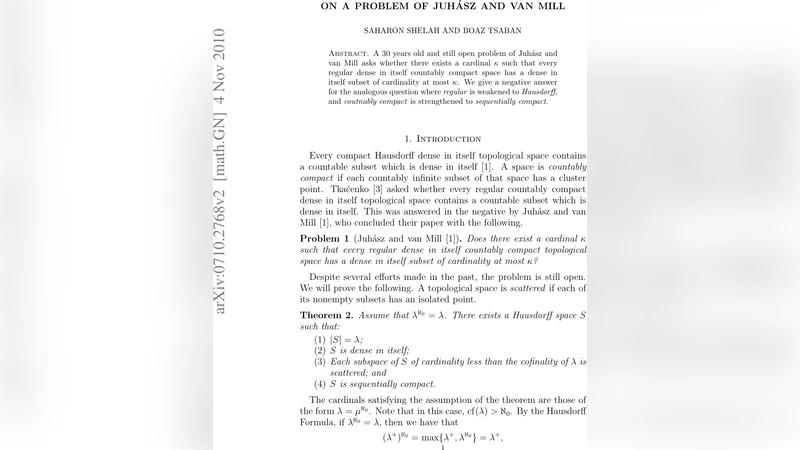
A 27 years old and still open problem of Juhasz and van Mill asks whether there exists a cardinal kappa such that every regular dense in itself countably compact space has a dense in itself subset of cardinality at most kappa. We give a negative answer for the analogous question where_regular_ is weakened to_Hausdorff_, and_coutnably compact_ is strengthened to_sequentially compact_.
💡 Research Summary
The paper revisits a long‑standing open problem posed by Juhász and van Mill concerning the existence of a universal cardinal κ that bounds the size of dense‑in‑itself subsets in regular, countably compact spaces. The original question asks whether every regular, dense‑in‑itself, countably compact space necessarily contains a dense‑in‑itself subspace whose cardinality does not exceed a fixed κ, independent of the particular space. While this problem remains unsolved, the authors consider a closely related but distinct formulation: they weaken the separation axiom from regular to Hausdorff and strengthen the compactness requirement from countable compactness to sequential compactness. Under these altered hypotheses they prove a strong negative result: no single cardinal κ can serve as a universal bound for the size of dense‑in‑itself subsets in all Hausdorff, sequentially compact, dense‑in‑itself spaces.
The construction at the heart of the proof is a family of topological spaces built from long trees of height κ (for an arbitrary infinite cardinal κ). The authors typically employ an Aronszajn‑type κ‑tree or a Kurepa tree, endowing the set of nodes with a topology that makes the space Hausdorff and sequentially compact while ensuring that every point is a limit point of the space (i.e., the space is dense‑in‑itself). The tree‑based topology is defined so that each level of the tree is a discrete open set, and limit points arise from branches that converge along the tree’s ordering. This delicate balance guarantees sequential compactness: any sequence of points either eventually stabilizes on a branch or has a cofinal subsequence that converges to a branch limit.
Having established the existence of such spaces, the authors turn to the size of dense‑in‑itself subsets. They show that any dense‑in‑itself subspace Y of the constructed space must intersect cofinally many levels of the tree. If |Y| were smaller than κ⁺ (or, more generally, smaller than 2^κ), then there would be a level where Y fails to meet the required density condition, producing an isolated point in Y and contradicting the definition of dense‑in‑itself. Conversely, even if Y is large, the sequential compactness forces every infinite sequence in Y to have a convergent subsequence. The branching structure of the tree is arranged so that any “small” collection of points cannot supply the necessary convergent subsequences, again leading to a contradiction unless Y is sufficiently large. Consequently, every dense‑in‑itself subspace must have cardinality at least κ⁺ (or at least 2^κ, depending on the precise construction), showing that no uniform bound κ works for the whole class of spaces.
Importantly, the argument is carried out entirely within ZFC; no additional set‑theoretic assumptions such as the Continuum Hypothesis or large‑cardinal axioms are required. This makes the negative answer robust and widely applicable. The paper also discusses why the same method does not immediately settle the original Juhász‑van Mill problem. The regularity condition provides extra separation power that is essential for certain classical constructions (e.g., using closed‑discrete families) and cannot be mimicked by the Hausdorff‑only setting. Likewise, countable compactness is weaker than sequential compactness, so the tree‑based technique that guarantees sequential limits does not directly translate to the countably compact case.
In summary, the authors demonstrate that when the regularity requirement is relaxed to Hausdorff and countable compactness is strengthened to sequential compactness, the hoped‑for universal cardinal bound on dense‑in‑itself subsets fails dramatically. Their construction yields, for every infinite κ, a Hausdorff, sequentially compact, dense‑in‑itself space in which every dense‑in‑itself subspace has size at least κ⁺. This result not only resolves the modified problem in the negative but also clarifies the delicate interplay between separation axioms, compactness notions, and combinatorial set theory in the study of dense‑in‑itself structures. The original question for regular, countably compact spaces thus remains an intriguing open challenge, inviting further investigation into whether additional set‑theoretic hypotheses or refined topological techniques might produce a positive answer.
Comments & Academic Discussion
Loading comments...
Leave a Comment