Discussions on "Riemann manifold Langevin and Hamiltonian Monte Carlo methods"
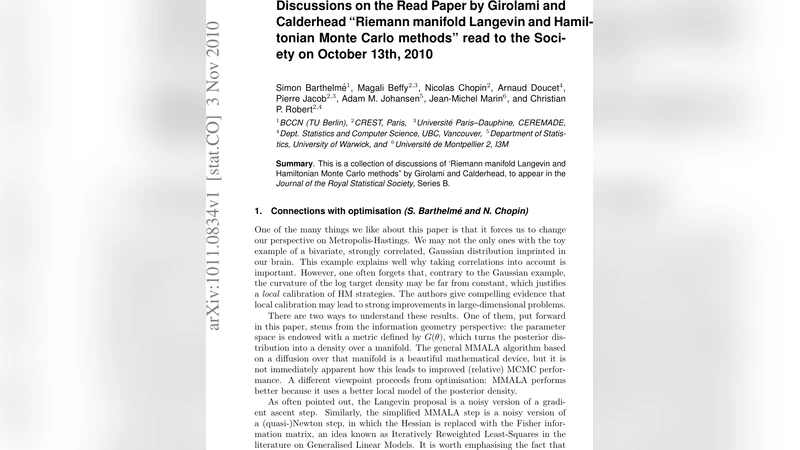
This is a collection of discussions of `Riemann manifold Langevin and Hamiltonian Monte Carlo methods" by Girolami and Calderhead, to appear in the Journal of the Royal Statistical Society, Series B.
💡 Research Summary
The paper is a curated collection of commentaries on the seminal work “Riemann manifold Langevin and Hamiltonian Monte Carlo methods” by Girolami and Calderhead. The original contribution introduced a geometric perspective to Markov‑chain Monte‑Carlo (MCMC) by endowing the parameter space with a Riemannian metric—typically the Fisher information matrix—so that proposals are generated along locally adapted directions and scales. This approach yields two algorithms: the Riemann‑Manifold Metropolis‑Adjusted Langevin Algorithm (RM‑MALA) and the Riemann‑Manifold Hamiltonian Monte‑Carlo (RM‑HMC). Both methods dramatically improve mixing in high‑dimensional, strongly correlated, or multimodal posterior distributions compared with traditional random‑walk Metropolis or Euclidean‑metric HMC, as demonstrated by a series of benchmark experiments in the original paper.
The discussion paper is organized into several thematic sections. The first set of remarks summarises the mathematical foundations: the construction of the metric tensor, the derivation of the stochastic differential equation for RM‑MALA, and the Hamiltonian dynamics for RM‑HMC. Contributors stress that the metric encodes curvature information of the target density, allowing the sampler to follow geodesic‑like trajectories that respect the underlying statistical structure. This results in higher effective sample sizes per unit computational effort.
The second section focuses on implementation challenges. Computing the full Fisher information matrix scales as O(d³) in the number of parameters d, and storing it can be prohibitive for models with thousands of dimensions. Several participants propose practical work‑arounds: low‑rank approximations, exploiting sparsity patterns common in hierarchical models, and leveraging automatic‑differentiation tools (e.g., TensorFlow, PyTorch) to obtain gradient and Hessian‑vector products without forming the matrix explicitly. Moreover, because the metric varies with the current state, the Hamiltonian equations become non‑separable, demanding reversible and volume‑preserving integrators. The community recommends symplectic integrators such as reversible leapfrog or higher‑order Runge‑Kutta schemes with adaptive step‑size control to maintain detailed balance and numerical stability.
A third strand of discussion examines the statistical adequacy of the Fisher‑information metric. In many realistic Bayesian problems the posterior deviates substantially from the asymptotic normality that underlies the Fisher approximation. Commentators suggest dynamic metric learning—updating the metric during sampling based on local curvature estimates—or hybrid schemes that blend a pre‑computed metric with a data‑driven correction term. Variational Bayes ideas are invoked to approximate the posterior curvature efficiently, and the possibility of parameterising the metric itself and treating it as an auxiliary variable is explored.
The final portion looks ahead to applications and research directions. Participants highlight the relevance of RM‑MALA and RM‑HMC for modern machine‑learning models, such as Bayesian neural networks, deep latent variable models, and complex stochastic differential equation models where parameter spaces are high‑dimensional and highly curved. By embedding interaction structure directly into the metric, one can achieve more faithful exploration than generic Euclidean HMC. The discussion also points to emerging computational strategies: GPU‑accelerated linear‑algebra for metric operations, parallelisation of the leapfrog steps, and the development of diagnostic tools that monitor metric conditioning and integrator error in real time.
Overall, the collection provides a balanced appraisal: the geometric insight of Riemann‑manifold MCMC offers clear theoretical advantages, yet practical deployment hinges on addressing metric computation, integrator design, and robustness to model misspecification. The consensus is that continued advances in automatic differentiation, scalable linear‑algebra, and adaptive metric learning will make RM‑MALA and RM‑HMC viable for a broader class of high‑dimensional Bayesian inference problems, opening a fertile avenue for future methodological research.
Comments & Academic Discussion
Loading comments...
Leave a Comment