Ladder Operators and Endomorphisms in Combinatorial Physics
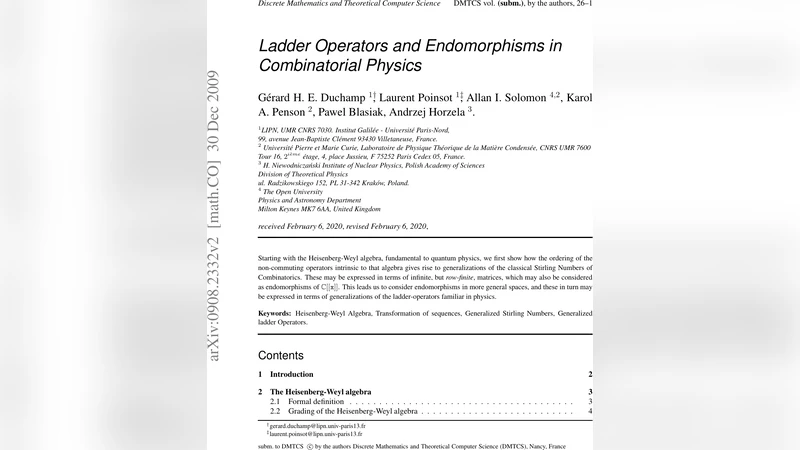
Starting with the Heisenberg-Weyl algebra, fundamental to quantum physics, we first show how the ordering of the non-commuting operators intrinsic to that algebra gives rise to generalizations of the classical Stirling Numbers of Combinatorics. These may be expressed in terms of infinite, but {\em row-finite}, matrices, which may also be considered as endomorphisms of $\C[[x]]$. This leads us to consider endomorphisms in more general spaces, and these in turn may be expressed in terms of generalizations of the ladder-operators familiar in physics.
💡 Research Summary
The paper begins by recalling the Heisenberg‑Weyl algebra $\mathcal{H}$ generated by the annihilation operator $a$, the creation operator $a^\dagger$, and the identity, with the canonical commutation relation $
Comments & Academic Discussion
Loading comments...
Leave a Comment