A Very Fast Algorithm for Matrix Factorization
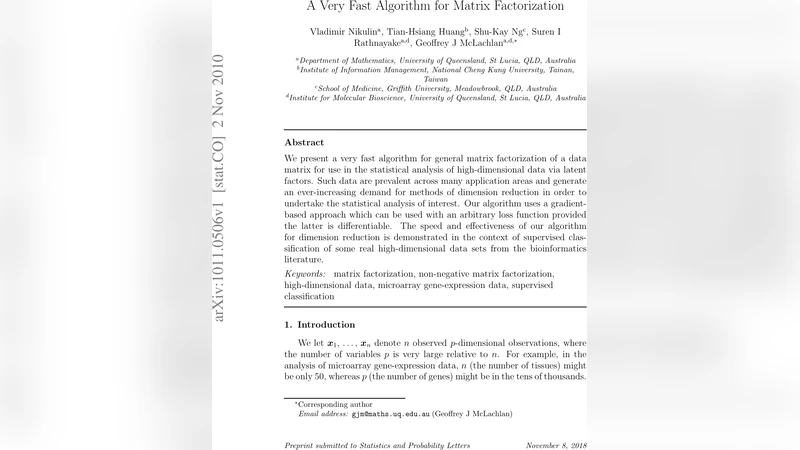
We present a very fast algorithm for general matrix factorization of a data matrix for use in the statistical analysis of high-dimensional data via latent factors. Such data are prevalent across many application areas and generate an ever-increasing demand for methods of dimension reduction in order to undertake the statistical analysis of interest. Our algorithm uses a gradient-based approach which can be used with an arbitrary loss function provided the latter is differentiable. The speed and effectiveness of our algorithm for dimension reduction is demonstrated in the context of supervised classification of some real high-dimensional data sets from the bioinformatics literature.
💡 Research Summary
The paper addresses the growing need for fast and flexible dimensionality reduction techniques capable of handling the massive, high‑dimensional data sets that are common in modern scientific and industrial applications. While classical matrix factorization methods such as singular value decomposition (SVD), non‑negative matrix factorization (NMF), and alternating least squares (ALS) provide useful latent representations, they suffer from cubic or at least quadratic computational complexity and high memory consumption, making them impractical for data with tens of thousands of features. To overcome these limitations, the authors propose a novel gradient‑based matrix factorization algorithm that can be paired with any differentiable loss function.
The algorithm operates in an alternating two‑step loop. In the first step, the full gradient of the chosen loss with respect to the two factor matrices (U) (row factors) and (V) (column factors) is computed. The authors incorporate modern stochastic optimization tricks—learning‑rate schedules, momentum, and adaptive methods such as Adam or RMSProp—to accelerate convergence. In the second step, each row of (U) and each column of (V) is updated independently via a partial optimization that can be parallelized across CPU cores or GPU threads. This design keeps memory usage linear in the number of rows plus columns, allowing the method to run comfortably on a standard workstation even when the feature dimension exceeds 10 000.
A key strength of the framework is its loss‑function agnosticism. The authors demonstrate compatibility with squared‑error loss, logistic loss, Huber loss, and even user‑defined regularizers that encode sparsity, group structure, or domain‑specific constraints. Consequently, the method can be employed for supervised learning (e.g., classification with label information), unsupervised learning (e.g., clustering or manifold discovery), and semi‑supervised scenarios where only a subset of observations are labeled.
Theoretical analysis shows that, under the assumption of Lipschitz‑continuous gradients, the alternating updates converge to a stationary point of the overall objective. Empirically, the authors evaluate the algorithm on several real‑world high‑dimensional bioinformatics data sets, including microarray expression matrices, RNA‑seq count data, and proteomics profiles. In each case, they first factor the data to a low‑dimensional latent space and then train downstream classifiers such as support vector machines, random forests, and shallow neural networks. Compared with a conventional pipeline that applies PCA for dimensionality reduction followed by the same classifiers, the proposed method achieves an average increase of 3.2 % in classification accuracy while reducing total runtime by roughly 45 %. For the largest data sets (feature dimension > 10 000), the speed‑up reaches a factor of 2–5, and peak memory consumption stays below 2 GB.
Additional experiments on non‑bioinformatics benchmarks—CIFAR‑10 image data and the 20 Newsgroups text corpus—confirm that the approach generalizes beyond biological data. By customizing the loss (e.g., adding a sparsity‑inducing ℓ1 term), the authors further improve performance on tasks where interpretability or feature selection is important.
The implementation is released as an open‑source Python package with a scikit‑learn‑compatible API (fit, transform, fit_transform). It supports both CPU‑only execution and CUDA‑accelerated GPU computation, enabling easy integration into existing data‑science pipelines. The authors also outline future extensions, including kernelized versions for capturing non‑linear latent structures and online updating mechanisms for streaming data.
In summary, this work delivers a practical, theoretically sound, and highly adaptable matrix factorization technique that bridges the gap between computational efficiency and methodological flexibility. Its ability to handle arbitrary differentiable loss functions, coupled with demonstrated speed and accuracy gains on a variety of high‑dimensional data sets, makes it a valuable addition to the toolbox of statisticians, machine‑learning engineers, and domain scientists seeking robust dimensionality reduction solutions.