The interactions of winds from massive young stellar objects
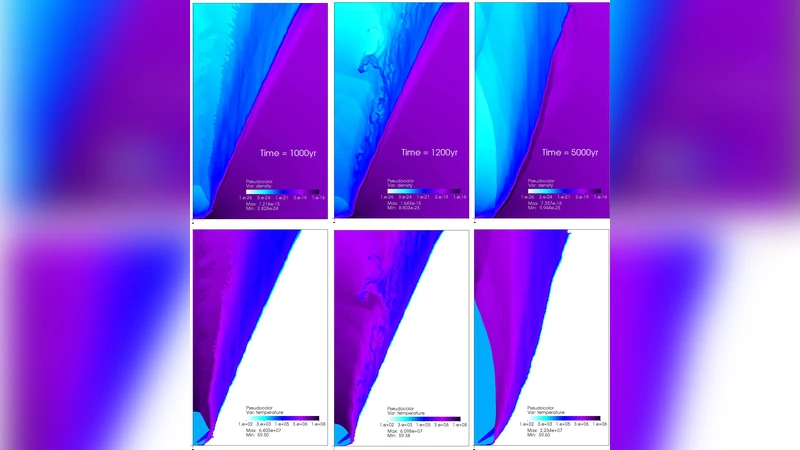
The supersonic stellar and disk winds possessed by massive young stellar objects will produce shocks when they collide against the interior of a pre-existing bipolar cavity (resulting from an earlier phase of jet activity). The shock heated gas emits thermal X-rays which may be observable by spaceborne observa- tories such as the Chandra X-ray Observatory. Hydrodynamical models are used to explore the wind-cavity interaction. Radiative transfer calculations are performed on the simulation output to produce synthetic X-ray observations, allowing constraints to be placed on model parameters through comparisons with observations. The model reveals an intricate interplay between the inflowing and outflowing material and is successful in reproducing the observed X-ray count rates from massive young stellar objects.
💡 Research Summary
This paper investigates the interaction between the supersonic stellar and disk winds emitted by massive young stellar objects (MYSOs) and the interior walls of a pre‑existing bipolar cavity that was carved out during an earlier jet phase. The authors construct three‑dimensional hydrodynamic simulations that incorporate radiative cooling, non‑equilibrium ionisation, and a realistic treatment of shock heating. The initial cavity geometry is taken to be a wide, low‑density conical structure with a radius of order 10³–10⁴ AU, consistent with interferometric observations of outflow cavities around massive protostars. Two wind components are introduced: a fast, low‑density stellar wind (velocities 1500–2500 km s⁻¹, density ≈10⁻¹⁶ g cm⁻³) and a slower, denser disk wind (300–800 km s⁻¹, density ≈10⁻¹⁵ g cm⁻³). Both winds are launched from the central source and impinge on the cavity walls at different angles, creating a complex network of shocks.
The simulations reveal two dominant shock fronts. The forward shock forms where the winds slam into the cavity wall, converting kinetic energy into thermal energy and heating the post‑shock gas to temperatures exceeding 10⁷ K. This hot plasma is the primary source of thermal X‑ray emission in the 0.5–8 keV band. A reverse shock propagates back into the wind material, generating turbulent mixing layers and, in some cases, allowing the wind to puncture the cavity and form narrow escape channels. The interaction region is highly time‑dependent; instabilities at the wind‑cavity interface produce clumps and filaments that modulate the X‑ray luminosity on timescales of months to years.
To connect the simulations with observations, the authors perform post‑processing radiative transfer using the X‑ray emission code APEC and include interstellar absorption (NH ≈ 10²² cm⁻²) as well as the instrumental response of the Chandra ACIS‑I detector. Synthetic images and spectra are generated for a range of viewing angles and distances. By comparing the synthetic count rates and spectral shapes with Chandra observations of several well‑studied MYSOs (e.g., AFGL 2591, IRAS 16547‑4247), they find that models with stellar wind speeds around 1800 km s⁻¹, disk‑wind densities of a few × 10⁻¹⁶ g cm⁻³, and cavity radii of ~5 × 10³ AU reproduce the observed X‑ray fluxes (∼10⁻³–10⁻² cts s⁻¹) and plasma temperatures (kT ≈ 2 keV) within the uncertainties.
The paper’s key contributions are: (1) a quantitative demonstration that the X‑ray emission from MYSOs can be explained by wind‑cavity shock heating rather than by magnetic reconnection or accretion shocks alone; (2) a detailed mapping of how wind parameters (velocity, density) and cavity geometry affect the emergent X‑ray spectrum, providing a diagnostic tool for interpreting future high‑resolution X‑ray data; (3) the identification of a turbulent mixing layer at the wind‑cavity interface that may drive variability in the X‑ray output. The authors argue that three‑dimensional hydrodynamic modeling, coupled with realistic radiative transfer, is essential for capturing the non‑linear dynamics of massive protostellar outflows.
In conclusion, the study successfully bridges theory and observation, showing that the observed X‑ray count rates and spectral characteristics of massive young stellar objects can be reproduced by a physically motivated wind‑cavity interaction model. This work lays the groundwork for more sophisticated magnetohydrodynamic simulations and for exploiting upcoming X‑ray missions such as Athena to probe the early feedback processes of massive star formation.
Comments & Academic Discussion
Loading comments...
Leave a Comment