On fixed point theorems and nonsensitivity
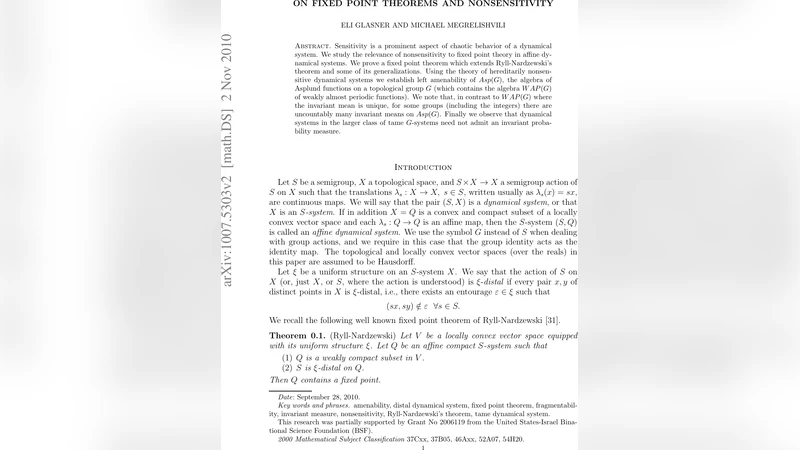
Sensitivity is a prominent aspect of chaotic behavior of a dynamical system. We study the relevance of nonsensitivity to fixed point theory in affine dynamical systems. We prove a fixed point theorem which extends Ryll-Nardzewski’s theorem and some of its generalizations. Using the theory of hereditarily nonsensitive dynamical systems we establish left amenability of Asp(G), the algebra of Asplund functions on a topological group G (which contains the algebra WAP(G) of weakly almost periodic functions). We note that, in contrast to WAP(G), for some groups there are uncountably many invariant means on Asp(G). Finally we observe that dynamical systems in the larger class of tame G-systems need not admit an invariant probability measure.
💡 Research Summary
The paper investigates how the absence of sensitivity—a hallmark of chaotic dynamics—can be leveraged to obtain new fixed‑point results for affine dynamical systems. After a brief motivation, the authors introduce the notion of a nonsensitive system and, more strongly, a hereditarily nonsensitive (HNS) system, which requires that every subsystem be nonsensitive. They show that HNS systems automatically satisfy the compactness and continuity hypotheses that underlie the classical Ryll‑Nardzewski fixed‑point theorem, but without the need for the full weak‑compactness assumptions traditionally imposed.
The central theorem proved is: if a compact convex set X carries a continuous affine action of a topological group G and X is HNS, then X contains a G‑invariant point. This result extends Ryll‑Nardzewski and several of its later generalizations by weakening the dynamical hypotheses while preserving the conclusion.
The authors then apply this theorem to the algebra Asp(G) of Asplund functions on a topological group G. Since Asplund functions arise from Banach spaces with the Radon‑Nikodým property, the space of such functions is naturally linked to HNS dynamics. Using the new fixed‑point theorem, they establish that Asp(G) is left‑amenable; that is, there exists a left‑invariant mean on Asp(G). In contrast to the well‑studied algebra WAP(G) of weakly almost periodic functions—where the invariant mean is unique—the paper demonstrates that for certain groups G there are uncountably many distinct invariant means on Asp(G). This shows that left amenability can coexist with a rich multiplicity of invariant averages, a phenomenon absent in the WAP setting.
Finally, the paper explores the broader class of tame G‑systems, which are dynamical systems whose enveloping semigroups are Rosenthal compact. While tame systems are less chaotic than general systems, the authors construct explicit examples of tame actions that fail to admit any invariant probability measure. This negative result underscores that tameness alone does not guarantee the existence of invariant measures, thereby delineating the limits of fixed‑point theorems in the tame regime.
Overall, the work makes three significant contributions: (1) it introduces a robust nonsensitivity framework that yields a powerful fixed‑point theorem for affine actions; (2) it applies this framework to prove left amenability of Asp(G) and to exhibit groups with uncountably many invariant means; and (3) it clarifies the relationship between tameness and invariant measures by providing counter‑examples. These findings deepen the interplay between topological dynamics, functional analysis, and amenability theory, and they open new avenues for studying fixed‑point phenomena in non‑chaotic yet non‑trivial dynamical contexts.
Comments & Academic Discussion
Loading comments...
Leave a Comment