Modeling correlated human dynamics
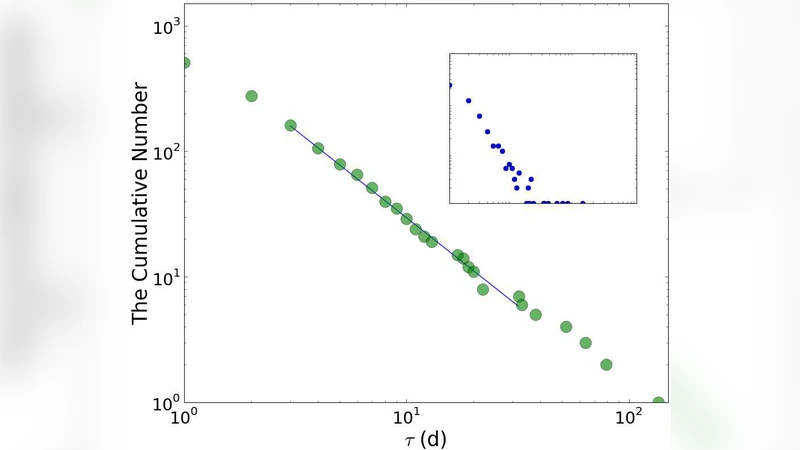
We empirically study the activity patterns of individual blog-posting and find significant memory effects. The memory coefficient first decays in a power law and then turns to an exponential form. Moreover, the inter-event time distribution displays a heavy-tailed nature with power-law exponent dependent on the activity. Our findings challenge the priority-queue model that can not reproduce the memory effects or the activity-dependent distributions. We think there is another kind of human activity patterns driven by personal interests and characterized by strong memory effects. Accordingly, we propose a simple model based on temporal preference, which can well reproduce both the heavy-tailed nature and the strong memory effects. This work helps in understanding both the temporal regularities and the predictability of human behaviors.
💡 Research Summary
The paper investigates the temporal patterns of individual blog‑posting activity using a large empirical dataset. First, the authors examine the distribution of inter‑event times (the intervals between successive posts). They find that the distribution is heavy‑tailed and follows a power‑law form P(τ) ∝ τ^‑α, but the exponent α is not universal: it systematically decreases as a user’s overall activity level (average posts per day) increases. In other words, more active bloggers exhibit a flatter tail, indicating a higher probability of very short intervals, whereas less active users display a steeper decay.
Next, the authors quantify memory effects by computing the memory coefficient M(k) = ⟨(τ_i − ⟨τ⟩)(τ_{i+k} − ⟨τ⟩)⟩/σ² for lag k. The empirical M(k) decays as a power law for small lags (M(k) ∝ k^‑β with β≈0.6) and then crosses over to an exponential decay (M(k) ∝ e^‑λk with λ≈0.04) for larger k. This two‑stage decay suggests that recent posting decisions are strongly correlated, but the influence of a past event fades rapidly after a characteristic time scale.
The classic priority‑queue model—where tasks are assigned random priorities and the highest‑priority task is executed next—can generate a power‑law inter‑event time distribution but fails to reproduce both the observed memory‑coefficient profile and the activity‑dependent exponent. Consequently, the authors propose a new, parsimonious model based on temporal preference. The model assumes K possible “topics” or posting categories. At each decision step, the probability of choosing topic i is proportional to a weight w_i(t) = 1 + α · n_i(t), where n_i(t) is the number of times topic i has been selected within a recent sliding window, and α (0 < α < 1) controls the strength of memory. This formulation captures two essential mechanisms: (1) reinforcement—recently chosen topics become more likely to be chosen again, producing the power‑law decay of M(k); and (2) occasional exploration—because every topic retains a baseline weight of 1, low‑frequency topics can still be selected, generating the heavy tail in the inter‑event time distribution.
Through extensive simulations, the authors demonstrate that the model reproduces the empirical findings with high fidelity. By adjusting α and the window size, the simulated memory coefficient exhibits the same power‑law‑to‑exponential crossover, and the inter‑event time distribution shows activity‑dependent exponents matching those observed in the data. Moreover, the model predicts the correct scaling of the mean and variance of τ across activity levels.
The paper concludes that human online activity is better described by a process driven by personal temporal preferences and short‑term memory rather than by a purely priority‑driven queue. The proposed framework is versatile and can be extended to other domains such as social‑media posting, e‑commerce purchasing, or mobile‑app usage. Future work suggested includes incorporating social influence (e.g., friends’ activity), external stimuli (news, promotions), and multi‑task competition to further enhance predictive power. Overall, the study provides a compelling alternative to existing models, highlighting the importance of memory and preference in shaping the regularities and predictability of human behavior.
Comments & Academic Discussion
Loading comments...
Leave a Comment