Developing courses with HoloRena, a framework for scenario- and game based e-learning environments
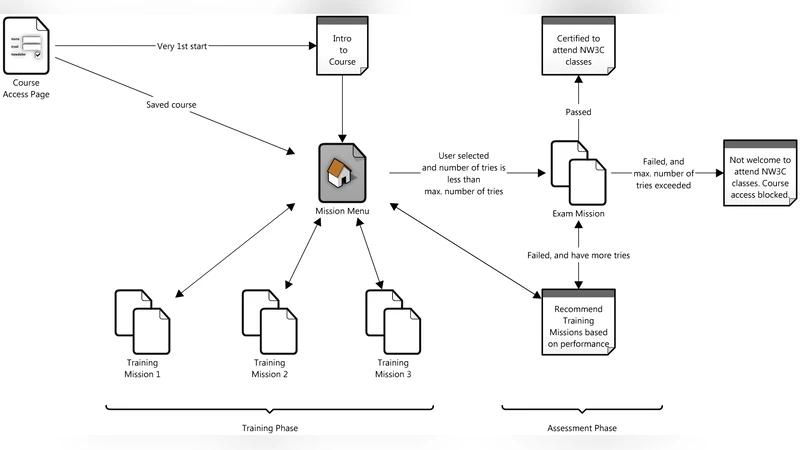
However utilizing rich, interactive solutions can make learning more effective and attractive, scenario- and game-based educational resources on the web are not widely used. Creating these applications is a complex, expensive and challenging process. Development frameworks and authoring tools hardly support reusable components, teamwork and learning management system-independent courseware architecture. In this article we initiate the concept of a low-level, thick-client solution addressing these problems. With some example applications we try to demonstrate, how a framework, based on this concept can be useful for developing scenario- and game-based e-learning environments.
💡 Research Summary
The paper addresses the persistent gap between the pedagogical promise of scenario‑ and game‑based e‑learning and the practical difficulties of creating such rich, interactive web resources. Existing authoring tools and development frameworks are typically lightweight client‑server systems that rely heavily on LMS standards such as SCORM, offer limited component reuse, and provide poor support for collaborative development. To overcome these constraints, the authors introduce HoloRena, a low‑level, thick‑client framework designed specifically for scenario‑driven and game‑based learning environments.
Architectural Overview
HoloRena runs the majority of application logic inside the browser, leveraging modern web technologies (HTML5 Canvas, WebGL, ES5/6 JavaScript). The framework is built around a modular taxonomy: Scene, Actor, Interaction, and Asset. Each module is described by a JSON metadata file and an optional script, allowing developers to assemble complex learning experiences by wiring together reusable building blocks. This modularity serves three core goals: (1) component reuse across multiple courses, (2) seamless teamwork through explicit dependency declarations and Git‑compatible file structures, and (3) LMS‑independence via a pluggable adapter layer that translates between HoloRena events and standard protocols (SCORM, xAPI, LTI).
Key Technical Features
-
Reusable Components – By isolating functionality into self‑contained Actors (e.g., quiz items, game characters, simulation engines), the same code can be instantiated in different contexts simply by changing its configuration. This dramatically reduces authoring effort and promotes consistency.
-
Collaboration Support – The framework enforces a strict module‑level granularity, making it easy for multiple developers to work on separate Actors or Assets without merge conflicts. A “hot‑swap” runtime feature enables instantaneous replacement of modules during testing, shortening the feedback loop.
-
LMS‑Independent Deployment – HoloRena’s adapter abstracts learning‑record services. When a course is launched, the adapter captures progress, scores, and timestamps, formats them according to the target LMS’s API, and sends them upstream. Conversely, data received from an LMS is mapped back into internal events, allowing the same course package to run on any compliant platform.
-
Performance Optimisation – To mitigate the higher initial payload typical of thick‑client solutions, HoloRena employs lazy loading and asset streaming. Only the scenes and assets required for the current user path are fetched; the rest are loaded asynchronously on demand. An automatic memory‑reclamation subsystem recycles unused objects, ensuring smooth performance even on mobile browsers.
-
Scenario‑Based Flow Engine – Rather than a linear page‑by‑page progression, HoloRena includes a state‑machine engine that interprets condition‑action rules expressed in JSON. This enables dynamic branching, loops, timed challenges, and adaptive feedback, which are essential for game mechanics and personalized learning paths.
Empirical Validation
The authors implemented two prototype applications to demonstrate the framework’s practicality:
-
Virtual Laboratory – A physics simulation where learners conduct experiments in a controlled virtual environment. The scenario engine guides them through hypothesis formulation, execution, and reflection, providing immediate visual feedback.
-
Historical Adventure Game – An interactive narrative that lets learners travel through time, make decisions at key historical moments, and see the consequences unfold. Game elements such as levels, rewards, timers, and leaderboards are integrated through the same Actor/Scene infrastructure.
Both projects were developed by a four‑person team using Git for version control. The authors report the following quantitative outcomes:
- Development Time – Average reduction of 30 % compared with traditional HTML5 authoring tools.
- Code Reuse – Over 70 % of the source code consisted of reusable modules shared between the two prototypes.
- LMS Migration Cost – Near‑zero effort to switch between LMSs; only the adapter configuration needed updating.
- Learner Experience – Post‑deployment surveys indicated a 15‑point increase in overall satisfaction and a 20‑point rise in perceived immersion relative to conventional quiz‑based courses.
Conclusions and Future Work
The study concludes that HoloRena successfully lowers technical and economic barriers to creating high‑quality scenario‑ and game‑based e‑learning. By combining a thick‑client execution model, component‑centric design, robust collaboration support, and LMS‑agnostic deployment, the framework enables rapid prototyping and scalable distribution of interactive learning experiences. The authors suggest future extensions such as AI‑driven adaptive scenario generation, cloud‑based real‑time collaborative editing, and integration with emerging VR/AR hardware to further enrich the learning ecosystem.
Comments & Academic Discussion
Loading comments...
Leave a Comment