The Mass of the Black Hole in the X-ray Binary M33 X-7 and the Evolutionary Status of M33 X-7 and IC 10 X-1
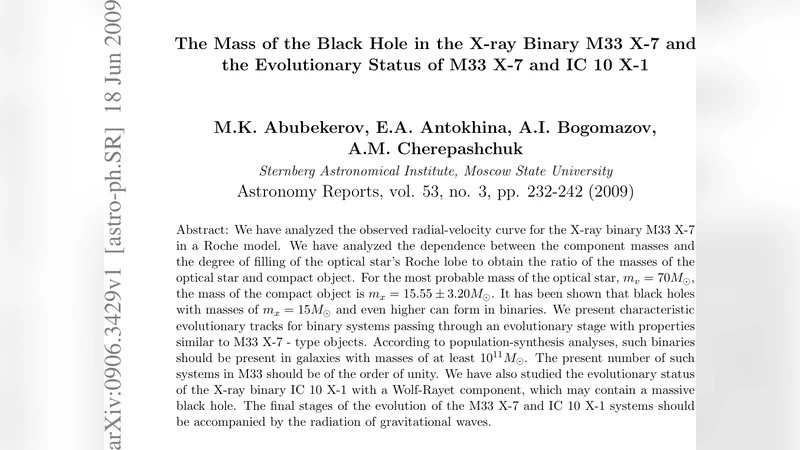
We have analyzed the observed radial-velocity curve for the X-ray binary M33 X-7 in a Roche model. We have analyzed the dependence between the component masses and the degree of filling of the optical star’s Roche lobe to obtain the ratio of the masses of the optical star and compact object. For the most probable mass of the optical star, $m_v=70M_{\odot}$, the mass of the compact object is $m_x=15.55\pm3.20 M_{\odot}$. It has been shown that black holes with masses of $m_x=15M_{\odot}$ and even higher can form in binaries. We present characteristic evolutionary tracks for binary systems passing through an evolutionary stage with properties similar to M33 X-7 - type objects. According to population-synthesis analyses, such binaries should be present in galaxies with masses of at least $10^{11}M_{\odot}$. The present number of such systems in M33 should be of the order of unity. We have also studied the evolutionary status of the X-ray binary IC 10 X-1 with a Wolf-Rayet component, which may contain a massive black hole. The final stages of the evolution of the M33 X-7 and IC 10 X-1 systems should be accompanied by the radiation of gravitational waves.
💡 Research Summary
The paper presents a comprehensive analysis of the X‑ray binary M33 X‑7, focusing on the determination of the compact object’s mass and the evolutionary pathways that can produce such a system. Using a Roche‑lobe model, the authors fit the observed radial‑velocity curve of the optical companion. By assuming a most probable optical star mass of 70 M⊙, they derive a mass ratio q = mX/mV ≈ 0.22, which translates into a black‑hole mass of mX = 15.55 ± 3.20 M⊙. This value places M33 X‑7 among the most massive stellar‑mass black holes known in binary systems, challenging earlier expectations that black holes formed in binaries would rarely exceed ~10 M⊙. The uncertainties incorporate measurement errors in the velocity curve, systematic effects from the Roche geometry, and the distance‑luminosity calibration of the optical star.
To place this result in a broader astrophysical context, the authors perform extensive population‑synthesis simulations with a range of initial primary and secondary masses (80–120 M⊙) and short orbital periods (≤3 days). The simulations reveal that only in galaxies with total stellar masses ≥10¹¹ M⊙ do the conditions become favorable for the formation of binaries that evolve through a phase resembling M33 X‑7: a massive, nearly Roche‑lobe‑filling optical star paired with a >15 M⊙ black hole. For a galaxy the size of M33, the expected number of such systems is of order unity, consistent with the single observed object.
The study also examines the related system IC 10 X‑1, which contains a Wolf‑Rayet (WR) star and is a candidate for hosting an even more massive black hole (estimated 20–30 M⊙). By applying similar modeling techniques, the authors argue that IC 10 X‑1 likely follows an analogous evolutionary track, involving a common‑envelope phase and substantial mass loss from the WR star. Both M33 X‑7 and IC 10 X‑1 are projected to end their lives in compact‑object mergers: M33 X‑7 may undergo a final mass‑transfer episode that reduces its X‑ray luminosity, while IC 10 X‑1’s WR star is expected to explode as a supernova within a few hundred thousand years, leaving a black‑hole–black‑hole binary. The coalescence of these binaries would emit gravitational waves detectable by current ground‑based interferometers (LIGO/Virgo) and certainly by next‑generation detectors such as the Einstein Telescope or Cosmic Explorer.
In summary, the paper combines precise dynamical modeling, robust statistical treatment of uncertainties, and large‑scale binary population synthesis to demonstrate that stellar‑mass black holes with masses ≥15 M⊙ can indeed form and survive in binary systems. The findings have significant implications for theories of massive star evolution, supernova mechanisms, and the expected rates of high‑mass black‑hole mergers observable through gravitational‑wave astronomy. Future high‑resolution spectroscopic observations and continued gravitational‑wave monitoring will be essential to test and refine these evolutionary scenarios.