Divided differences and the Weyl character formula in equivariant K-theory
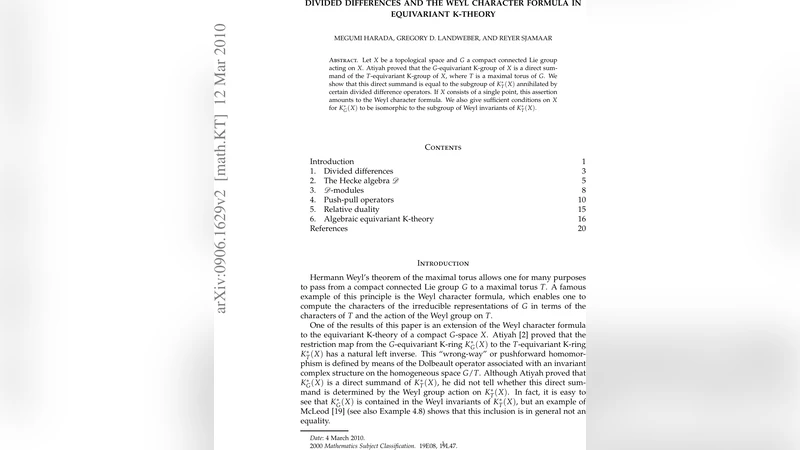
Let $X$ be a topological space and $G$ a compact connected Lie group acting on $X$. Atiyah proved that the $G$-equivariant K-group of $X$ is a direct summand of the $T$-equivariant K-group of $X$, where $T$ is a maximal torus of $G$. We show that this direct summand is equal to the subgroup of $K_T^(X)$ annihilated by certain divided difference operators. If $X$ consists of a single point, this assertion amounts to the Weyl character formula. We also give sufficient conditions on $X$ for $K_G^(X)$ to be isomorphic to the subgroup of Weyl invariants of $K_T^*(X)$.
💡 Research Summary
The paper investigates the relationship between the equivariant K‑theory of a compact connected Lie group (G) acting on a topological space (X) and the equivariant K‑theory with respect to a maximal torus (T\subset G). Atiyah’s classical result states that the (G)‑equivariant K‑group (K_G^(X)) embeds as a direct summand of the (T)‑equivariant K‑group (K_T^(X)). The authors refine this embedding by introducing a family of divided‑difference operators ({\partial_\alpha}_{\alpha\in\Delta^+}) attached to the positive roots of (G). For any element (\xi\in K_T^*(X)) they define
\
Comments & Academic Discussion
Loading comments...
Leave a Comment