Pixel-lensing as a way to detect extrasolar planets in M31
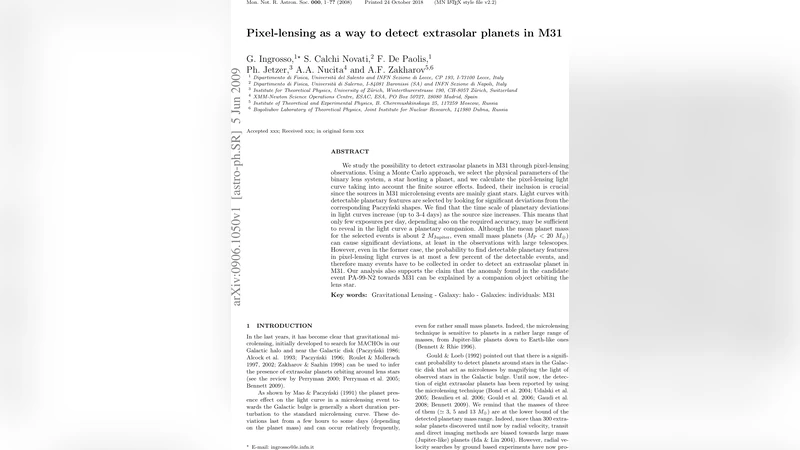
We study the possibility to detect extrasolar planets in M31 through pixel-lensing observations. Using a Monte Carlo approach, we select the physical parameters of the binary lens system, a star hosting a planet, and we calculate the pixel-lensing light curve taking into account the finite source effects. Indeed, their inclusion is crucial since the sources in M31 microlensing events are mainly giant stars. Light curves with detectable planetary features are selected by looking for significant deviations from the corresponding Paczy'{n}ski shapes. We find that the time scale of planetary deviations in light curves increase (up to 3-4 days) as the source size increases. This means that only few exposures per day, depending also on the required accuracy, may be sufficient to reveal in the light curve a planetary companion. Although the mean planet mass for the selected events is about $2 M_{\rm {Jupiter}}$, even small mass planets ($M_{\rm P} < 20 M_{\oplus}$) can cause significant deviations, at least in the observations with large telescopes. However, even in the former case, the probability to find detectable planetary features in pixel-lensing light curves is at most a few percent of the detectable events, and therefore many events have to be collected in order to detect an extrasolar planet in M31. Our analysis also supports the claim that the anomaly found in the candidate event PA-99-N2 towards M31 can be explained by a companion object orbiting the lens star.
💡 Research Summary
The paper investigates whether extrasolar planets orbiting stars in the Andromeda galaxy (M31) can be discovered through pixel‑lensing observations of microlensing events. Because individual source stars in M31 cannot be resolved, pixel‑lensing measures the flux variation of a whole pixel that contains many stars. The authors adopt a Monte‑Carlo approach to generate a large ensemble of binary‑lens configurations (a host star plus a planet) and to compute the corresponding light curves, explicitly including finite‑source effects. This inclusion is essential: the typical sources in M31 microlensing are red giants with radii of several solar radii, so the point‑source approximation would severely mis‑represent the magnification pattern.
In each simulation the lens‑star mass is drawn from 0.1–1 M⊙, the planet‑to‑star mass ratio from 10⁻⁶ to 10⁻² (corresponding to planetary masses from roughly 0.1 M⊕ up to 10 MJ), and the dimensionless separation s (planet‑star distance in units of the Einstein radius) from 0.6 to 1.6, covering the region where planetary caustics are most prominent. Source radii are sampled between 1 and 10 R⊙, reflecting the giant‑star population. For each set of parameters a full pixel‑lensing light curve is generated, adding realistic observational noise (background sky, photon statistics, cadence). The authors then compare each curve to the standard Paczyński single‑lens model and flag a “detectable planetary deviation” when the χ² improvement exceeds 3σ and the deviation lasts at least half a day.
Key findings are: (1) The duration of planetary perturbations grows with source size, reaching 3–4 days for the largest giants. Consequently, only a few exposures per night may be sufficient to capture the signal, relaxing the need for high‑cadence monitoring that is mandatory in Galactic bulge surveys. (2) The average planet mass among events that pass the detection criteria is about 2 MJ, but even low‑mass planets (<20 M⊕) can produce measurable anomalies if observed with large telescopes (≥8 m aperture) that deliver high signal‑to‑noise ratios. (3) The overall probability of finding a detectable planetary signature in a pixel‑lensing event is modest—at most a few percent of all observable events—implying that several hundred to a few thousand events must be collected to expect a single planetary detection. (4) The anomalous light curve of the previously reported candidate PA‑99‑N2 is well reproduced by a binary‑lens model with a planetary companion of roughly 6 MJ at s≈1.2, supporting the hypothesis that the anomaly originates from a planet rather than a binary star.
The authors discuss practical implications for future surveys. A network of large‑aperture telescopes capable of nightly monitoring of M31 would be required to accumulate the necessary event statistics. Accurate knowledge of source star properties (e.g., via spectroscopy or multi‑band photometry) would improve finite‑source modeling. Advanced data‑reduction pipelines—difference imaging, systematic error mitigation, and possibly machine‑learning classifiers—are essential to isolate the subtle planetary deviations from background variability. They also note that upcoming wide‑field facilities such as the Vera C. Rubin Observatory (LSST) could dramatically increase the number of pixel‑lensing events, thereby enhancing the chances of detecting extragalactic planets.
In summary, the study provides a thorough theoretical framework showing that pixel‑lensing can, in principle, reveal planets in M31, but the low intrinsic detection efficiency demands large‑scale, high‑precision monitoring campaigns. The work paves the way for the first extragalactic exoplanet discoveries and offers concrete guidance for designing observational strategies to achieve that goal.
Comments & Academic Discussion
Loading comments...
Leave a Comment