Kinematics and Modeling of the Inner Region of M83
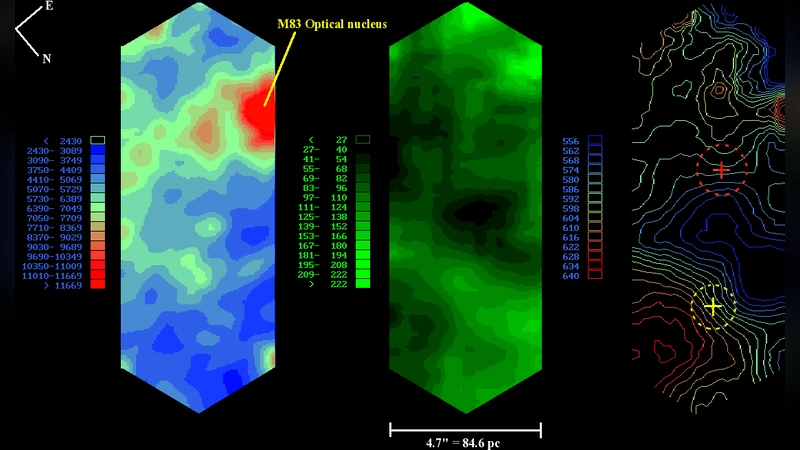
Two-dimensional kinematics of the central region of M 83 (NGC 5236) were obtained through three-dimensional NIR spectroscopy with Gemini South telescope. The spatial region covered by the integral field unit (~5" x 13" or ~90 x 240 pc), was centered approximately at the center of the bulge isophotes and oriented SE-NW. The Pa_beta emission at half arcsecond resolution clearly reveals spider-like diagrams around three centers, indicating the presence of extended masses, which we describe in terms of Satoh distributions. One of the mass concentrations is identified as the optical nucleus (ON), another as the center of the bulge isophotes, similar to the CO kinematical center (KC), and the third as a condensation hidden at optical wavelengths (HN), coincident with the largest lobe in 10 micron emission. We run numerical simulations that take into account ON, KC and HN and four more clusters, representing the star forming arc at the SW of the optical nucleus. We show that ON, KC and HN suffer strong evaporation and merge in 10-50 Myr. The star-forming arc is scattered in less than one orbital period, also falling into the center. Simulations also show that tidal-striping boosts the external shell of the condensations to their escape velocity. This fact might lead to an overestimation of the mass of the condensations in kinematical observations with spatial resolution smaller than the condensations’ apparent sizes. Additionally the existence of two ILR resonances embracing the chain of HII regions, claimed by different authors, might not exist due to the similarity of the masses of the different components and the fast dynamical evolution of M83 central 300 pc.
💡 Research Summary
The authors present a detailed kinematic study of the inner 90 × 240 pc of the nearby spiral galaxy M 83 (NGC 5236) using three‑dimensional near‑infrared integral‑field spectroscopy obtained with Gemini South’s NIFS instrument. The observations target the Pa β (1.28 µm) emission line at a spatial resolution of ~0.5″ (≈10 pc) over a field of ~5″ × 13″ oriented SE‑NW. The Pa β velocity field displays three distinct “spider‑like” patterns, each indicating a separate mass concentration. By fitting each pattern with a Satoh (1980) model—a combination of a spherical core and a rotating disk—the authors derive the following masses: the optically bright nucleus (ON) with ~1 × 10⁸ M⊙, the kinematic centre coincident with the bulge isophotal centre and the CO velocity centre (KC) with ~1.5 × 10⁸ M⊙, and a heavily obscured condensation (HN) that is invisible in the optical but coincides with the brightest 10 µm lobe, with ~8 × 10⁷ M⊙.
To explore the dynamical fate of these components, the team constructed an N‑body simulation that includes ON, KC, HN and four additional massive clusters representing the star‑forming arc located southwest of the optical nucleus. The initial positions and velocities are taken directly from the observations, and each component is represented by a Satoh potential. The simulation incorporates mass loss through a spring‑damping scheme and external tidal forces, and it is evolved for up to 100 Myr.
The results show rapid and violent interactions. ON, KC and HN experience strong tidal stripping and lose a substantial fraction (30–50 %) of their mass within 10–50 Myr, eventually merging into a single, more massive central object. The four clusters of the star‑forming arc are dispersed within roughly one orbital period (~5 Myr); some are scattered outward while others fall inward, feeding the central mass concentration. An important side effect revealed by the simulation is that tidal stripping can accelerate the outer shells of a condensation to escape velocity. When observations have a spatial resolution comparable to or coarser than the apparent size of such condensations, the escaping material is still included in the measured line‑of‑sight velocity dispersion, leading to an over‑estimation of the dynamical mass.
The authors also revisit the claim that two inner Lindblad resonances (ILRs) bracket the chain of H II regions in M 83’s inner 300 pc. Their dynamical model shows that the mass distribution is dominated by three comparable components rather than a single, smoothly varying potential. Because the system evolves on timescales of only a few tens of Myr, any resonance structure would be short‑lived, casting doubt on the existence of stable ILRs in this region.
In summary, the paper demonstrates that the central 300 pc of M 83 is not a simple, single‑nucleus system but a dynamically complex environment containing at least three massive condensations and a transient star‑forming arc. High‑resolution near‑infrared integral‑field spectroscopy combined with realistic N‑body simulations reveals rapid mass redistribution, merger, and evaporation processes that reshape the nucleus on timescales of 10–50 Myr. The work also highlights a methodological caution: limited spatial resolution can cause dynamical masses to be over‑estimated when tidal stripping is significant. These findings have broader implications for interpreting the central kinematics of other nearby starburst galaxies and for understanding how nuclear star clusters, massive gas condensations, and embedded black holes co‑evolve in the early stages of galaxy evolution.