Particles versus fields in PT-symmetrically deformed integrable systems
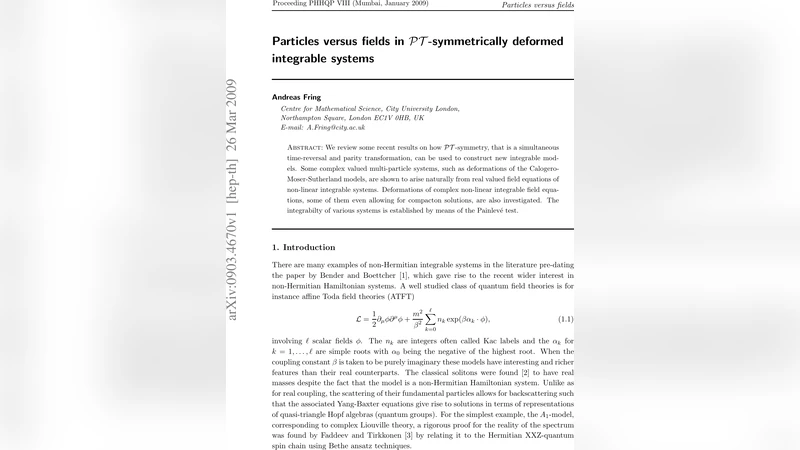
We review some recent results on how PT-symmetry, that is a simultaneous time-reversal and parity transformation, can be used to construct new integrable models. Some complex valued multi-particle systems, such as deformations of the Calogero-Moser-Sutherland models, are shown to arise naturally from real valued field equations of non-linear integrable systems. Deformations of complex non-linear integrable field equations, some of them even allowing for compacton solutions, are also investigated. The integrabilty of various systems is established by means of the Painleve test
💡 Research Summary
The paper surveys recent developments that exploit parity‑time (PT) symmetry – a simultaneous spatial reflection and time reversal – to generate novel integrable models. It begins by recalling that PT‑symmetric non‑Hermitian Hamiltonians can possess entirely real spectra, a fact that has motivated extensive work in quantum mechanics. The authors then show how this principle can be transferred to classical nonlinear field equations and many‑body particle systems.
In the first part they start from well‑known real‑valued integrable field equations such as the Korteweg‑de Vries (KdV), modified KdV, sinh‑Gordon and nonlinear Schrödinger equations. By applying a PT‑symmetric complex shift of the spatial coordinate, x → x + iα, the multi‑soliton solutions of these equations are mapped onto the dynamics of complex many‑particle systems. The resulting particle Hamiltonians turn out to be deformations of the Calogero‑Moser‑Sutherland (CMS) models, with pairwise interactions of the form V(x)=g/(x−iα)². Because the interaction potential is PT‑invariant, the corresponding Hamiltonian remains PT‑symmetric and its eigenvalues stay real despite the underlying complex coordinates. The authors verify that the Lagrangian and Hamiltonian structures survive the transformation, preserving integrability.
The second part of the work proceeds in the opposite direction: instead of starting from a real field theory, the authors directly deform complex nonlinear field equations so that they respect PT symmetry. They introduce complex coupling constants into the nonlinear terms (e.g., u_t + α(u³)x + βu{xxx}=0 with α,β∈ℂ) and impose relations between the real and imaginary parts that guarantee PT invariance (for instance, α_I = −β_I). These deformed equations admit not only the usual soliton solutions but also compactons – solitary waves with finite support. The paper presents explicit compacton profiles for specific parameter regimes and discusses their stability.
A central methodological tool throughout the study is the Painlevé test. For each deformed model the authors perform a Laurent expansion around movable singularities and check whether the only allowed singularities are poles. The test confirms that the majority of the PT‑deformed systems satisfy the Painlevé property, indicating that they are indeed integrable. In the case of the complex CMS models, the authors construct explicit Lax pairs (L,M) and demonstrate the existence of an infinite hierarchy of conserved quantities, thereby establishing complete integrability in the traditional sense.
The discussion section highlights the broader implications of these findings. PT symmetry emerges as a unifying principle that can bridge real and complex integrable structures, allowing one to generate new particle‑field correspondences, novel soliton and compacton solutions, and complex many‑body interactions with real spectra. Potential applications range from PT‑symmetric optics (where complex refractive indices obey the same symmetry) to condensed‑matter systems where lattice excitations might be described by PT‑deformed field theories. The authors conclude that PT‑symmetrically deformed integrable models open a fertile research avenue, offering both deeper theoretical insight into the nature of integrability and practical routes to engineer exotic wave phenomena in physical media.
Comments & Academic Discussion
Loading comments...
Leave a Comment