On-chip spectro-detection for fully integrated coherent beam combiners
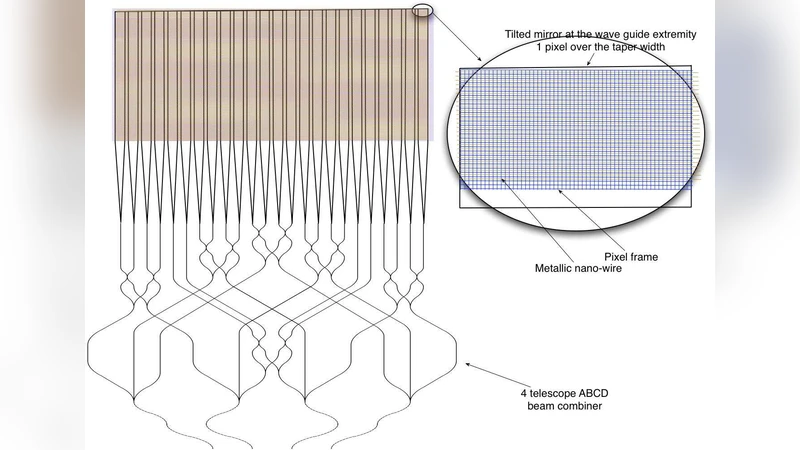
This paper presents how photonics associated with new arising detection technologies is able to provide fully integrated instrument for coherent beam combination applied to astrophysical interferometry. The feasibility and operation of on-chip coherent beam combiners has been already demonstrated using various interferometric combination schemes. More recently we proposed a new detection principle aimed at directly sampling and extracting the spectral information of an input signal together with its flux level measurement. The so-called SWIFTS demonstrated concept that stands for Stationary-Wave Integrated Fourier Transform Spectrometer, provides full spectral and spatial information recorded simultaneously thanks to a motionless detecting device. Due to some newly available detection principles considered for the implementation of the SWIFTS concept, some technologies can even provide photo-counting operation that brought a significant extension of the interferometry domain of investigation in astrophysics . The proposed concept is applicable to most of the interferometric instrumental modes including fringe tracking, fast and sensitive detection, Fourier spectral reconstruction and also to manage a large number of incoming beams. The paper presents three practical implementations, two dealing with pair-wise integrated optics beam combinations and the third one with an all-in-one 8 beam combination. In all cases the principles turned into a pair wise baseline coding after proper data processing.
💡 Research Summary
The paper introduces a fully integrated coherent beam‑combining platform that merges modern photonic integrated circuits with emerging photon‑counting detector technologies to meet the demanding requirements of astronomical interferometry. The central concept is the Stationary‑Wave Integrated Fourier Transform Spectrometer (SWIFTS), which creates a fixed standing‑wave pattern inside a waveguide by interfering the incoming beams. Because the spatial frequency of the standing wave is directly related to the optical wavelength, the spectrum of the input light can be recovered simply by sampling the intensity distribution of the standing wave, eliminating any moving parts such as scanning mirrors that are required in conventional Fourier‑transform spectrometers.
SWIFTS is combined with ultra‑sensitive, photon‑counting detectors (e.g., superconducting nanowire single‑photon detectors or silicon avalanche photodiodes operated in Geiger mode). These detectors provide near‑zero read‑out noise and can count individual photons at gigahertz rates, dramatically improving the signal‑to‑noise ratio for faint astronomical sources and enabling high‑speed fringe tracking. The simultaneous measurement of the standing‑wave intensity and the total photon flux yields both spectral and photometric information in a single acquisition.
Three practical implementations are presented. The first two demonstrate pair‑wise beam combination using a Y‑junction and a directional coupler, respectively. In each case a one‑dimensional array of photon‑counting detectors samples the standing‑wave pattern associated with a single baseline. The recorded photon‑count time series are mapped directly onto spatial‑frequency space, filtered for the baseline‑specific frequency component, and used to reconstruct the interferometric fringe phase without performing a conventional FFT.
The third implementation scales the concept to an eight‑beam “all‑in‑one” combiner. All eight inputs are coupled into a multimode interference region where a two‑dimensional detector matrix samples the resulting standing‑wave field. Because each of the 28 possible baselines generates a unique spatial frequency, the detector matrix simultaneously captures the full set of baseline spectra. Data processing follows the same principle: spatial‑frequency extraction, phase retrieval, and fringe reconstruction for each baseline, enabling simultaneous imaging and spectroscopy of the target.
Key technical challenges include detector pitch and quantum efficiency, waveguide loss, and the need for sub‑micron detector spacing to resolve short‑wavelength features. The authors address these by selecting low‑loss Si₃N₄ or SiO₂ waveguide platforms, employing adiabatic tapers to maximize coupling efficiency, and leveraging state‑of‑the‑art photon‑counting arrays with pitches below one micron.
The integrated SWIFTS approach offers several decisive advantages over traditional bulk‑optics interferometers. The absence of moving parts eliminates mechanical vibrations and non‑linear scan errors, allowing the instrument to be miniaturized for space‑borne or portable applications. Photon‑counting detection extends the dynamic range to the regime of extremely low photon flux, opening new scientific opportunities such as observing distant supernovae, probing protoplanetary disks, or conducting high‑resolution spectroscopy of faint extragalactic sources.
In summary, the paper demonstrates that by embedding a stationary‑wave Fourier‑transform spectrometer within a photonic chip and pairing it with modern photon‑counting detectors, it is possible to realize a compact, high‑speed, high‑sensitivity coherent beam combiner. This technology constitutes a paradigm shift for astronomical interferometry, promising scalable multi‑beam operation, real‑time fringe tracking, and simultaneous spectral‑photometric measurement, and it is poised to become a cornerstone of next‑generation interferometric facilities both on the ground and in space.
Comments & Academic Discussion
Loading comments...
Leave a Comment