Astrophotonics: a new era for astronomical instruments
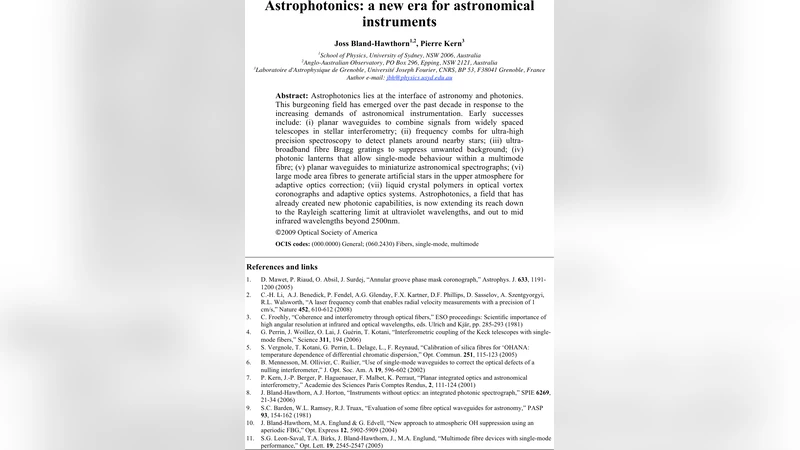
Astrophotonics lies at the interface of astronomy and photonics. This burgeoning field – now formally recognized by the optics community – has emerged over the past decade in response to the increasing demands of astronomical instrumentation. Early successes include: (i) planar waveguides to combine signals from widely spaced telescopes in stellar interferometry; (ii) frequency combs for ultra-high precision spectroscopy to detect planets around nearby stars; (iii) ultra-broadband fibre Bragg gratings to suppress unwanted background; (iv) photonic lanterns that allow single-mode behaviour within a multimode fibre; (v) planar waveguides to miniaturize astronomical spectrographs; (vi) large mode area fibres to generate artificial stars in the upper atmosphere for adaptive optics correction; (vii) liquid crystal polymers in optical vortex coronographs and adaptive optics systems. Astrophotonics, a field that has already created new photonic capabilities, is now extending its reach down to the Rayleigh scattering limit at ultraviolet wavelengths, and out to mid infrared wavelengths beyond 2500nm.
💡 Research Summary
Astrophotonics, the interdisciplinary field bridging astronomy and photonics, has rapidly matured over the past decade to meet the ever‑increasing performance demands of modern astronomical instrumentation. This paper surveys the most impactful technologies that have emerged, explains how they overcome the limitations of conventional bulk optics, and outlines the roadmap toward broader wavelength coverage and full system integration.
The first major breakthrough is the use of planar waveguide interferometric combiners. By routing starlight from widely separated telescopes through lithographically defined waveguides, phase stability at the 10⁻⁴ λ level is achieved in a footprint orders of magnitude smaller than traditional beam‑splitters. Laboratory demonstrations show sub‑nanometer path‑length control, enabling next‑generation long‑baseline interferometry with dramatically reduced vibration sensitivity.
Frequency combs constitute the second pillar. Mode‑locked lasers locked to atomic references provide a dense, absolutely calibrated grid of optical frequencies. When coupled directly to astronomical spectrographs, they permit radial‑velocity measurements with precision better than 10 cm s⁻¹, a threshold essential for detecting Earth‑mass exoplanets around nearby stars.
Ultra‑broadband fiber Bragg gratings (FBGs) form the third technology. By inscribing deep, multi‑line rejection filters into low‑loss fibers, atmospheric OH emission and instrumental background can be suppressed by >30 dB across the near‑infrared band. This dramatically improves the signal‑to‑noise ratio of high‑resolution infrared spectroscopy, especially for faint, high‑redshift sources.
Photonic lanterns represent the fourth advance. They convert a multimode input—typical of seeing‑limited telescope feeds—into dozens of single‑mode channels without loss of étendue. The resulting single‑mode streams can be fed to integrated interferometers or adaptive‑optics wavefront sensors, merging the light‑gathering power of large apertures with the precision of single‑mode photonics.
Miniaturized planar‑waveguide spectrographs constitute the fifth development. By folding diffraction gratings and collimators onto a chip, spectrographs with resolving powers R ≈ 100 000 have been realized in devices smaller than 1 m and weighing only a few hundred grams. Such instruments are ideal for space missions, CubeSats, or remote observatories where mass and volume are at a premium.
Large‑mode‑area (LMA) fibers for laser guide star (LGS) generation are the sixth. High‑power 589 nm lasers are delivered through LMA fibers to the upper atmosphere, creating artificial reference stars for adaptive optics. The larger core reduces nonlinear effects and improves coupling efficiency, delivering up to five times more photon return than conventional fibers, thereby extending AO correction to fainter natural guide stars and larger fields of view.
The seventh breakthrough involves liquid‑crystal polymer (LCP) devices. By patterning spatially varying birefringence, LCP vortex coronagraphs and deformable mirrors can impose precise phase masks that cancel starlight over a broad wavelength range (400–800 nm). When combined with real‑time adaptive optics, they enable high‑contrast imaging capable of directly detecting exoplanets at contrasts better than 10⁻⁸.
Current research pushes astrophotonic components toward the ultraviolet (λ < 350 nm) and the mid‑infrared beyond 2.5 µm. UV expansion requires sub‑100 nm lithography and low‑absorption materials such as Al₂O₃ or MgF₂, while mid‑IR development focuses on low‑loss chalcogenide or fluoride glass waveguides and superconducting nanowire detectors for photon counting.
Despite impressive laboratory performance, several challenges remain for full deployment: reproducible large‑scale manufacturing, thermal and mechanical stability in harsh observatory environments, and efficient optical‑to‑electrical conversion. Overcoming these hurdles promises cost and mass reductions of one to two orders of magnitude compared with traditional bulk‑optics systems, while delivering higher throughput, better stability, and multi‑wavelength capability.
In conclusion, astrophotonics has already generated new photonic functionalities and is poised to become the backbone of next‑generation astronomical instruments, from interferometers and high‑precision spectrographs to adaptive‑optics systems and high‑contrast imagers. Its continued evolution will likely integrate with radio, X‑ray, and gamma‑ray observatories, creating a truly unified, photon‑engineered platform for exploring the universe.
Comments & Academic Discussion
Loading comments...
Leave a Comment