A mid-term astrometric and photometric study of Trans-Neptunian Object (90482) Orcus
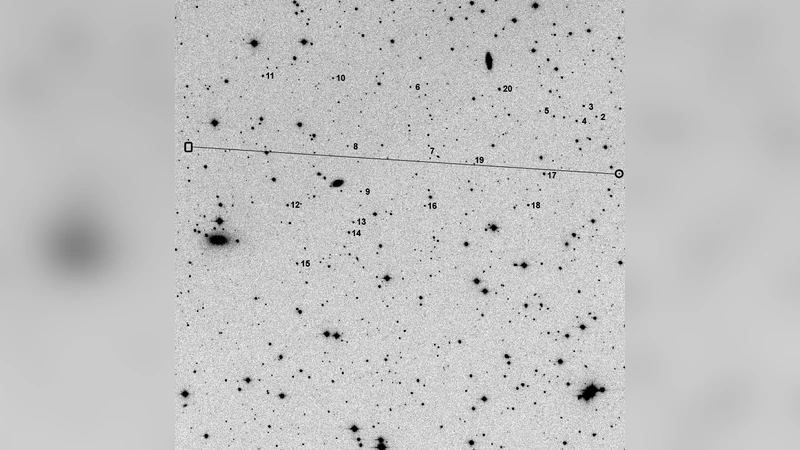
From CCD observations of a fixed and large star field that contained the binary TNO Orcus, we have been able to derive high-precision relative astrometry and photometry of the Orcus system with respect to background stars. The RA residuals of an orbital fit to the astrometric data revealed a periodicity of 9.7+-0.3 days, which is what one would expect to be induced by the known Orcus companion. The residuals are also correlated with the theoretical positions of the satellite with regard to the primary. We therefore have revealed the presence of Orcus’ satellite in our astrometric measurements. The photocenter motion is much larger than the motion of Orcus around the barycenter, and we show here that detecting some binaries through a carefully devised astrometric technique might be feasible with telescopes of moderate size. We also analyzed the system’s mid-term photometry to determine whether the rotation could be tidally locked to the satellite’s orbital period. We found that a photometric variability of 9.7+-0.3 days is clear in our data, and is nearly coincident with the orbital period of the satellite. We believe this variability might be induced by the satellite’s rotation. There is also a slight hint for an additional small variability in the 10 hr range that was already reported in the literature. This short-term variability would indicate that the primary is not tidally locked and therefore the system would not have reached a double synchronous state. Implications for the basic physical properties of the primary and its satellite are discussed. From angular momentum considerations we suspect that the Orcus satellite might have formed from a rotational fission. This requires that the mass of the satellite would be around 0.09 times that of the primary, close to the value that one derives by using an albedo of 0.12 for the satellite and assuming equal densities for both objects.
💡 Research Summary
The authors present a mid‑term astrometric and photometric investigation of the trans‑Neptunian object (90482) Orcus and its known satellite Vanth, using a series of CCD images of a fixed, dense star field. By measuring the positions of Orcus relative to background stars, they obtained high‑precision relative astrometry over several months. After fitting a standard orbital solution, the right‑ascension residuals displayed a clear sinusoidal periodicity of 9.7 ± 0.3 days. This period matches the orbital period of Vanth, and the residuals are positively correlated with the theoretical satellite positions, indicating that the photocenter of the unresolved Orcus‑Vanth system is being displaced by the satellite’s motion. The displacement of the photocenter is substantially larger than the motion of Orcus around the system barycenter, demonstrating that even modest‑size telescopes (≈1–2 m) can detect binary companions through carefully designed astrometric techniques when the photocenter shift is appreciable.
The same dataset was subjected to time‑series photometric analysis. A Lomb‑Scargle periodogram revealed a dominant 9.7‑day brightness variation, essentially coincident with Vanth’s orbital period. The authors argue that this modulation could arise from the satellite’s rotation (or from mutual illumination effects) as it presents varying cross‑sections to the observer. In addition, a weaker signal near 10 hours—previously reported in the literature—appears as a subtle excess in the power spectrum. This short‑term variability suggests that the primary, Orcus, is not tidally locked to Vanth, implying that the system has not yet reached a double‑synchronous state where both bodies share the same rotational and orbital period.
To explore the origin of the satellite, the authors performed an angular‑momentum analysis. Assuming equal bulk densities for Orcus and Vanth and adopting an albedo of 0.12 for the satellite, they infer a satellite‑to‑primary mass ratio of roughly 0.09. Such a ratio is consistent with a formation scenario via rotational fission: a rapidly rotating proto‑Orcus would become centrifugally unstable, shedding material that coalesces into a companion of the observed size. This hypothesis also aligns with the relatively large photocenter shift, as the satellite’s mass is sufficient to move the system’s light centroid appreciably while still being unresolved in direct imaging.
The paper’s key contributions are threefold: (1) it demonstrates that periodic astrometric residuals can reveal unseen binary companions, even when the companion is not directly resolved; (2) it shows that photometric monitoring can independently confirm the satellite’s orbital period and assess tidal locking; and (3) it provides a plausible formation pathway for Vanth based on angular‑momentum constraints. The authors suggest that extending this approach—combining long‑baseline astrometry, high‑precision photometry, and eventually high‑resolution imaging—could refine the orbital inclination, eccentricity, and exact mass ratio of Orcus‑Vanth, and could be applied to other distant Kuiper‑belt binaries where direct resolution remains challenging.
Comments & Academic Discussion
Loading comments...
Leave a Comment