Exact Bayesian Analysis of Mixtures
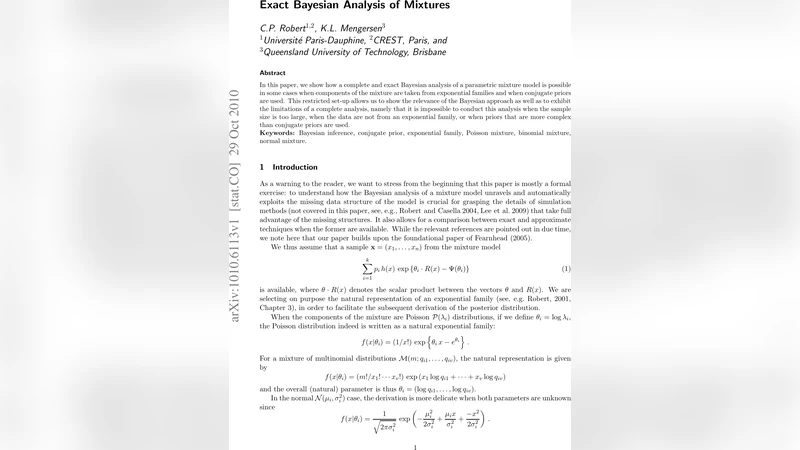
In this paper, we show how a complete and exact Bayesian analysis of a parametric mixture model is possible in some cases when components of the mixture are taken from exponential families and when conjugate priors are used. This restricted set-up allows us to show the relevance of the Bayesian approach as well as to exhibit the limitations of a complete analysis, namely that it is impossible to conduct this analysis when the sample size is too large, when the data are not from an exponential family, or when priors that are more complex than conjugate priors are used.
💡 Research Summary
The paper investigates the conditions under which an exact Bayesian analysis of finite mixture models can be carried out without resorting to approximation techniques. The authors focus on a very specific but mathematically tractable setting: each component density belongs to an exponential family and the prior distributions for the component parameters and the mixing proportions are chosen to be conjugate to those families. By introducing latent allocation variables that indicate which component generated each observation, the hierarchical model can be written in a closed‑form product of a Dirichlet prior for the mixing weights and conjugate priors for the component parameters. Because of conjugacy, the conditional posterior distributions of the weights and the component parameters retain the same functional form as their priors, and the only remaining difficulty lies in integrating over the allocation variables.
The key technical result is that, for exponential‑family components with conjugate priors, the joint posterior can be expressed as a finite sum over all possible allocation vectors. Each term in the sum depends only on the sufficient statistics of the data assigned to each component (the counts of observations per component and the aggregated sufficient statistics of those observations). Consequently, the marginal likelihood, the posterior predictive distribution, and any Bayes factor can be written in exact, closed‑form expressions that involve only combinatorial weights and updates of the prior hyper‑parameters. In principle, this provides a fully analytical solution to the Bayesian inference problem for mixture models.
However, the authors emphasize that the combinatorial explosion of the number of allocation configurations—(K^{n}) for (K) components and (n) data points—renders the exact computation infeasible for all but the smallest data sets. They quantify this “combinatorial blow‑up” by presenting timing experiments that show exponential growth in both memory consumption and CPU time as the sample size increases. Moreover, the exact methodology breaks down when the data do not belong to an exponential family (because sufficient statistics no longer exist in a simple form) or when non‑conjugate priors are employed (which introduce intractable integrals).
To address these practical limitations, the paper discusses several possible mitigations. Dynamic programming or recursive convolution techniques can reduce the computational burden in special cases where the component likelihoods have a discrete structure. More generally, the authors argue that when exact calculation is impossible, one must turn to standard approximate Bayesian tools such as variational inference, Gibbs sampling, or reversible‑jump MCMC. They also note that the exact expressions for the marginal likelihood can serve as a benchmark for assessing the accuracy of such approximations.
The authors conclude by highlighting the conceptual value of the exact analysis. It demonstrates how the Bayesian framework naturally incorporates parameter uncertainty, yields closed‑form predictive distributions, and provides exact Bayes factors for model comparison—features that are especially valuable in small‑sample scientific experiments where approximation error can dominate. At the same time, the work delineates the boundary between tractable and intractable Bayesian mixture modelling, thereby guiding practitioners on when to rely on analytical results and when to adopt computational approximations.
In summary, the paper makes a clear contribution: it shows that exact Bayesian inference for mixture models is mathematically possible under the restrictive combination of exponential‑family components and conjugate priors, but that the combinatorial nature of the latent allocation space imposes a severe practical ceiling on sample size. This dual message—both the power of exact Bayesian reasoning and the inevitability of approximation in realistic settings—offers a useful perspective for statisticians and data scientists working with mixture models.
Comments & Academic Discussion
Loading comments...
Leave a Comment