On the enumeration of d-minimal permutations
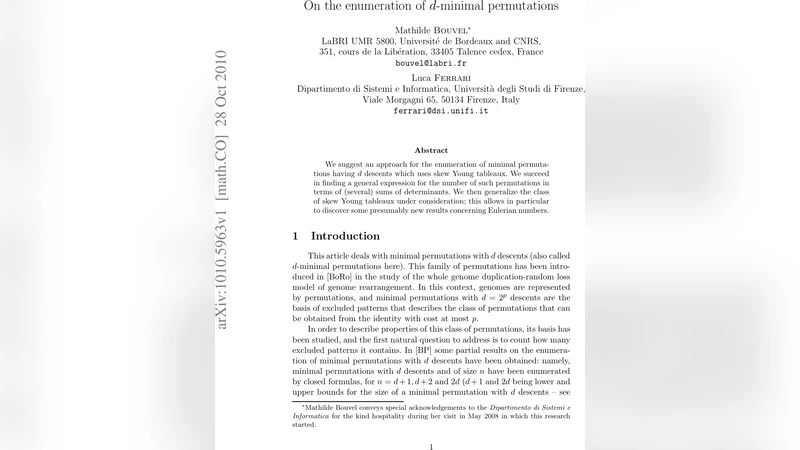
We suggest an approach for the enumeration of minimal permutations having d descents which uses skew Young tableaux. We succeed in finding a general expression for the number of such permutations in terms of (several) sums of determinants. We then generalize the class of skew Young tableaux under consideration; this allows in particular to discover some presumably new results concerning Eulerian numbers.
💡 Research Summary
The paper tackles the longstanding problem of enumerating permutations that have exactly d descents and are minimal with respect to this statistic (i.e., no proper sub‑permutation has the same number of descents). The authors introduce a novel bijection between such “d‑minimal permutations” and a class of skew Young tableaux, which they call “skew tableaux of depth r”. In these tableaux the rows are strictly increasing while the columns are strictly decreasing, and the shape consists of two non‑overlapping rectangles arranged in a skew (staircase‑like) fashion. This bijection translates the combinatorial problem of counting permutations into the problem of counting admissible fillings of the skew shape.
The core technical contribution is the conversion of the tableau‑counting problem into a determinantal formula. By encoding each admissible filling as a 0‑1 matrix and applying the Laplace expansion, the authors show that the number of tableaux of a given shape can be expressed as a sum of determinants of integer matrices (A_{i,j}(k_1,\dots ,k_r)) that depend on a composition ((k_1,\dots ,k_r)) of (n-d). The general enumeration formula reads
\
Comments & Academic Discussion
Loading comments...
Leave a Comment